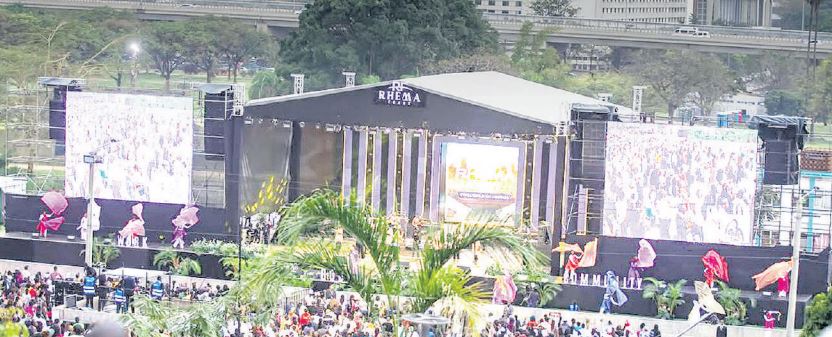
 Rhema Feast held at Uhuru Park in Nairobi /HANDOUT
There was a time not long ago when the voice of Kenya’s youth echoed in the streets, restless and unrelenting, demanding to be heard. That same voice rose again at Rhema Feast 2025, but this time not in chants against government, rather in worship, prayer and the proclamation of God’s word.
The energy was no less intense, only redirected towards the eternal. It was a striking sight to see the same generation that has shaken the political establishment bend their knees and lift their hands in yearning for the Lord. It spoke of a hunger not only for bread or jobs or justice, but for righteousness, wisdom and truth.
This weeklong gathering proved to be a refreshing convocation that the youth of Kenya had longed for with unspoken yearning. The organisers were not only prepared but attuned to the pulse of this generation, ready to serve a feast for their souls. What they offered was not entertainment but an answer to the deep cry of a searching people.
From the pulpit, the messages came forth like thunder, clear, uncompromising and charged with eternal weight. Apostle Joshua Selman, the keynote speaker, whose preaching has since reverberated across Kenyan social media platforms, anchored his charge in the words of Christ, “I will build my Church, and the gates of hell shall not prevail against it.” He declared with apostolic certainty that the Church is not a monument to human charisma but the living Body of Christ, quickened and fashioned by the power of the Spirit.
In Greek, rhema means spoken word and in Christianity, it refers to the living and Spirit-inspired spoken word or message from God applied to an individual.
The young were given a solemn charge of discernment, and challenged to seek a quality and purposeful life that God predetermined for them. In a generation wearied by the failures of leaders, both political and ecclesial, the emphatic message on character and integrity will continue to ring out like a clarion trumpet.
Selman’s messages reminded the multitude that the Lord’s house cannot be built upon celebrity or spectacle but upon the eternal pillars of consecration, humility and obedience.
Yet it was not merely doctrinal meticulousness from Selman; there was a prophetic charge throughout the event. The youth were urged to marry passion with competence, to become skilled in their crafts, to sanctify their studies, their professions and their businesses as altars unto God.
Mission, he said, is not confined to the pulpit. The lecture hall, the design studio, the marketplace and the boardroom are all mission fields if inhabited by Spirit-filled believers. His metaphors of architecture and building spoke vividly: each believer a living stone, each vocation a pillar, each act of faithfulness part of Christ’s eternal edifice.
Nathaniel Bassey’s worship further deepened the atmosphere at Uhuru Park. Trumpet in hand, he led the congregation into moments that were more than music, they were encounters. Many testified afterwards that they felt Heaven touch Earth. And when the sessions closed, the youth did not simply disperse; they poured into the Nairobi night still singing hymns and turning the city streets into sanctuaries. Videos of this flooded social media, a testament that what took place was not confined to the grounds of Uhuru Park but overflowed into the public square. This was probably the most effective crusade the city, and probably the country, have ever experienced.
Kenyan ministers such as Julian Kyula, the organiser and host, together with JB Masinde and Mark Kariuki, provided vital local anchors, ensuring that the feast was not simply a showcase of international guests but a true expression of both the Kenyan and the global church.
To conceive and deliver such an extraordinary gathering is itself an act of fathering revival, for nurturing and shepherding the youth is certain to yield lasting fruit. Alongside the preachers, Kenyan gospel voices such as Evelyn Wanjiru, the Ruach Praise and Worship team, and others ministered powerfully, their songs weaving the nation’s own heartbeat into the wider symphony of worship.
Both the sacred and the civic have a part to play in shaping the destiny of a people, and perhaps Kenya’s future depends on how these two spheres engage the youth with wisdom and integrity.
The government may design policies, manifestos and budget lines, yet its efforts often falter when young people lack inner compass and moral anchoring. The church, on the other hand, is called to nurture this compass, not through empty rhetoric but through the enduring work of discipleship, prayer and obedience.
The Kingdom of God advances not with fanfare or political decree but with a quiet inexorability, like yeast working through dough until the whole is transformed. Great gatherings ignite passion and awaken vision, but it is the unglamourous daily disciplines that sustain a life of purpose.
If the civic arm equips the youth with skills and opportunity while the sacred calls them into integrity, consecration, and eternal hope, then together they can respond to the cry of a generation that longs for meaning and direction.
In this balance of revival and discipleship, the Kenyan church has shown it takes its charge seriously. New believers are being grounded in the Word and strengthened in prayer, the typical Pentecostal pattern after such gatherings.
Beyond the altar call, intentional equipping continues across congregations through programmes in financial integrity, leadership, mental wellness, and ethical entrepreneurship.
Deliverance Church, Purpose Centre and others are shaping young people not only in devotion but also in life skills and marketplace resilience.
What remains vital is mentorship. A generation long left to wander between extremes needs fathers and mothers in the faith, who walk with them in covenant, not control.
Small groups, citywide fellowships, and digital platforms must sustain what is birthed at Rhema, keeping conversations alive and youth accountable. Selman’s 2024 charge still stands: young believers must not be tossed by every wind of doctrine. Churches must create spaces where scripture is opened faithfully and truth is distinguished from hype, so that passion matures into rootedness.
Kenya’s youth are hungry for purpose, and when that hunger is meaningfully engaged, they gather in their tens of thousands. The task is to move from roar to rootedness, from moment to movement, from fire to fruit. If the fervour of Rhema Feast is matched with structures of discipleship, mentorship, and empowerment, a generation will be rescued.
Rhema 2025 was not merely a conference, it was a summons. The responsibility now lies with churches, leaders, and every believer to ensure the hunger of this generation finds not just a fleeting meal but an abiding table in the Kingdom of God. The feast has shown what is possible; the work is to ensure the seed does not fall on rocky soil, and that Kenya’s youth remain constructively engaged.