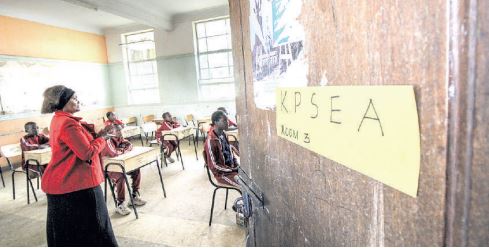
 City Primary School Grade 6 candidates ahead of the Kenya Primary School Examination Assessment on November 25, 2022 /ENOS TECHE
Education, like living organisms, must continually grow. This is achieved through regular reviews and tweaks to meet user demands.
As part of this process, a quiet revolution is currently unfolding in our schools and other educational institutions. Kenya, long lauded for its robust education system, is on a radical overhaul to align its curricula with 21st Century global trends and needs.
The proposed Kenya National Educational Assessments Council (KNEAC) Bill 2025 is not merely a policy shift but also a profound reimagining of learning itself—one that prioritises critical thinking, technological integration and practical skills over archaic rote memorisation.
This transition mirrors a broader global movement, from Rwanda’s reduced classroom hours to Finland’s focus on holistic development. Yet, it is uniquely Kenyan in its bottom-up execution and historical resonance.
At the core of Kenya’s reforms is the adoption of technology-driven assessment systems. The Kneac Bill proposes AI-powered scoring, digital marking and real-time evaluations to replace pen-and-paper exams, ensuring objectivity and efficiency. This leap into digitalisation acknowledges that future economies demand fluency in technology, not just regurgitation of facts.
Moreover, the reforms impose harsh penalties for exam cheating, including as many as 10 years imprisonment for possessing leaked materials – a clear signal that integrity is paramount in cultivating a skilled workforce.
These changes are radical yet necessary. For too long, Kenya’s education system, like many in post-colonial Africa, emphasised rote learning, producing graduates ill-equipped for a dynamic job market. The new competency-based curriculum instead fosters problem solving, creativity, and digital literacy. It echoes global trends whereby “soft skills”, such as collaboration and adaptability are prized over static knowledge.
As employers worldwide emphasise these competencies, Kenya’s pivot ensures its youth remain competitive.
Rote learning – memorisation without understanding – has dominated education systems since ancient times. In Egypt and Mesopotamia, priests drilled students in repetitive writing and arithmetic for a reason: to maintain bureaucratic control.
The same wasn’t true in the case of Kenya’s former exam-focused model that prioritised test scores over genuine comprehension, leading to high dropout rates and employer dissatisfaction.
Today, however, the futility of rote learning is undeniable.
In an age where AI chatbots like ChatGPT can instantly recall facts, education must transcend memorisation. As current educational research indicates, skills-based learning promotes long-term retention, critical thinking and real-world application – attributes essential for navigating complex modern challenges. Kenya’s embrace of project-based activities and vocational pathways acknowledges that education must cultivate innovators, not just recall experts.
Unlike top-down impositions, Kenya’s ongoing reforms are strikingly participatory. The CBC emerged from nationwide consultations, reflecting grassroots demands for relevance and inclusivity. This approach recognises that sustainable change must address local realities, from rural infrastructure shortages to urban employment needs. By empowering teachers, parents and communities to shape curricula, Kenya ensures education serves societal needs rather than alienating learners through abstract theories.
Historically, education systems have always mirrored societal priorities. In ancient Greece, Athenian schools emphasised philosophy and civic duty to cultivate engaged citizens, while Sparta focused on military drills to sustain its warrior culture.
Similarly, Mesopotamian scribes were trained in record-keeping to manage burgeoning economies and Egyptian priests educated elites to preserve theological and administrative hierarchies.
Kenya’s reforms echo this ancient wisdom: education must serve the nation’s aspirations. By prioritising technology, skills and equity, Kenya is not merely chasing global trends but also building a system that reflects its own economic ambitions and democratic values.
Challenges remain – teacher training, resource allocation, and resistance to change – but the direction is promising.
As Kenya aligns its education system with the demands of a digital era, it offers a model for other developing nations: education reform must be bold, contextual and human-centred. For in the end, an education system that nurtures creativity and character will always outperform one that merely produces exam passers.
The writer is a public policy analyst, [email protected]