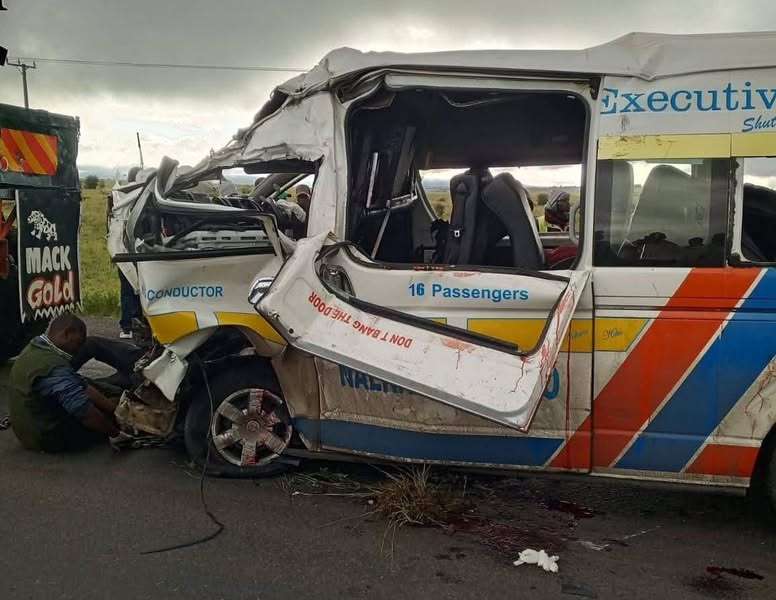
 The scene of the accident where two people died on the spot after a passenger matatu rammed into a trailer along the Nairobi - Mombasa highway at Malili, Makueni county, on May 13, 2025./FILE
It involves a combination of using tech for enforcement, infrastructural overhaul and rigorous training for drivers and schoolchildren.
The comprehensive report from the Roads ministry, released ahead of a critical national summit, outlines the steps being taken under the National Road Safety Action Plan (NRSAP) 2024-28, launched by President William Ruto last year.
Ruto’s administration is banking on the roadmap to achieve the global target of a 50 per cent reduction in road traffic deaths and injuries by the end of 2030.
Road accidents remain a leading cause of death in the country, claiming thousands of lives annually and leaving many more with life-shattering injuries.
The detailed measures will be a central topic of discussion at a three-day national road safety summit convening in Mombasa starting today.
Roads CS Davis Chirchir is expected to underscore this comprehensive approach at the Mombasa summit.
“We must interrogate what it is we have to do better to reduce road carnage. We will appreciate that we do so much…and have huge budgets, as well as staff. We must ask ourselves tough questions on why we haven’t reduced road accident deaths to avert an impact on our economy on account of losing lives,” he said.
A major focus is on treating identified "blackspots”, which are blamed for the high road carnage in the country.
The ministry said completed interventions include the redesigned Kibarani/Makupa causeway, traffic separation at the infamous Salgaa-Sachangwan stretch and new pedestrian bridges along the Northern Corridor.
The state reports the dualling of Ngata Bridge is nearly complete, while works are ongoing at Bonje, Gitaru-Rungiri and the Coptic roundabout.
“To standardise this process, KeNHA is developing blackspot management guidelines anchored in the international best-practice safe system approach,” the report reads.
The government has also been using Star Ratings, an objective measure of a road's inherent safety, with more than 1,256km of road network across agencies already assessed.
Major infrastructure projects are also being viewed for safety compliance.
Among them is the proposed dualling of the Rironi-Nakuru-Mau Summit highway, the Kwa Jomvu-Mariakani road, and the enhancement of the Nyali-Mtwapa-Kilifi corridor.
A key pillar of the strategy is the establishment of County Transport and Safety Committees (CTSCs) through gazettal for all 47 counties.
Furthermore, 81 per cent of these county committees have already been inducted to prepare them for the roles.
According to the brief, a framework for automated traffic fines and penalties is also under consideration, aiming not only to enhance enforcement but also to help generate revenue.
It is also emerging that the National Transport and Safety Authority (NTSA) has pinpointed high-risk locations and vulnerable road user categories across the country.
Similarly, the Kenya Rural Roads Authority (KeRRA) has analysed 32 priority roads and established high-risk corridors for targeted interventions.
"It is now empirically clear where the hazardous road sections are, who is most affected, and what the primary causes are,” a ministry official said.
This data would inform road safety audits conducted by NTSA, KeNHA, KeRRA and KURA during all phases of a road's lifecycle.
The state says as a result, KURA alone has constructed 87km of walkways, designed 277km of urban roads, built 17 bridges and maintained thousands of kilometres.
On vehicle safety, the Kenya Bureau of Standards is enforcing stricter Pre-Export Verification of Conformity for used imports and has developed 35 standards covering speed limiters as well as electric vehicles.
The state is further banking on new motor vehicle inspection regulations, awaiting publication, to expand mandatory inspection to private vehicles.
To combat speeding, a major risk factor, a project to automate speed management using smart cameras for instant fines is ongoing.
Similarly, a study on the automation of driver testing, including re-testing, has been completed, aiming to improve the competency of licensed drivers.
With EU support, the NTSA and the Kenya Institute of Curriculum Development have fully integrated road safety into the school curriculum from Pre-primary 1 to Grade 12, a programme that was rolled out in January this year.
New Schools Transport Regulations also await publication to govern the safety of school vehicles and operations, the government said.
On enforcement, it is reported that the National Police Service and NTSA undertake joint operations and trainings.
“Between January and August 2025, the police sensitised more than 95,000 individuals, including 6,659 drivers, 18,176 motorcyclists, and thousands of pedestrians, students and PSV officials.”
As per the report, the government, through Jica, is implementing a project to establish a crash data system domiciled at the police service.
INSTANT ANALYSIS
The true test of the interventions’ successes will be in sustained funding, ruthless implementation, and combating the deep-seated culture of traffic indiscipline. The plan is impressive on paper; its success now hinges on consistent execution and an unwavering political will that transcends electoral cycles.