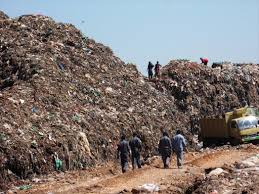
A heap of waste at Dandora dumpsite/FILE
Saida Mohamed has for the past 17 years lived in Nairobi’s Viwandani area.
She describes life there as hell on earth.
“We are exposed to pollution from dust, waste and sewage. A week cannot pass without seeking medical attention,” Mohamed says.
The situation compelled them to start cleaning activities.
“We have to take action and ensure our surroundings is clean. Authorities must also ensure garbage piling up within our residences are collected on time,” Mohamed says.
While some members of the community have resorted to burning the waste, they are oblivious of health risks the fumes pose.
“We need a dumping site and regular collection of waste to deal with some of these challenges. Drainage should also be improved," she said.
There is also need to have sewer lines that work, Mohamed said.
Some community members are also helping to raise the awareness on the need to conserve the environment.
But despite this, most industries are still polluting the environment and as such, there is need for the state to stamp its authority.
Christine Mutuku, a resident from Viwandani and a member of the Muungano wa Wana Vijiji movement, also raised similar issues.
She says the initiative has helped them solve land, housing and services problems.
“We have partnered with the county government, residents and the Breathe Nairobi Initiative to deal with pollution. Poor garbage collection is the major problem," Mutuku says.
Even though there are holding points for garbage, the county fails to collect them on time, causing some of the trash to be washed into Ngong River when it rains.
Just like Mohamed, Mutuku is urging authorities to take action on companies polluting the environment.
“Some factories around the area are also polluting the river by directing contaminated waste. Their toxic fumes also contaminate the air we breath," she says.
"But even so, we have held a number of meetings to try and resolve this challenge because our children are the most affected."
Air pollution is considered the world's leading environmental health risk by the WHO, with fine particulate matter (PM2.5– (particles less than 2.5 micrometres) ) being the most harmful pollutant.
On August 29, the Breathe Nairobi Initiative conducted a community-led clean-up in Mukuru, one of Nairobi’s largest informal settlements, to combat air pollution.
The exercise involved more than 300 residents and addressed a critical environmental and public health crisis, where pollution levels are nearly eight times the limit set by WHO.
Nairobi's air quality consistently falls into a range considered unhealthy by current WHO standards.
In 2020, the average PM2.5 concentration in Nairobi was nearly three times the current WHO annual mean recommended limit.
While the ranking can vary, recent data from real-time monitors placed Nairobi as Africa's second most polluted city.
In Mukuru for instance, the concentration averages nearly eight times the World Health Organization's recommended safe annual limit.
These high levels are exacerbated by significant waste management challenges in Nairobi's informal settlements, where the common practices of open dumping and burning of waste release toxic pollutants into the air.
These high pollution levels have direct and severe health consequences, disproportionately affecting residents of informal settlements and leading to conditions such as eye irritation, respiratory diseases, heart disease, cancer and, in the most severe cases, death.
In Kenya, air pollution was responsible for about 2,500 premature deaths in Nairobi in 2019, representing about 15 per cent of the total deaths that year.
Globally, exposure to air pollution is linked to about eight million premature deaths annually.
Agriculture, industry, transport—and increasingly, wildfires—remain the biggest sources of particulate matter, one of the most dangerous pollutants.
Particulate matter is a complex mix of microscopic solid particles and liquid droplets suspended in the air, including dust, dirt, soot, smoke and other pollutants like sulfates and nitrates.
They are categorised by size, with PM2.5 being particularly harmful because they can be inhaled deep into the lungs and even the bloodstream.
A report by the World Meteorological Organisation says while eastern China recorded improvements thanks to sustained action, northern India remained a hotspot.
Wildfires pushed levels above average in Canada, Siberia and central Africa, with the Amazon basin recording the worst anomaly amid record fires and drought.
Even progress carries paradoxes. Regulations slashing sulphur in shipping fuels have saved lives and reduced asthma cases, but also reduced the cooling effect of sulphates, nudging global warming upward.
The Breathe Nairobi Initiative seeks to improve environmental health by empowering communities through knowledge, skills and collective action.
Ahead of the cleanup, a pre-training session was conducted to equip residents with sustainable waste management skills, including recycling and waste segregation and to educate them on the impact of burning waste.
This cleanup was part of a larger series of community-led activities that led to the International Day of Clean Air for Blue Skies on September 7.
The International Day of Clean Air for Blue Skies was marked under the theme “Together for Clean Air – Invest in Clean Air Now.”
These events, which included a cleanup in Mathare on August 27 and cleanups and mural paintings in Kibera and Korogocho on September 1, helped mobilise more than 900 residents.
The initiative uses practical training and community art to raise awareness of the health impacts of pollution and empower residents to take ownership of their environment.