 Aerial View of Mukuru affordable houses /File
President William Ruto sailed to power in 2022 with promises of reformist policies to transform the social economy of Kenyans from all walks of life.
The Kenya Kwanza administration captured the country’s imagination, launching innovative programmes, ranging from the ambitious fertiliser and seed subsidy programmes meant to boost food production, a new higher education funding model, the Hustler Fund, affordable housing and the Social Health Insurance Fund (SHIF).
But as the regime marks three years at the helm of the country’s leadership, many of those policies have failed to spark, with supporters and critics alike insisting that they could have been handled better.
Yesterday, the government spokesperson, Isaac Mwaura, defended Ruto's three-year scorecard, crediting his policies under the bottom-up economic model for the economic transformation.
Mwaura credited the regime for reviving the economy, arguing that the country was on its knees when Ruto took office.
Currently, SHIF is at the centre of a massive fraud scandal that has shaken public trust and exposed deep cracks in the country’s health financing system.
Audits revealed fraudulent claims worth Sh10.6 billion, with money flowing into nonexistent hospitals and fake patient files.
Some rogue facilities inflated bills, while others billed SHA for services never rendered. Shockingly, even ghost hospitals (clinics that don’t physically exist) managed to receive payouts. Meanwhile, legitimate hospitals and real patients were left struggling as genuine claims went unpaid.
In June, Ruto’s flagship financial inclusion initiative, famously known as the Hustler Fund, was suspended after it emerged that the State Department for Cooperatives Development cannot account for Sh8 billion in the financial year ending June 2023.
According to the Auditor General’s report for that period, the state department spent Sh12 billion against an approved budget of Sh22.96 billion, resulting in Sh8.2 billion that the department cannot account for. Several other billions have disappeared into thin air after borrowers defaulted.
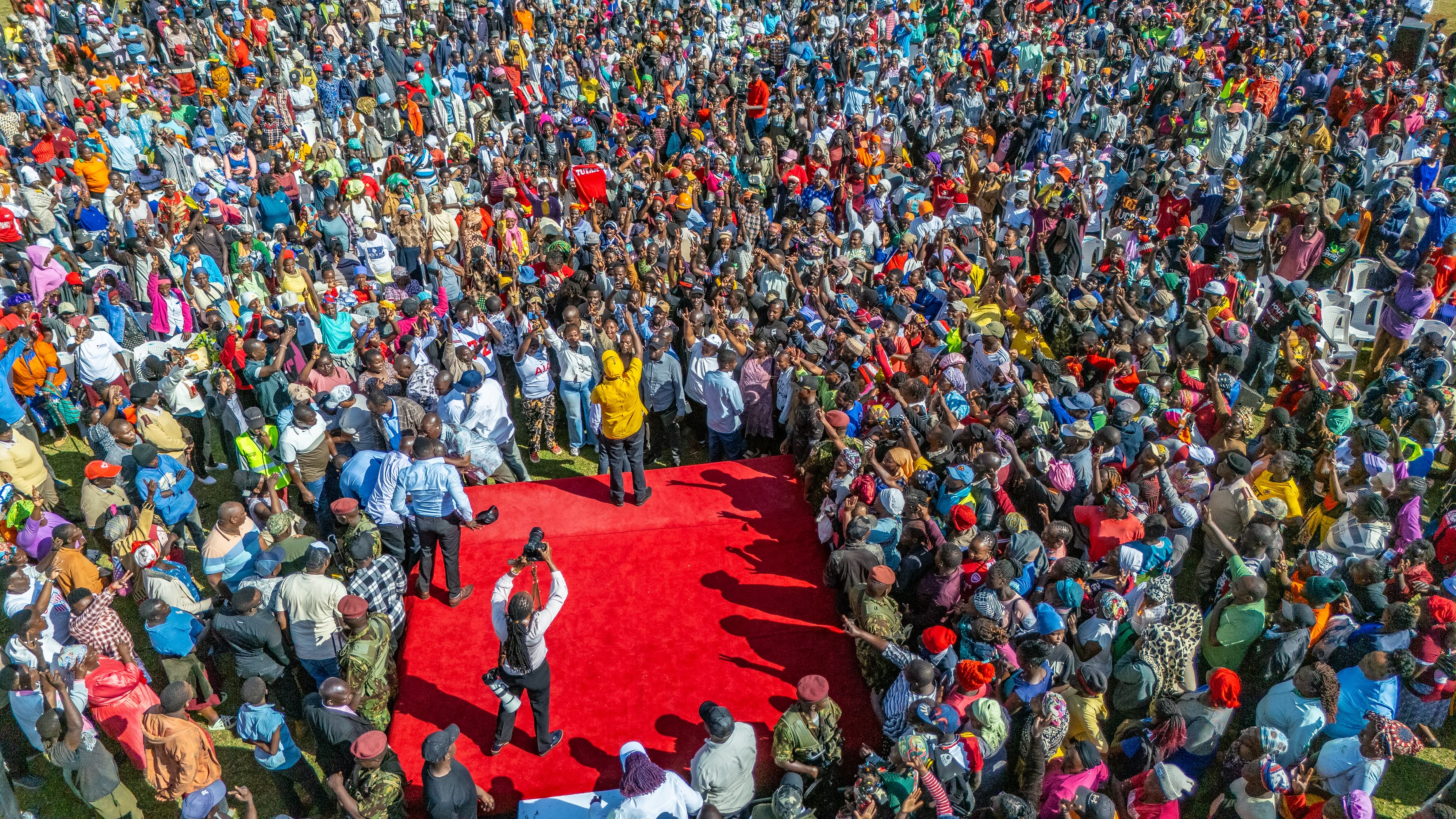
On Friday, Ruto continued to blow his trumpet when he met a delegation of grassroots leaders from Murang’a county in Nairobi, saying he has achieved too much in a short time, way ahead of the previous three presidents combined.
A State House report detailing the Kenya Kwanza administration’s scorecard defended various policies introduced during the period under review, saying they have surpassed initial objectives in a very short time.
For instance, the house on the hill hailed healthcare reform under Ruto’s administration, terming SHA in October last year as ‘a delivered promise.’
According to the report, SHA has registered 24.7 million Kenyans, a massive increase from the seven million covered under the previous NHIF system.
“Universal healthcare, long promised, long delayed, is now becoming a reality under President Ruto’s administration,” the brief adds.
The state terms the new health funding model as the “turning point in health financing and access.”
It requires employees to part with 2.75 per cent of their income to access more medical services. It replaced the National Health Insurance Fund (NHIF), which was deemed outdated and unfair to the poor.
“The fund provides free primary healthcare, emergency services, and coverage for critical illnesses. By June 2025, the scheme had benefitted 5.75 million patients and mobilised Sh49.2 billion,’’ State House said.
The funding model requires all Kenyans to contribute 2.75 per cent of their income, replacing a system deemed unfair to the poor.
Ruto has also fronted the Affordable Housing Programme, a flagship project, as one of his milestones in his legacy plan.
He said the programme is active in 44 counties and aims to deliver 150,000 units.
The government says it has already created over 320,000 jobs under the programme, citing the recent handover of homes to 1,000 families in Nairobi’s Mukuru estate as testament to its commitment to give Kenyans decent housing.
“For the first time in post-independence history, the dream of affordable, dignified housing for all is within reach,” State House said.
The state praised the Hustler Fund, its digital financial inclusion initiative, launched in November 2022 to provide accessible and affordable credit to families and small traders, for driving financial inclusion.
According to Ruto, over 25 million Kenyans have accessed loans worth Sh70 billion, mobilising Sh4.5 billion in savings. He adds that its revolutionary credit scoring model is credited with enabling those previously excluded from the formal credit system to access loans.
Several politicians aligned to the current broad-based government, including Nairobi Women Representative Esther Passaris, have praised the head of state for solid social and economic policies that have stabilised the cost of living and made life easier for Kenyans.
While some policy, economic experts and accountability defenders have some kind words for Ruto’s policies, critical ones like Mutemi Kiama, a social justice defender, are adamant that some of the policies were either rushed or structurally designed to fail in order to benefit a few individuals, in a classic state capture.
“Ruto came into power with a solid agenda to accumulate as much wealth as he could within the first years of his presidency. That required the implementation of policies that transferred national wealth to him and cronies. All these policies implemented in the past three years have been designed to achieve this objective,’’ he said.
“From a health system that was available open source being procured for Sh104 billion, public land being used for ‘affordable housing’ instead of social housing, essentially transferring public land to the unaccountable Hustler Fund. This is plain grand looting.”
Steve Biko, a lawyer and financial expert, says that although Ruto’s Bottom-Up Transformation Agenda has contributed to a reduction in the cost of living from an inflation of 9.6 to 4.1 per cent, a stronger Kenyan shilling, and increased agricultural output, significant challenges remain.
“There are questions on the tangible impact of various socioeconomic policies on everyday lives. Healthcare has deteriorated, with more than 89 per cent of Kenyans today paying out-of-pocket for medical bills.”
“Although SHIF was touted as a game-changer, inefficiencies, corruption and lack of proper financing have crippled the system. Families are being pushed into poverty by hospital bills, while public hospitals face constant strikes, drug shortages and dilapidated infrastructure.”
Joel Meyo, a South African-based public policy expert and economist, wonders why some state officers are fumbling innovative ideas like the universal health insurance, e-procurement and fertiliser subsidy programmes.
“Ruto’s innovative polices touch on basics: agriculture, health, education, ICT and finance. SHIF, fertiliser subsidy, the new university funding model, Hustler Fund, among others, were intended to bring efficiency and affordability.”
“It is sad that a state officer can knowingly pay millions to a nonexistent health facility or give a clean bill of health to substandard fertiliser. Those opposing the e-procurement system must declare their ill interests too. This amounts to sabotage.”
National Treasury CS John Mbadi, while meeting officials of the Financial Journalism Society of Kenya a fortnight ago, lamented about a short-sighted cartel syndicate keen to sabotage reforms initiated by the government for selfish gains.
According to him, reforms— programmes and projects like SHIF, aborted renovation of Jomo Kenyatta International Airport and e-procurement— if well embraced, are meant to improve the general quality of living and support economic growth.
Inefficiencies reported in some of the state’s policy projects have sown a seed of hopelessness among citizens, with Angela Muthoni, a master’s student at the University of Nairobi and his aging mother fearing that education, once a source of hope, is collapsing.
According to them, the rushed implementation of the Competency-Based Curriculum continues to confuse parents, teachers and learners.
“Tuition costs have risen, with university students struggling to afford higher fees after government cuts in funding. Primary and secondary schools grapple with overcrowded classes and inadequate facilities,’’ Muthoni said.
Okoa Uchumi, a social and economic accountability think tank, believes that most of the policies introduced by the current regime were designed not to support Kenyans but to drain them of their elusive income.
According to the civic organisation, Kenya’s problem is not a revenue problem but an expenditure problem, which includes budgetary and legislative corruption.
“Four in every 10 Kenyans are poor, and many more are at risk of falling into poverty unless urgent and decisive action is taken to allocate public resources wisely and spend prudently. Their dreams of a dignified life are constantly shattered and essential public services, particularly in agriculture, education, health, and other critical sectors, continue to deteriorate.”
Diana Gichengo, executive director at the Institute for Social Accountability and convener of the Okoa Uchumi campaign, summarises Ruto's scorecard as a mere policy proclamation rather than a process.
According to her, affordable housing was converted into a compulsory levy without the legal and institutional safeguards needed to protect citizens, leading to court battles and missed targets.
''SHIF and other reforms promised better services, but poor design and rushed rollout have weakened primary health and strained schools. Although it has resulted in high revenue, it is marred by misplaced expenditure, pointing to corruption,'' Gichengo told the Star.