They traverse villages and towns in motorcades, complete with sirens and police chase cars—symbols of the trappings of power they enjoy.
Governors sit in grand offices, control billions of shillings sent to the counties, and wield authority to shape policies and development agendas.
To many, the county chiefs are modern-day ‘small gods’ whose word is law within their jurisdictions—thus the high-stakes political fight for the positions across the country.
But behind the glamour of power, motorcades, and big budgets lies a job fraught with political landmines, blackmail, financial strain and constant battles for survival.
“Being a governor is like working in a landmine—you have to buy your peace at every level,” Council of Governors chairman Ahmed Abdullahi told delegates during last month’s devolution conference in Homa Bay.
Makueni Governor Mutula Kilonzo Jr lifted the lid on the demanding and challenging nature of the governor’s job.
“The job is very demanding. The job description is not well-documented, and no one speaks about it,” he said.
With the inconsistent release of funds, bottlenecks in the approval of expenditure, the county CEOs are struggling to breathe.
“Every step of the way, there is an encumbrance, with national interference being top of the list. However, there is a joy in making an impact and a difference,” Mutula said.
The job, the county chief said, requires one to be very alert, be innovative and prepared to handle crises daily.
From the moment they take office, governors inherit a cocktail of financial, political and administrative headaches.
They include huge pending bills, a bloated workforce and run-down facilities.
But still, they are required to clear the bills, reduce the workforce without sacking the existing ones, and at the same time accommodate their loyalists and friends.
Often, they are on the radar of the anti-graft agencies, who pounce on them at the slightest opportunity.
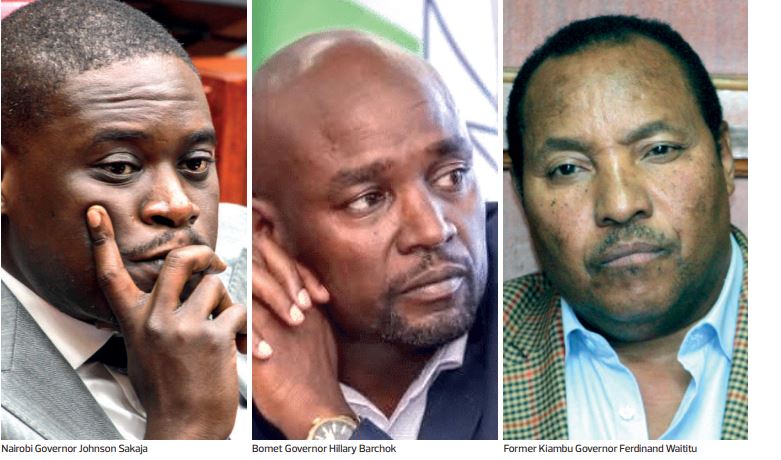
Nairobi Governor Johnson Sakaja, who recently survived an impeachment threat by MCAs, described the job as the most fulfilling.
“One must be quick to learn technical aspects of service delivery while being politically conscious, balancing high expectations with limited resources. All while wearing a smile and never complaining,” Sakaja said.
According to the city boss, being a governor requires the mind of a CEO, the heart of a social worker and the grit and resilience of a politician, the innocence of a dove and the patience of a nursery school teacher.
“Being a governor is a very difficult job. Sometimes I regret becoming a governor. The pressure is too much and expectations from voters are very high,” Vihiga Governor Wilber Ottichilo admitted in a past interview.
Governors are expected to deliver development in health, roads, agriculture, water and education – yet often with delayed or inadequate disbursements from the National Treasury.
Many counties survive hand-to-mouth, barely able to pay salaries, let alone initiate projects. Pending bills, sometimes inherited from previous regimes, choke their administrations before they even settle in.
Perhaps the most treacherous minefield is politics.
Governors must constantly negotiate with MCAs, who control budget approvals and can trigger impeachment at the slightest provocation.
Since the advent of devolution in 2013, the Senate has handled 19 impeachment cases involving county bosses, eight of them in the last three years alone.
Abdullahi said that while no MP or MCA has ever been recalled for abusing their office, four governors have been successfully impeached.
“This then begs the question: are Kenyans only electing the wrong governors? Is it only governors that are so bad that they have to be impeached and they can’t finish their term?”
Political observer Martin Andati said the trappings governors enjoy come with huge responsibility, thus the numerous challenges.
“Any job that's lucrative and has a lot of privileges as well as power, like that of governors, will definitely have its own challenges,” Andati said.
He added, “So, anybody going for it must be ready to navigate those challenges as they enjoy the benefits.”
This, Andati said, explains why despite all those so-called challenges, there is still huge competition for the position.
Add to this the constant feuds with MPs—either jostling for political influence or undermining governors in their strongholds.
Senators, who are supposed to provide oversight, often have their eyes fixed on the governor’s seat, making relationships even frostier.
“Governors are the biggest threat to devolution. If you are elected to serve the people, but the only thing you do is to steal public money, if the EACC (Ethics and Anti-Corruption Commission] comes after you, who will you blame?” Kitui Senator Enoch Wambua said.
County Assemblies Forum secretary-general Mwaura Chege said a governor’s job requires a person with a mix of political and governance experience to effectively run the administration.
“A governor’s seat is an executive position, but it is also very political. What happens in most cases, we elect governors who cannot balance both. That is where the problem comes,” he said.
Mwaura, who is also Nairobi’s Ngara MCA, added that the high accountability threshold set by the public, especially Gen Z, has piled pressure on the political class, especially those holding executive offices such as governors.
“There is pressure on politicians, generally, from the President to the MCAs. The public wants us to deliver. MCAs get the biggest pressure because they are closest to the people. That is why we put pressure on the governors to deliver,” he said.
Party leaders, meanwhile, expect governors to bankroll party activities, stretching their financial and political bandwidth further.
Governors also work under the unblinking gaze of the EACC.
The sheer volume of funds at the county level has made them prime targets of graft investigations, with many dragged into court over procurement scandals and alleged misuse of resources.
Since 2013, three governors have been convicted of corruption. They are former Samburu Governor Moses Lenolkulal (Samburu), Ferdinand Waititu (Kiambu) and Daniel Waithaka (Nyandarua).
Currently, two others are facing imminent arrest and prosecution after the Office of the Director of Public Prosecutions approved their prosecution.
They are Bomet Governor Hillary Barchok and former Bungoma Governor Wycliffe Wangamati.
At the same time, they face unrelenting pressure from relatives, friends and political allies seeking tenders, appointments, or handouts. Balancing patronage politics with accountability has proved a near-impossible task.
Unlike MPs or senators, governors cannot hide behind legislation or oversight mandates.
They are judged by physical outcomes—roads built, hospitals equipped, water taps flowing, or, conversely, stalled projects that become monuments of failure.
“Governors cannot escape their record,” Nairobi-based governance expert who did not wish to be named said. “When their term ends, citizens can literally point to what they did or failed to do.”
As devolution enters its second decade, the governor’s office is proving to be Kenya’s most punishing political job.
It demands political acumen, managerial skill, financial prudence and the patience to navigate a landscape riddled with competing interests.
Prestigious though it may seem, being a governor is not for the faint-hearted. It is, without doubt, the toughest seat in Kenya’s political landscape.