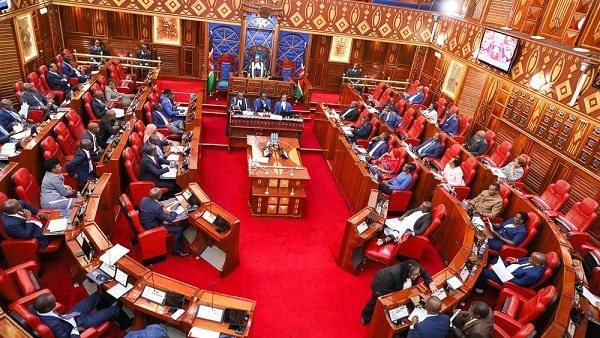
Divisions have emerged as stakeholders continue to present their views on the Constitution of Kenya (Amendment) Bill, 2025, which seeks to enhance the oversight and legislative mandate of the Senate.
The Justice, Legal Affairs and Human Rights Committee of the Senate is spearheading public participation on the Bill.
The proposed law is co-sponsored by majority leader Aaron Cheruiyot (Kericho) and minority leader Stewart Madzayo (Kilifi).
So far, more than 20 stakeholders—including professional bodies, constitutional commissions, lobby groups and human rights organisations—have submitted their views.
While some have lauded the Bill as progressive and key to strengthening Parliament and entrenching devolution, others have raised strong objections.
Among the institutions that have appeared before the committee are the Kenya Law Reform Commission, Commission on Revenue Allocation, Bajeti Hub, Institute of Economic Affairs, County Assemblies Forum, Law Society of Kenya and the Council of Governors.
KLRC challenged the proposal to give senators powers to consider the national government’s budget and Money Bills—laws that impose taxes and levies.
“KLRC recommends that the committee retain the distinction, leaving Money Bills exclusively to the National Assembly,” it said.
The commission proposed creating a clear framework to categorise county-related bills and Money Bills.
It also recommended introducing a two-thirds majority requirement in the National Assembly to overturn Senate-passed county-impact bills.
CRA, while supporting the Bill as timely, opposed extending the Senate’s mandate to include the appointment and removal of chairpersons and members of constitutional commissions and independent offices, warning this would duplicate roles and create unnecessary bureaucracy.
The Institute of Public Finance welcomed the Bill but expressed concern about both Houses reviewing budget documents without a clear mediation mechanism in case of a deadlock.
“This concern is heightened by the high veto thresholds currently provided, which may not always be practical,” IPF said.
Nonetheless, it praised the reforms, noting that granting the Senate an expanded role in scrutinising Appropriation Bills, the Finance Act and Budget Estimates would strengthen accountability and inclusivity in fiscal oversight.
The LSK was also in support, saying it would enhance legislative efficiency and deepen devolution.
“The Bill removes restrictions limiting the Senate to only county-related bills, allowing most (except those raising national revenue) to originate in either House, thereby promoting a more balanced legislative process,” LSK president Faith Odhiambo said.
She, however, cautioned against introducing a supermajority veto on allocation and appropriation bills, warning it could cause legislative paralysis.
Instead, LSK proposed a mandatory mediation mechanism to resolve disputes.
Also backing the Bill was the Council of Governors, particularly the requirement that all bills be passed by both Houses before presidential assent.
“County governments have been excluded from legislation considered only by the National Assembly. This Bill restores balance by reinforcing the Senate’s role in protecting counties,” CoG said.
The Bill proposes sweeping changes to the Senate’s role, including the authority to approve the national budget, vet constitutional office holders and veto decisions of the National Assembly.
It also allows the Senate to originate any legislation, participate in the removal of state officers and establish a County Assembly Fund to grant assemblies financial autonomy.
It also seeks to formalise the Senate’s leadership structure by recognising the Speaker, majority and minority leaders, in law.
Currently, the Senate’s role is largely confined to county matters, leaving it widely seen as underpowered.
If enacted, the Bill would significantly strengthen the Senate—mirroring aspects of the US Senate—and reshape Kenya’s legislative framework.
Instant Analysis
The Constitution of Kenya (Amendment) Bill, 2025, seeks to enhance the devolved system of government by amending key constitutional provisions. The amendments are aimed at clarifying the roles of the National Assembly and the Senate and strengthening legislative processes. The Bill also expands the Senate’s role in budget-making and provides for special procedures for the passage of financial legislation. Through these reforms, the Bill aims to entrench a more balanced, accountable, and functional system of devolution in Kenya’s constitutional framework.