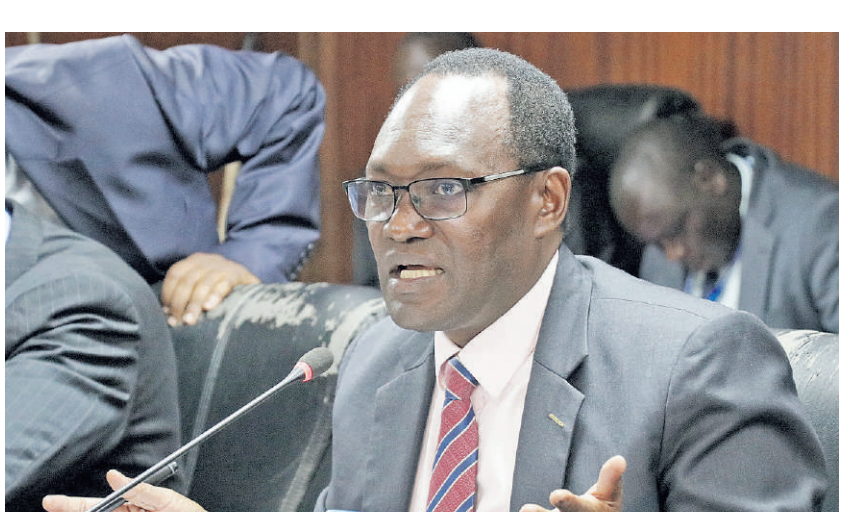
 Treasury PS Chris Kiptoo appears before the Public Debt and Privatisation Committee on June 4/FILE
The government has mounted a strong defence of its flagship e-Citizen platform following a special audit that revealed potential irregularities in payments to companies not originally part of the core consortium.
Treasury PS Chris Kiptoo made a case for the system in a brief to the National Assembly, saying its procurement was above board, indicating that the system has been in place since 2017.
He also argued that the system has enabled the government to collect more revenues, jumping from Sh20 billion in the 2022-23 fiscal year to Sh163 billion in the 2024-25 spending period.
At the heart of the controversy are payments made in the contract signed between the ICT Authority and a consortium of Webmasters Kenya Limited, PesaFlow Limited and Olive Tree Media Limited.
Auditor General Nancy Gathungu had flagged these payments as potentially exposing the government to legal challenges and accountability issues.
Kiptoo explained that payments were legally justified through contractual evolution rather than irregular expenditures.
The government had stopped payments to the vendors after the International Finance Corporation, which had contracted the service providers, handed over the system to the National Treasury, he added.
After the handover, Treasury stopped the vendors from accessing the convenience fee, leading to a protracted court battle which lasted five years (1997-2002).
The PS explained that the government opted to settle the matter out of court and that the ICT Authority made payments of about Sh850 million and stopped all transactions on the portal.
The Immigration department thus took over in July 2024, with the PS detailing that it has paid all the components under the contract, summing up to Sh1.1 billion.
On concerns that the government has no control of the system, the PS said the claims were untrue, arguing that the vendor agreed to “completely and unconditionally hand over the platform”.
“The handover entails a complete and unconditional surrender of all source code…all applications and modules supporting the services to the control of the ICT Authority.
“The various instances of source code for different applications are compiled and stored within data centres managed by the respective government bodies,” the PS explained.
He cited the case of the National Transport and Safety Authority, saying its source codes are securely housed in the agency’s dedicated data centre.
The PS, however, clarified that the government does not own the payment gateway infrastructure.
Instead, the contract explicitly covered the cost of utilising the payment gateway as a service, similar to how businesses use platforms like PesaPal or Visa—without owning them.
“The companies transacting using these payment channels don't own them but pay a fee for the use of the same,” the PS explained.
Perhaps the most concerning finding was the discovery of unlisted bank accounts that had received millions in e-Citizen collections over four fiscal years.
The said accounts were not among the ones approved by Treasury, raising red flags about potential revenue diversion.
Treasury said those were ‘agency accounts’ opened jointly by PesaFlow and Equity Bank specifically for revenue collection on behalf of the government.
PesaFlow continued to remit all collected revenue to the official government account at Equity Bank, Kiptoo said, including the specific amounts cited in the audit.
He held that once the matter came to the Treasury's attention, authorities moved swiftly to request full details of these agency accounts and issued instructions to freeze them.
The audit revealed that the platform had over-collected Sh1.8 billion from taxpayers by charging a flat Sh50 convenience fee, instead of a pro-rated percentage model.
The PS acknowledged this failure, stating that the relevant authorities had not implemented the pro-rated service charge as required.
“It is true that there was a delay in implementing the revised fees as per the gazette notice due to system challenges,” he said.
Experts have proposed various solutions to strengthen the platform's governance, including establishing a proper legislative framework that defines ownership and control.
They have also advised that real-time digital audit trails be created, with automatic reconciliation, even as Treasury lamented about how the audit was handled.
“The Auditor General didn't share the final audit report before tabling it in Parliament as required by law; this omission limited our ability to rectify the audit findings,” the PS said.
Instant Analysis
The e-Citizen system continues to expand despite these controversies, with the National Treasury proposing to extend the platform to county revenue collection, a move that governors have rejected as an attempt to "undermine devolution and micromanage affairs of counties". This expansion vision underscores the government's commitment to the centralised digital payment model despite the identified challenges.