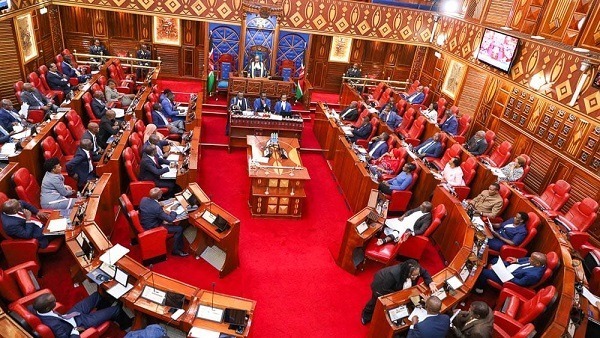
 The Senate/FILE
The Senate has received a boost in its bid to enhance its oversight and legislative mandate after several institutions and stakeholders backed its efforts to amend the constitution.
Read Also
The lawmakers, through the Justice, Legal Affairs and Human Rights Committee, are currently receiving public views on the Constitution of Kenya (Amendment Bill), 2025.
The Bill is co-sponsored by Majority Leader Aaron Cheruiyot (Kericho) and Minority Leader Stewart Madzayo (Kilifi).
In the submissions made before the committee, various institutions, including the Law Society of Kenya, the Council of Governors and County Assemblies Forum, have backed the bid, albeit with slight adjustments.
LSK President Faith Odhiambo said the Bill, if enacted, will enhance the legislative efficiency of Parliament and bolster the principle of devolution.
“The Bill removes restrictions limiting the Senate to only county-related bills, allowing most (except those raising national revenue) to originate in either House, promoting a more balanced legislative process,” Odhiambo said.
The provision that the Senate plays an active role in the budget-making process, Odhiambo said, will strengthen fiscal oversight in the county and national government.
“The Bill requires joint parliamentary approval for key state officers and commissions, ensuring inclusivity, accountability and legitimacy in governance,” she said.
However, the lawyer's body opposed the bid to give either of the Houses a supermajority veto for allocation and appropriation bills.
“The supermajority veto, while intended to resolve disagreements, could lead to legislative gridlock on critical financial bills,” she said, proposing a mandatory mediation process to solve a crisis.
For their part, the Council of Governors lauded the Bill for its provision that a bill must be passed by both Houses before assent.
This, they said, will reinforce the Senate’s role in the protection of the interests of counties in law-making.
“County governments have also been assigned certain responsibilities in legislation considered by the National Assembly only, yet the Senate does not consider the said Bills,” CoG said.
MCAs, in their submission through CAF, lauded the Bill as progressive but opposed the expansion of the Senate’s oversight to include revenue collected at the county level.
"This cumulative expansion threatens to encroach on the constitutionally assigned oversight functions of County Assemblies under Article 185(3) of the Constitution and Section 8 of the County Governments Act," they said.
In the Bill, the lawmakers are seeking authority to approve the national budget, vet constitutional office holders and veto decisions made by the National Assembly.
It proposes granting the Senate power to originate any piece of legislation, participate in the removal of state officers from office and establish a County Assembly Fund to give members of county assemblies financial autonomy.
“The principal object of the Bill is to strengthen and secure devolution. The draft Bill seeks to provide a framework to achieve this purpose by reviewing the mandate of the Senate and the National Assembly,” the Bill says.
It also proposes a formal leadership structure for the Senate, including the speaker, majority leader and minority leader.
Currently, the Senate’s role is largely limited to county matters, leaving many to view it as underpowered. The proposed changes would significantly strengthen its role—mirroring aspects of the US Senate—and reshape Kenya’s legislative framework.
The initiative has the backing of opposition chief Raila Odinga, who in May told senators, “We would like to see our Senate work like that of the US – give it proper powers and responsibilities,” drawing applause from members.
Under the proposed system, legislative authority at the national level would be exercised jointly by both Houses, with Bills originating in either chamber.
Allocation bills could start in the Senate, while appropriation bills could begin in the National Assembly—both subject to amendment and potential veto by the originating House.
“The principal object of the Bill is to strengthen and secure devolution. The draft Bill seeks to provide a framework to achieve this purpose by reviewing the mandate of the Senate and the National Assembly," the Bill’s preamble says.
In another radical proposal, a Bill allocating revenue to the two levels of government may originate in the Senate, but the National Assembly may propose and pass amendments to it.
Conversely, an appropriation Bill may originate in the National Assembly, but the Senate may propose and pass amendments to it.
“Where a receiving House amends an allocation or an appropriation Bill, the originating House may veto the amendments by a resolution supported by at least two-thirds of members,” it says.