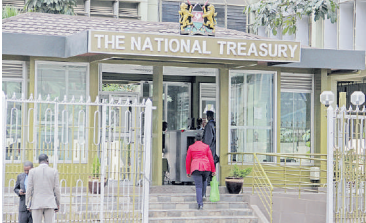
 Entrance to the National Treasury building in Nairobi /FILE
Kenya plans to borrow at least Sh347.2 billion in the international market in the current financial year, moving away from high-cost debt to innovative funding.
Chief among the Annual Borrowing Plan for 2025/6 released Tuesday by the National Treasury is the country’s inaugural debt-for-food swap worth $1 billion (Sh130 billion), an arrangement with the World Food Program (WFP).
The mechanism would allow the country to convert part of its existing debt into food resources without taking on new loans.
Negotiations with the WFP focus on transforming part of Kenya’s debt into investments in food security programmes.
Funds freed up through the swap could be directed toward agricultural projects, irrigation systems, food storage facilities, and nutrition programs, helping ease food insecurity in the country.
The UN Food and Agriculture Organization (FAO) estimates that more than 3.4 million Kenyans currently face acute food insecurity, driven by climate change, population growth, and limited access to modern farming practices.
The plan is expected to help Kenya ease its high debt burden, currently estimated at around 67 per cent of the country’s Gross Domestic Product (GDP).
President William Ruto’s administration has taken over Sh3.5 trillion in new loans in the past 32 months, pushing the national debt to Sh12.1 trillion.
This translates to a debt burden of about Sh208,000 for every citizen, almost double compared to an average of Sh106,000 a decade ago.
The International Monetary Fund (IMF) classifies the country as being at high risk of debt distress.
This would not be Kenya’s first experience with debt swaps. In 2024, Germany supported a €60 million (Sh9.01 billion) debt conversion initiative in exchange for Kenyan government investments in climate projects.
The government also plans to draw another $1 billion (Sh130 billion) as part of $1.5 billion (Sh193.2 billion) privately placed bond in the United Arab Emirates (UAE) by December this year.
The country drew initial $500 million (Sh65 billion) in the last financial year.
The UAE lending, agreed last year, has an 8.25 per cent interest rate and will be repaid in $500 million installments in 2032, 2034 and 2036.
"We can use it partly for liability management, partly for budgetary support, or exclusively for budgetary support," National Treasury boss John Mbadi told journalists at a past press briefing.
He revealed that the government will use $900 million of the $1.5 billion bond to buy back a 2027-maturing Eurobond, while the rest will be used to retire syndicated loans that are falling due later this year.
The exchequer plans to borrow $500 million (Sh65 billion) using sustainability-linked bonds by March 2026, a World Bank loan of $757 million (Sh97.8 billion) by March next year and another loan of $457 million (Sh59.1 billion) in June.
It is also looking to cut its debt costs by turning to securitised debt and converting a $5 billion (Sh645.6 billion) rail loan into the Chinese currency.
According to the report, Kenya seeks to raise Sh22.1 billion through floating a Samurai Bond denominated in Japanese Yen by December this year.