 Education CS
Julius Ogamba
at Maasai Mara
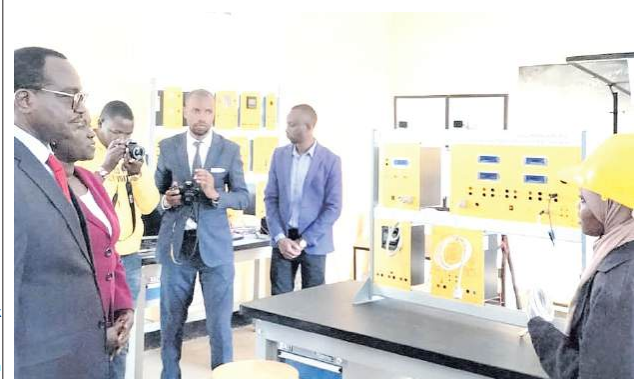
Technical and
Vocational
Institute in Narok
after presiding
over the ‘Elimu
Mashinani’ Forum
at Maasai Mara
University /KNA
Education CS
Julius Ogamba
at Maasai Mara
Technical and
Vocational
Institute in Narok
after presiding
over the ‘Elimu
Mashinani’ Forum
at Maasai Mara
University /KNA
Title: Why state, universities face testing times amid fee cuts
Public universities already grappling with a financial crisis face an even bleaker future following the government’s decision to slash fees to historic lows.
This situation can only be remedied if the government pumps substantial resources into catering for the fee reductions. Institutions have begun implementing the directive issued in July, after sustained pressure from parents and students who decried the high cost of education.
The directive, effective September 1, applies to public universities and coincides with the new academic year. While the move has eased the burden on families, it has come at a steep cost for universities already mired in financial and governance crises.
The development is now threatening to disrupt learning, leave staff unpaid and push some institutions to the brink of closure. The crisis is characterised by mounting debts, currently exceeding Sh76 billion, reduced government funding and inefficiencies in internal management.
Attempts by the Star to get information from the Higher Education PS, Beatrice Inyangala and some Vice Chancellors were futile. The PS was in a meeting and promised to respond to our requests after, but had not done so by press time.
Inyangala recently admitted the dire state of many institutions but blamed poor management and rigid, outdated structures that hinder efficiency.
“Most of our universities are in crisis. The time to change our future is now. We must reengineer university management and adopt cost-cutting measures,” the PS said.
Inyangala urged university council chairs to rethink their approach to management by adopting financial innovation, cost-efficiency strategies and enterprise models to stabilise the higher education sector.
“This can be done by strengthening internal audit and quality assurance departments for the identification and mitigation of risks,” she said.
Vice Chancellors Prof Kiplagat Kotut (Moi University) and Prof Paul Wainaina (Kenyatta University) did not respond to our inquiries. Rongo University VC, Prof Samuel Gudu, referred us to the chairman of the committee of Vice Chancellors, Prof Daniel Mugendi, who was unreachable.
The drastic fee cuts—by as much as 75 per cent in some cases—threaten to push institutions deeper into distress, raising questions about their long-term survival.
A review of fee structures confirms substantial reductions. Universities implementing the new rates for students admitted through the Kenya Universities and Colleges Central Placement Service include the University of Nairobi, Moi University and Egerton University.
Others are Maseno University, Kenyatta University, Jomo Kenyatta University of Agriculture and Technology, University of Eldoret and Masinde Muliro University of Science and Technology.
At Moi University, for example, the School of Education reduced fees for fourth-year government-sponsored students by 76 per cent—from Sh33,750 to Sh8,000 per semester.
“This fee is subject to revision at the sole discretion of the university,” a notice stated. However, confusion persists for first-year and continuing students under the new funding model, as updated structures are yet to be uploaded on student portals.
At Maseno University, first-year students pursuing a Bachelor of Arts in Criminology with IT now pay Sh14,000 per semester, down from over Sh30,000.
At the University of Nairobi, first-year students pursuing Data Science and Journalism pay Sh17,538 per semester, a sharp drop from the previous Sh46,520.
Ironically, these reductions come at a time when many public universities are desperate for a bail-out. Bloated wage bills, mounting debts, declining enrolment due to competition from private universities and erratic cash disbursements have plunged higher education into chronic instability. Overdependence on government capitation has further worsened the situation.
National Assembly’s Education Committee chairman, Julius Melly, challenged universities to stop over-relying on government support and begin generating revenue through alternative sources such as student enrolment, enterprise development and research grants.
“Universities should no longer be seen solely as academic institutions but as entities capable of generating income,” Melly said. Former presidential advisor Moses Kuria echoed the sentiment.
“Vice Chancellors should be trained to think like CEOs. If a VC can’t run a business like Safaricom, they shouldn’t be running a university,” Kuria said.
But University Don Prof Macharia Munene said the government should immediately bridge the financial gap triggered by the extreme fee reduction to get the universities back on their footing.
According to Macharia, most public universities are on their knees because of poor education policies that saw the state reduce funding, as well as bad management of the institutions.
“Reduction of fees is good. It is welcome. But there must be an immediate proportional funding by the government. If that does not happen, we are staring at a dim future for universities,” he said. He added, “The country has the obligation to educate its children. And a good university education is part of that obligation. Instead of building churches, let them fund education.”
The professor observed that the rains started beating university education after the withdrawal of absolute funding of universities, the commercialisation of education and the allowance for the proliferation of private universities.
Experts warn that the crisis is undermining the quality of education, citing frequent lecturer strikes, shrinking research funding and inadequate investment in modern teaching resources. The strain is already visible. At Moi University, lecturers are in their fourth week of a strike over unpaid arrears. Last year, the institution closed for several months due to financial paralysis.
The Technical University of Kenya is in similar trouble, weighed down by a Sh12 billion debt and persistent salary delays. Its payroll consumes Sh270 million monthly, with Sh5 billion in unremitted statutory deductions.
The latest report by Auditor General Nancy Gathungu shows most public universities spend unsustainably on salaries, highlighting the cashflow crisis engulfing the sector.
Of 42 institutions reviewed, 39 breached the Public Finance Management regulation that caps wage expenditure at 35 per cent of revenue.
TUK was the worst offender, spending Sh3.27 billion on salaries against Sh2.81 billion in revenue—a wage bill equivalent to 116 per cent of income. Taita Taveta University follows, with wages consuming 87 per cent of revenue.