
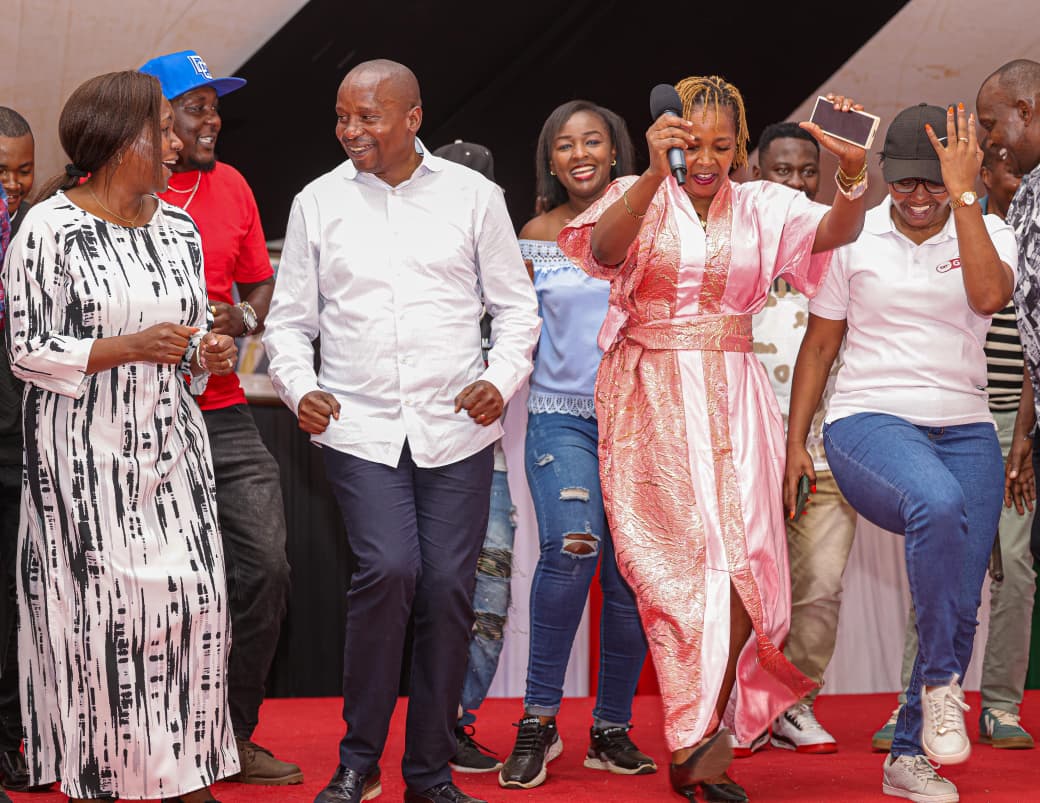
 Deputy President Kithure Kindiki, Embu Governor Cecily Mbarire join youths for a dance during a meeting in Nairobi, September 6, 2025.
Activities of the administration’s top figures point to a pattern showing that the path to its re-election in 2027 runs directly through the youthful population.
The government has launched a strategy that has a blend of policy initiatives and direct engagement targeting the youth, who are emerging as the most consequential demographic in the country’s politics.
The numbers seen by the Star in a brief on the strategy for the young people tell a compelling story of the targeting.
The Ruto administration cites the 76,000 teachers it has since employed, with plans to add another 24,000 by December.
This, if implemented, would amount to a third of all teachers employed in Kenya between 1963 and 2022.
They also cite the affordable housing programme as having created 350,000 jobs with an eventual target of one million positions.
The government is also banking on 282 Jitume Labs and ICT hubs, with an aim they provide digital opportunities for 185,000 youth.
As per the notes, plans are underway to expand the hubs to 1,450, with the aim of creating one million jobs by 2027.
The government further posits that the overseas labour programme has already placed 430,000 young Kenyans abroad, with a target of one million placements.
Pundits hold that the figures aren't just employment statistics but are the foundation of a re-election strategy.
Deputy President Kithure Kindiki has emerged as the administration's primary messenger to the youthful populace.
He has been crisscrossing the country to deliver a carefully calibrated message that validates youth concerns while steering them towards institutional channels.
In his campaigns, the DP has been acknowledging the legitimacy of youth demands for accountability while cautioning against methods that might "endanger the peace and stability of the nation".
Perhaps most significantly, the administration has developed a narrative framework that positions youth not as a problem to be managed but as an asset.
“The youth are the biggest asset that Kenya has today and in the future,” he told students, business owners, artists and professionals from Mbeere North at the weekend.
“Kenya boasts of a highly educated, knowledgeable, innovative and talented young population, assuring us of a bright future ahead.”
“The government is accelerating the programmes for job and income creation, investing more in infrastructure development to facilitate the realisation of the dreams and aspirations of young people,” the DP said.
The government's youth strategy comprises multiple interconnected components.
First, there are the employment programmes, including Kazi kwa Ground for construction jobs, Kazi Mtandaoni for digital opportunities, and Kazi Majuu for international placements.
There is also the upcoming Nyota programme that will provide 100,000 youth-led businesses with training and Sh50,000 grants.
The second component is on educational reforms, including the Competency-Based Curriculum and expansion of technical training, with the aim to better align education with economic needs.
The government further seeks to up recognition of prior learning, the brief stating that the aim is to certify those with self-acquired skills to empower them and expand their job market.
Third, the government targets talent development through sports academies in every constituency and creative industry reforms for the arts and athletics sectors.
Kenya Kwanza has also moved to assure the young people in the creative industry that it would deal with cartels taking away their earnings.
“The ongoing reforms in the creative economy, especially the dismantling of cartels hiding under collective management organisations to defraud our performing artists, content creators and musicians, will go a long way in empowering thousands of young people operating in the creative space,” Kindiki said.
Kenya Kwanza holds itself up as the administration that will not view the youth through a security lens or as passive beneficiaries of patronage.
They are viewed as active political agents whose concerns must be addressed through substantive policy rather than symbolic gestures.
DP Kindiki has, in his outreaches, warned the youth against being "exploited by those seeking to undermine the country" while promising substantive reforms.
The administration eyes a combination of job creation, educational reform and respectful engagement to undo the scepticism that has defined youth-led politics over time.
INSTANT ANALYSIS
The trust deficit between youth and political institutions remains substantial, built up over years of unmet promises. There's also the question of whether these programmes can deliver tangible results quickly enough to satisfy a demographic that has shown diminishing patience with political rhetoric. Recent youth-led protests demonstrate that this demographic cannot be taken for granted.







