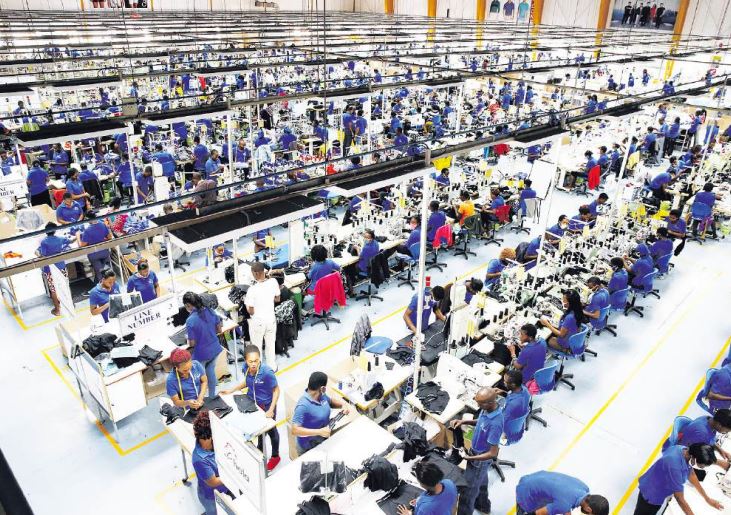
 Kenyan workers prepare men’s underwear at Hela Intimates Export Processing Zone factory in Athi River, Machakos./FILE
Three weeks from today, over 66,000 Kenyans employed in the apparel industry alone would not be assured of their jobs if a last-minute decision is not made to extend Agoa, which expires on September 30.
With a one-to-one ratio of indirect jobs and supporting an estimated five dependents per worker, it means that about 660,000 Kenyans rely on apparel exports to the US under Agoa for their livelihoods, a number that will be affected if the Export Processing Zones and related businesses decide to downsize, according to the Kenya Association of Manufacturers.
Since its enactment in 2000, the Act has been at the core of US economic policy and commercial engagement with Africa, giving eligible sub-Saharan African countries duty-free access to the US market for over 1,800 products, in addition to more than 5,000 products that are eligible for duty-free access under the Generalized System of Preferences programme.
“The truth is blunt. Investors set up in Kenya to access the US duty-free. Competing against Bangladesh, Vietnam or Egypt without it is untenable. Agoa has been our competitive edge. Without it, we risk losing a critical driver of growth and Kenya’s seat at the global manufacturing table could disappear, erasing 25 years of progress,” KAM’s Apparel Manufacturers and Exporters sector chairperson Pankaj Bedi said, noting also the thousands of jobs on the line.
It comes barely two months after the US Agency for International Development officially closed its doors after President Donald Trump dismantled the agency over its allegedly “wasteful spending.”
More than 80 per cent of all the agency's programmes were cancelled as of March, a move estimated to have impacted between 35,000 to 54,000 jobs in Kenya, mainly in the health sector.
USAID has been a major partner in Kenya, investing an estimated $500 million (Sh64.76 billion) annually in programmes tackling HIV/Aids, maternal health, food security and democratic reforms.
The sudden halt left NGOs and government agencies scrambling, with fears of stalled projects and job losses.
Last week, a federal judge ordered the Trump administration to release billions in foreign aid approved by Congress but the impact on halting USAID funding has already had a major impact.
With Agoa also nearing its end, Kenya’s industrialisation dream is headed to a dark moment with massive layoffs expected mainly in Export Processing Zones.
Kenya had 105 gazetted EPZs in 2024, with 180 operating enterprises within them.
These zones, mostly private and a bunch of public ones, are distributed across the counties of Mombasa, Kilifi, Nairobi, Kwale, Machakos, Kiambu, Nakuru, Bomet, Embu, Nandi, Meru, Murang’a, Kajiado, Kirinyaga, Taita Taveta and Naivasha.
Others are in Elgeyo-Marakwet, Uasin Gishu, Laikipia, Narok, Kitui, Kisumu and Homa Bay.
Investment Principal Secretary Abubakar Hassan said SEZs and EPZs have created 30,000 direct jobs through 90 operational businesses in the last two-and-half years.
“They form part of the President’s three job-creation pillars: Jobs Kwa Ground, Jobs Majuu and Jobs Kwa Mitandao,” the PS sad.
Kenya has been banking on Agoa as a crucial avenue for industrialisation and job creation, mostly for women and youth.
“We are looking forward to the renewal of Agoa in its current or new format. Trade between Kenya and the US is crucial for our historical relationship,” KAM chief executive Tobias Alando told the Star.
Kenya’s Investment, Trade and Industry ministry has been lobbying for renewal of Agoa and preferential terms for her exports.
Last month, CS Lee Kinyanjui led a Kenyan delegation to Washington for trade talks, where the two countries agreed to begin the process of negotiating a reciprocal trade deal, as Trump’s administration opens up to bilateral trade agreements in the wake of a tariff review, which saw Kenya slapped with a 10 per cent rate.
"Kenya is deeply interested in the commencement of formal negotiations with the United States government. A reciprocal trade agreement is crucial for securing long-term access to the US market for Kenyan products and will provide the stability needed to unlock new investments," Kinyanjui said.
"A number of US firms have already expressed strong interest in establishing or expanding their operations in Kenya, and this framework will be a key enabler for that growth."
The EPZs and SEZs have been the main beneficiaries with textile and apparel being the biggest exports under Agoa over the years.
The value of monthly exports is estimated at Sh4.5 billion, or Sh150 million per day, according to a study by London-based Institute of Economic Affairs.
In 2024, Kenya exported goods worth Sh60.57 billion to the US market, representing a 19 per cent increase from the previous year. It was the top exporter of textile and apparel products to the US under Agoa.
Other eligible products include certain agricultural goods such as coffee and nuts, and potentially some leather products, although the focus has been on the apparel sector.
This means collapse of Agoa will have multiplier effects that could wipe out even more jobs than expected, with hundreds of businesses in the textile and apparel value chain being hit, a move likely to throw President William Ruto off balance in his plans to address the high unemployment in Kenya.
The Federation of Kenya Employers highlights a severe youth unemployment crisis, with youth with unemployment at 67 per cent and over one million young people entering the labour market annually without sufficient jobs to absorb them.
FKE attributes this to a mismatch between skills produced by the education system and market demands, as well as a generally unfavourable investment climate.
Unemployment has been linked to the high poverty levels in Kenya, with World Bank emphasising the urgent need for environmental and economic reforms, improved social protection and enhanced climate resilience to prevent millions from falling deeper into poverty, especially in fragile and conflict-affected economies on the continent.
East African Business Council vice chairperson Jas Bedi, who is Kenya Private Sector Alliance chairman, has since called on Kenya and the East African Community member states to rethink how they are doing business to expand markets, attract investments for job creation and economic growth, even as Kenya remains optimistic of either an extension of Agoa or favourable trade terms with the US.
“We must adapt faster than the rest of the world and seize opportunities collectively. Global dynamics are shifting, Agoa will expire and the world is moving from multilateral agreements to transactional bilateral agreements. We must know our competitors as East Africa and negotiate for better tariff terms,” Bedi said.
Kenya eyes market opportunities under the EAC, African Continental Free Trade Area and other global markets to try and mitigate the impact if Agoa fails to be renewed, with tariffs being imposed on exports to the US.
According to EAC, Arid and Semi-Arid Lands and Regional Development CS Beatrice Askul, the EAC’s 300 million citizens present a vast market and adopting digital solutions within the Single Customs Territory will further facilitate trade.
Agoa was initiated by President Bill Clinton, who signed it into law in May 2000. President George W Bush extended it twice.
The Agoa Renewal and Improvement Act of 2024, which was introduced by Senators Chris Coons and James Risch, sought to extend the bill for 16 years until 2041 and continue to boost Africa’s duty-free status as a means of “attracting private sector investment to help underwrite economic development.”