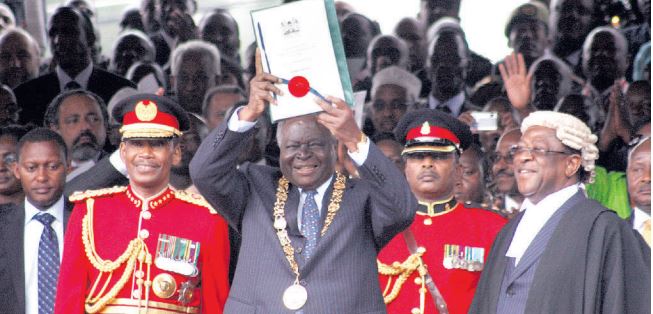
 President Mwai Kibaki and then Attorney General Amos Wako during the promulgation of the new constitution at Uhuru Park on August 27, 2010 /FILE
President William Ruto gazetted the day as an official public holiday for all Kenyans to reflect and appreciate our gains as a nation, from the post-Independence era to the new constitutional dispensation.
The Constitution was overwhelmingly supported by Kenyans in the referendum on August 4, 2010, with 68.6 per cent voting in favour. It was promulgated by President Mwai Kibaki on August 27, 2010.
This marked the culmination of a tedious process that had been initiated immediately the Narc Kenya government was voted into office in 2002, having promised to deliver a new constitution within its first 100 days in office.
Remarkably, immediately after assuming office, the Kibaki-led government kick-started the new constitution-making process, having ridden on the reforms agenda to gain immense support from all sides of the political divide.
After meticulous public consultations and engagements, the Constitution of Kenya Review Commission formulated the Bomas Draft and presented it at the National Constitution Conference where it was endorsed in its entirety.
The draft had proposed, inter alia, that the Executive be headed by a prime minister and further weakened the powers of the presidency.
The Bomas Draft was supported by the former Prime minister Honourable Raila Odinga and his team, whereas, President Kibaki and his allies opposed its proposals.
To counter them, President Kibaki’s team introduced the Kilifi Draft, also referred to as the Wako Draft, which was an edited version of the original Bomas Draft but with substantial changes.
The Kilifi/Wako Draft was submitted to a referendum on November 21, 2005. President Kibaki’s team supported and adopted the Banana symbol, while Raila Odinga’s team opposed the changes introduced to the original Bomas Draft and campaigned against it under the Orange symbol.
The proposed new constitution was rejected by 58 per cent of the voters, with only 41 per cent voting in support. This was a resounding defeat for President Kibaki and his team.
The subsequent general elections held on December 27, 200,7 by the Samuel Kivuitu-led Electoral Commission of Kenya were marred by grave human rights infringements and violations.
More than 1, 200 Kenyans lost their lives and more than 300,000 others were displaced. As a result, the international community was compelled to intervene to restore peace and normalcy in the country and to prevent further deprivation of fundamental rights and freedoms.
The mediation process, led by the former United Nations Secretary-General Kofi Annan, culminated in the signing of a peace accord in which the parties agreed to share power and to fast-track long-overdue land, electoral and constitutional reforms.
Notably, in 2009 the Committee of Experts (CoE) was established and immediately kick-started the reviewing the Constitution of Kenya Review Commission draft, along with all other previous drafts. It also conducted public participation and stakeholder engagements.
Further, the CoE considered input from members of the Parliamentary Service Commission, which recommended a raft of amendments.
They included the right to recall Members of Parliament, enforcement of the two-thirds gender rule in elective bodies and scrapping the proposed presidential age limit of 35 years for candidates.
It was from this vigorous process that the CoE finally harmonised everything to produce the Harmonised Draft, which was subsequently submitted to a referendum, supported overwhelmingly, and promulgated as the Constitution of Kenya 2010.
That ushered in a new constitutional dispensation, marked a new dawn for Kenya and signalled a paradigm shift from the usual modus operandi.
Key provisions introduced by the Constitution, inter alia, include the Bill of Rights, separation of powers and independence of institutions, public participation and involvement of the people in decision-making.
It also introduced devolution, which has been a game changer by bringing power, resources and development closer to the citizenry.
It is lauded as one of the most progressive constitutions in Africa and globally. A report by the Comparative Constitutions Project indicates only South Africa’s constitution compares to Kenya’s.
It cites safeguarding and protecting human rights and fundamental freedoms, as well as promoting the separation of powers and the independence of institutions, particularly judicial independence.
Citing a renowned Chinese proverb that “Even the best needles are not sharp at both ends,” despite Kenya’s 2010 Constitution being among the most progressive constitutions globally, it has its flaws, omissions, and has encountered hurdles in implementation.
Schedule 4 of the Constitution that provides for distribution of functions between the national and county governments is yet to be fully implemented.
A core principle of devolved systems of governments is that funds should follow functions. This has not been fully adhered to, as counties continue to struggle to finance key functions such as health services and disaster management.
In addition, rampant delays by the National Treasury to disburse county funds has been crippling operations and services. Additionally, public participation and the engagement of the people in decision-making processes have not been satisfactory as envisioned by the framers of the Constitution.
As a result, courts have time and again rendered various pieces of legislation and executive actions unconstitutional for lack of sufficient public participation.
Socrates, also referred to as the father of western philosophy, once said that a life unexamined is not worth living and suggested that we should always be introspective in our dealings.
In the same spirit, I believe that it’s high time we conduct a rigorous audit of the 2010 Constitution, identify its shortcomings, and propose radical reforms for posterity.
Notably, a constitution is described as a living document because it is flexible and can be modified to suit prevailing needs and circumstances.
Further, in the Holy Gospel of Mark 2:27, Jesus Christ our Lord and Saviour says, “The Sabbath was made for man, not man for the Sabbath.” Similarly, the law is made for man and not man for the law and therefore, once the law stops serving human interests, it should be amended to fit the present situation. It is incontrovertible that many contentious issues require imperative consideration.
They include doubling the allocation to counties from 15 per cent to 30 per cent of national revenue, strengthening watchdog and oversight institutions to combat corruption, merging institutions and constitutional commissions performing similar functions, scrapping the twothirds gender rule and nominations in elective bodies, making the Senate the Upper House with distinct roles, establishing allocation of a specified percentage of national revenue for the Judiciary Fund to promote judicial independence and financial autonomy, and anchoring the position of the official Leader of the Opposition in the Constitution.
The clarion call by the former Prime Minister Honourable Raila Odinga for an intergenerational conclave should be embraced on the condition that it should be public-led, inclusive and consultative.
Incorporating all generations in the engagements is critical because different generations face different challenges, hold diverse opinions and offer unique proposals, all of which should be factored into the final recommendations.
Reminiscing about our journey of agitating for constitutional reforms from the post-colonial period to the current constitutional dispensation, we appreciate the tremendous progress made.
It is therefore incumbent upon every Kenyan to respect, uphold, and defend the gains that we’ve made to prevent their being watered down.