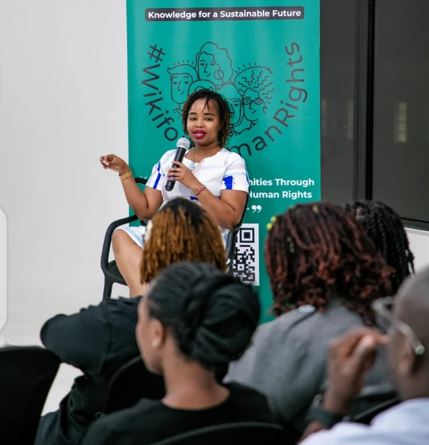
 Winning Kabintie, team leader at Wikimedia Kenya User Group, during a function to reward top contributors./HANDOUT
The Wikimedia Kenya User Group, an affiliate of the Wikimedia Foundation, is making significant strides in bridging digital knowledge gaps about Kenya and Africa on the world’s largest free online encyclopedia—Wikipedia.
Through initiatives like Wiki for Human Rights, a global campaign aimed at improving access to reliable information on human rights and sustainability, local volunteer editors are enriching the digital space with localised and accessible content.
The group has focused on translating articles from English into Swahili and enhancing underdeveloped entries to better serve Kenyan audiences.
Over the past four weeks alone, editors have improved more than 120 Wikipedia articles, rescuing them from potential deletion.
Additionally, they created 10 new entries on critical human rights topics, including the biography of the late human rights lawyer Willie Kimani and an article on Kenya’s two-thirds gender rule, which advocates for gender parity in public representation.
“We believe that when people are well-informed and have access to information—especially in a language they understand and without cost—they are empowered to make better decisions,” said Winnie Kabintie, Team Lead at Wikimedia Kenya User Group.
Kabintie emphasized that documenting local knowledge is especially vital in the era of Artificial Intelligence.
“As technology evolves, the more documented information we have, the easier it becomes to represent Kenya's work globally. Many topics related to our environment, laws, and even notable individuals remain underrepresented or invisible online. Our efforts help fill that gap,” she explained.
Among the standout contributors to this year's campaign was Brian Oballa, one of the top three editors recognized for their efforts.
“The experience was eye-opening. Creating an article from scratch was particularly challenging. For an article to be accepted on Wikipedia, it must meet notability standards, which requires thorough research,” he said.
Ijait Aluku, a human rights advocate with Haki Jamii—an NGO that empowers marginalized communities—underscored the role of information in rights awareness.
“Empowering communities with information enables them to claim their rights. This is not just about individuals—it’s about all stakeholders, including government agencies, understanding the law and their responsibilities,” Aluku noted.
“Access to information also aligns with the spirit of our Constitution. It’s about living up to what our legal framework intended.”
Conservationist Jonathan Odongo highlighted the intersection of human rights and environmental protection.
“Information is power. Those who are informed can meaningfully contribute to decision-making. When it comes to conservation, for example, communities are often excluded from policy processes. This needs to change,” he said.
The Wiki for Human Rights campaign in Kenya has, over the past three years, improved more than 600 articles and translated over 200 into Kiswahili—furthering the mission of accessible and inclusive knowledge for all.