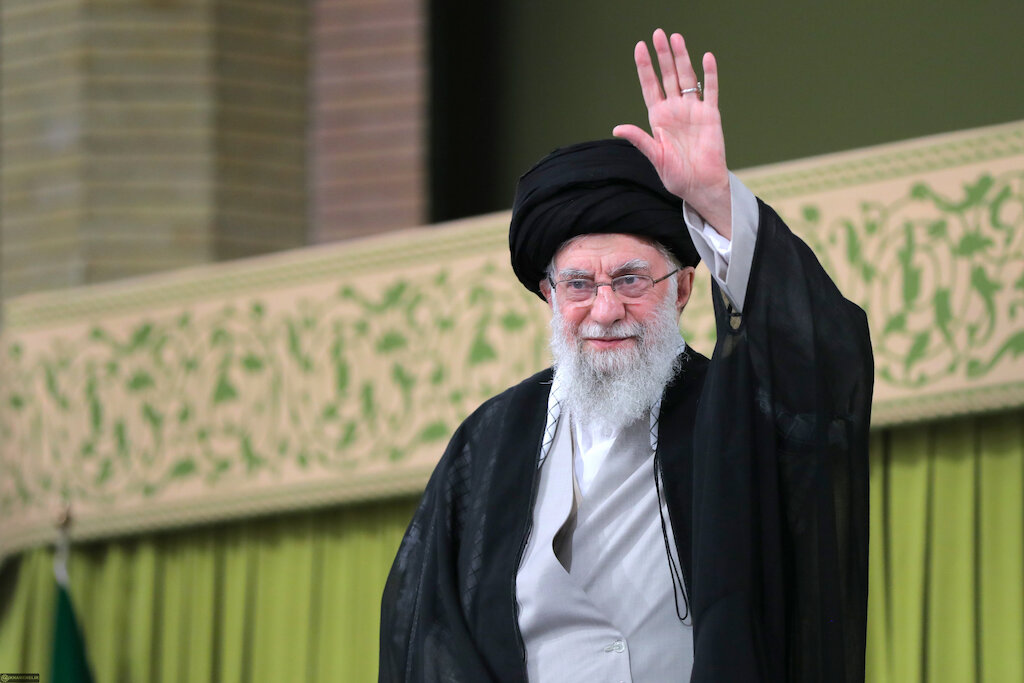
 Iranian Supreme Leader Ayatullah Ali Khamenei
In an age when the world is searching for leaders who can inspire genuine transformation, few figures stand out as distinctly as Ayatullah Seyyed Ali Khamenei, the Supreme Leader of Iran. Known globally as both a religious authority and political statesman, Ayatullah Khamenei’s leadership is rooted not in ideology alone but in faith.
Before rising to political prominence, he was a scholar and spiritual teacher, and it is this foundation in divine and religious teachings that continues to shape his worldview. His conduct, decisions and philosophy of leadership reflect a depth of conviction that sets him apart from many of today’s world leaders.
Khamenei’s charisma is evident not only among the people of Iran but also across the wider Muslim world. It is a charisma rooted in his spiritual depth, religious scholarship and cultural authority – qualities that have enabled him to guide Iranian society politically while also inspiring Islamic communities and other nations globally.
His political leadership is deeply rooted in religious principles that are valued across all divine traditions, and especially in Islam. These principles include respect for human dignity, the rejection of oppression and aggression, honesty in word and deed, the inseparability of religion and politics, opposition to apartheid and racial or economic superiority, belief in a saviour for humanity, the centrality of morality in public life and the promotion of pure religious thought to guide society toward faith.
It is through this framework that his style of leadership differs from that of many other world leaders. For Khamenei, religion is not an accessory to life but its very foundation.
He emphasises that without religion, modern society risks collapse, as faith is meant to bring peace, stability and security to human life. Guided by this conviction, he strongly opposes the development and use of weapons of mass destruction. On the basis of divine values, he has issued a binding fatwa declaring nuclear weapons forbidden, ensuring that Iran’s nuclear programme remains peaceful and preventing its diversion toward military purposes.
These religious beliefs and convictions, which have shaped his character, are reflected in his political thought and style of leadership. His firmness in speech, clarity of mind, moral integrity and perseverance in the strategies he adopts are evident in his approach to political governance.
Khamenei seeks to apply, in the context of contemporary Islamic governance, the principles and methods practiced during the time of the Prophet Muhammad and the leadership of Imam Ali, the prophet’s successor and one of the earliest caliphs of Islam.
Adapting such a model to modern times is a formidable task, given the vast differences in social, political and cultural conditions more than 1,400 years after the prophet’s era. To achieve this, he relies on reliable jurisprudential and religious sources to interpret the rules, ethics and governance patterns of that early Islamic period, while adapting them to meet the challenges and complexities of today’s world.
This approach requires profound religious insight, enabling him to harmonise politics and governance with both rational principles and spiritual values, without falling into contradiction. Over nearly four decades of leadership, Khamenei has demonstrated this capacity, presenting to the world a model of governance rooted in what he terms “religious democracy.”
Today, what we often see is a lack of comprehensive understanding of Khamenei in his political, religious and cultural dimensions. While widely recognised as a political leader, he is equally a writer, thinker and cultural figure with a deep appreciation for literature and the arts.
His breadth of knowledge in intellectual, cultural and literary fields allows him to engage with scholars, artists and specialists in their own language, often leaving audiences impressed by his insight. Moreover, his jurisprudential and religious interpretations – particularly in the realms of economics and politics, and always mindful of both national and international contexts – are highly regarded among contemporary religious scholars.
Unfortunately, international discourse about Khamenei often reduces him to his political role and global positions, portraying only a limited, surface-level image. This narrow view overlooks the deeper religious, cultural and intellectual foundations that shape his outlook. Without recognising this core dimension of his character, it is impossible to gain a true or accurate understanding of his political thought.
In essence, Khamenei is not only a political leader but also a religious, cultural, and literary figure. To truly grasp his vision, one must turn to the wealth of knowledge he has shared through dozens of books and hundreds of speeches and writings over the past five decades.
The writer is the cultural counsellor at the Iranian embassy