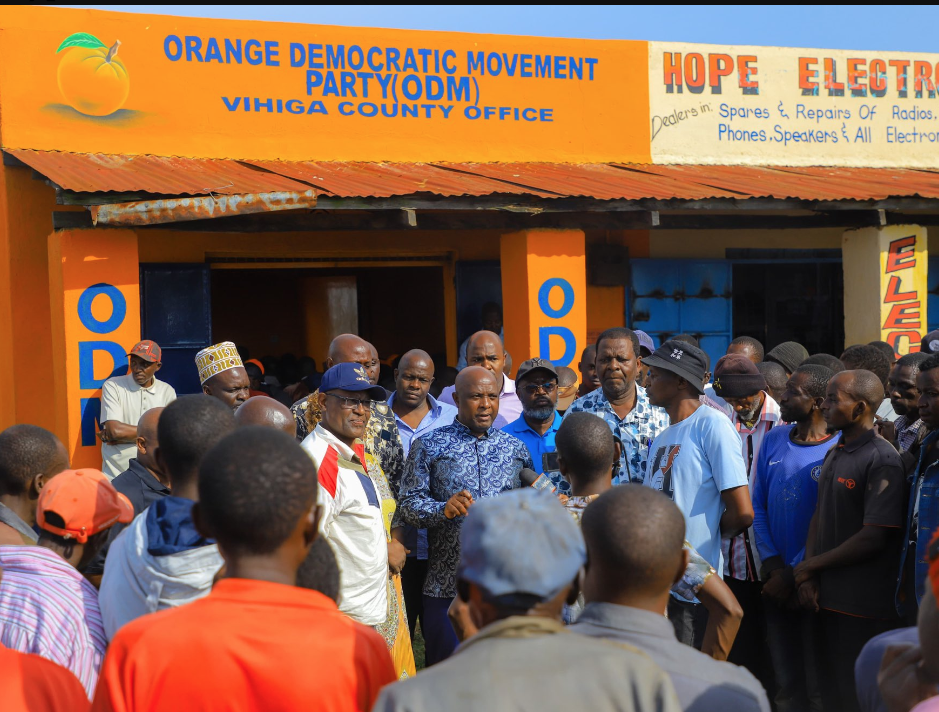
 ODM Vihiga office
As the country approached the 2002 general election, the clamour for constitutional review had reached fever pitch. President Daniel Moi was doing his last term in office and wanted as much peace as possible to exit with grace.
The cooperation with Raila Odinga and eventual dissolution of the NDP had to a large extent neutered the opposition.
The civil society thus jumped into the void and took over the leadership of the process under the chairmanship of Oki Ooko Ombaka. This hijack and isolation of Parliament and other relevant government institutions did not go down well with Moi. It was to Raila’s networks in the civil society that he turned to streamline the process.
The now ODM leader was now serving in Cabinet as Energy minister and would soon after be made the secretary-general of the ruling party Kanu. The party had rebranded after merging with NDP but the process became messy. Old guards led by Vice-President George Saitoti and the vocal secretary-general Joseph Kamotho were thrown under the bus.
Moi made the mistake of unilaterally anointing Uhuru Kenyatta as his successor. Almost half of the Cabinet resigned and joined the opposition. But the events of Kasarani created so much tension in the country that no meaningful constitutional review could be handled.
Raila had managed to bring in Prof Yash Pal Ghai to work together with the Ufungamano group under one commission. Perhaps this event best demonstrated Raila’s special skills in statecraft.
The opposition under Mwai Kibaki promised to make the constitutional review top priority. They romped home in victory and embarked on the work immediately. The Ghai commission was granted funds to commence work at the Bomas of Kenya. Delegates were identified and nominated from all social spheres of the country.
The new government was already suffering from internal cracks. Two distinct factions emerged and the Bomas process provided them with a field to play each other.
In an ironic twist of fate, the breakaway team from Kanu, led by Raila, proved to be progressive than their opposition counterparts now in government led by Martha Karua. Tragedy struck when Dr Crispin Mbai was assassinated. He chaired the crucial devolution tent. The question of devolution was the platform on which the ideological differences in the Cabinet played out.
The Karua group rooted for decentralisation but cheekily called it devolution. The Raila team pushed for more power to be taken to lower and semi-autonomous governments established at the regions.
With the tragic demise of Mbai, the conference lacked a steady hand and necessary academic and expert skills to guide the discussions. When the work was finished albeit not fully, Ghai handed over the draft for a referendum. However, the Karua group reconvened in Kilifi and came up with final draft.
They argued that the Bomas draft was too expensive for the government to implement because it had many loopholes that required to be cleaned.
It is the referendum on the Kilifi draft that gave birth to ODM party. From within the government Raila’s team came together with the opposition under Uhuru to campaign against the draft laws. Samuel Kivuitu who was managing the referendum as chairperson of the defunct Electoral Commission of Kenya gave the two camps each a fruit to identify with. For those supporting he gave them the banana as their symbol.
But for the opposers he gave them an orange as their symbol. When the chips were down, the government side lost the referendum by an overwhelming majority. And thus at steps of the iconic KICC, Raila in the company of the opposition and the Kanu brigade in Cabinet made the announcement “hata hii chungwa itakuwa chama”. Kibaki dissolved and reconstituted his Cabinet but the orange team had seen a rare political opportunity not to be missed.
They declared that the MoU between LDP and NAK was dead and would now chart their own path from the betrayal lessons learnt. The Orange Democratic Movement was formed as a political vehicle to challenge Kibaki in the election scheduled in two years.
The celebrations were short-lived. The party faced immediate headwinds as every legal hurdle was placed in its path to deny it registration as a political party. ODM therefore operated as a movement until early 2007 when Mugambi Imanyara was persuaded to change the leadership.
Apparently, as Raila and company were busy celebrating, Imanyara with connivance of state apparatchiks stealthy registered the movement as a political party. Then Kalonzo Musyoka, because of self-insecurity, introduced another spanner in the works. With the assistance of Daniel Maanzo he registered ODM-Kenya.
Uhuru Kenyatta also bolted out of the opposition coalition to battle for the leadership of Kanu with Nicholas Biwott. Kanu members from the Rift Valley largely led by William Ruto remained in the movement in spite of the challenges. Uhuru retained the chairmanship of Kanu against the onslaught from Biwott.
But he realised that the party had lost its bastion of Moi’s support base. He thus decided not stand in the 2007 presidential elections. He threw his support behind Kibaki but the ODM continued to expand and got political foothold in key regions as the Coast and Western in addition to the Nyanza and Rift Valley. The ensuing election was fiercely fought, results disputed and got the country into post-election violence.
The ODM of 2007 went into election as the most vibrant political party since the Kanu of 1963. After Imanyara agreed to the new leadership structure, a lot of intellectual energy went into work. Among ranking officials were the ideologue Prof Peter Nyong’o (now Kisumu governor) and the renowned economist Dalmas Anyango.
Together with the civil service team from the Nyayo regime, and academics led by Prof Larry Gumbe, they established groups that developed position papers for every development agenda that the party planned. These position papers would later form the basis of the party’s manifesto. Raila’s launch of his presidential bid at the KICC remains the most organised with clarity in messaging and pragmatism in the development pillars.
ODM had declared that its ideology was social democracy. It was therefore easy to avoid the pitfalls of policy contradictions that bedevil political parties today.
The party enjoyed goodwill from across the country and this made its campaigns easy to manage. The main campaign teams were supported by formations of women and youth volunteers including yours truly, who was serving then as the founding chair the youth league.
When the Grand Coalition government came into being, ODM demonstrated that it had prepared much better than PNU to run government. Using the vast pool of intelligentsia in its ranks, the party made many development initiatives through policy formulation.
Many public institutions and government agencies were reformed as guided by the party. Electoral justice was identified as a major challenge and IEBC was established. The education sector saw the exponential growth in university and tertiary education through the establishment of new institutions.
NHIF worked and health institutions improved on their service delivery tremendously. The country witnessed unprecedented growth in infrastructural development. The economy grew and Kenyans were enjoying life. In its ranks the party had the highest number of youthful leaders serving in the Cabinet and other government agencies. But the most significant and greatest contribution is the 2010 Constitution.
In fulfilment of the Bomas spirit, it has entrenched devolution as a system of governance. Devolution has made investment in local development much easier and predictable than when it was led by the central government. Raila is considered the father of devolution and thus makes ODM the party that has transformed the country. However, doubts are lingering whether the party still has the silver shine and mettle of yore?
The party has been challenged to improve on its internal processes to make decision making democratic without much success. This is a major weakness that some pundits have blamed on the successive loss at the presidential elections that the party suffered.
Does it still command the respect and loyal support it enjoyed at its launch? The jury is out. As it celebrates its 20th anniversary, it has serious issues to ponder about.