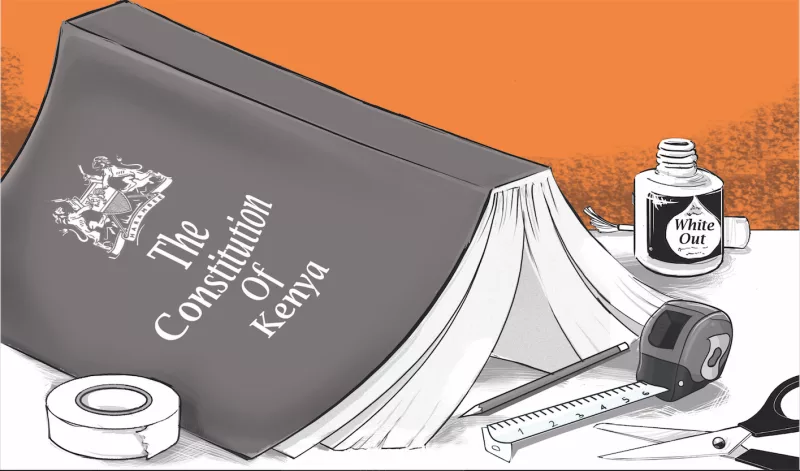

Fifteen years ago, Kenya inaugurated a new constitution after years of struggle to replace the regressive framework inherited at independence.
For much of its existence, the document has been treated with the protection and leniency often accorded to something new, a privilege that may not be available as it matures.
Previous amendment attempts have risen like tides, only to recede. Yet, in truth, they have been gathering force. A great flood is coming.
One of the strongest arguments against amendment has been that the Constitution is too young.
This is a valid point. Constitutions are not born mature.
In their infancy, they are poorly understood and often given the benefit of doubt.
Flaws and lapses are seen as teething problems. Transitional bodies such as the Commission on Implementation of the Constitution (CIC) and the Transitional Authority were established to guide its early years.
The next phases are less forgiving. The Constitution has so far survived amendment efforts such as the Okoa Kenya Initiative of 2016, the Punguza Mzigo Initiative of 2019, and the Building Bridges Initiative (BBI) of 2022.
But the storm is gathering. President William Ruto’s first memorandum to Parliament proposed legislative and constitutional changes to ensure compliance with the two-thirds gender principle and to entrench the National Government Constituency Development Fund (NGCDF) and related funds into the Constitution.
Soon after, Kenya Kwanza and Azimio formed the National Dialogue Committee (NADCO) to “find solutions to issues bedevilling the country.” The NADCO report proposed reforms that would require constitutional amendments, including constitutionalising the NGCDF and creating the office of Prime Minister.
Political consensus is a powerful asset in any constitutional amendment drive.
Once consensus is achieved, the remaining hurdles are largely socio-political and judicial. Socio-political barriers can be overcome since citizens are often swayed by strong political voices. Judicial challenges are more complex, though not insurmountable.
History offers perspective. Kenya’s independence constitution was heavily amended between its third and sixteenth years (1966–1982), during a period of political hegemony, before becoming more difficult to change.
It took another decade to amend it again with the multiparty clause in 1992, and two more decades to repeal it altogether in 2010. Our current constitution is at a point where it is neither too young nor too old to be altered.
It is also important to note that constitutions are not cast in stone, and amendments are not inherently bad. The real danger lies in the process and the intentions behind them.
Best practice favours gradual, thematic amendments rather than omnibus changes, as underscored in the BBI judgment. Each proposal, or cluster of related proposals, should stand on its own vote.
Kenyans must also remember that politicians do not have a monopoly on initiating constitutional change. Civil society, professional bodies, and citizens themselves can start amendment processes.
Civil society, in particular, has historically played a central role in constitutional discourse and should not hesitate to propose its own reform initiatives.
That said, Kenya has yet to realize the full promise of the 2010 Constitution. Implementation remains incomplete.
There is still work to be done. As we face these delicate moments, we must seek serenity to accept the things that should not change, courage to change the things that must, and wisdom to know the difference.
Derrick Makhandia is an Advocate of the High Court of Kenya with over 10 years’ experience in Public Interest Litigation, public policy, land rights, etc. He holds a PGD from the Kenya School of Law and a Bachelors of Law Degree from Moi University