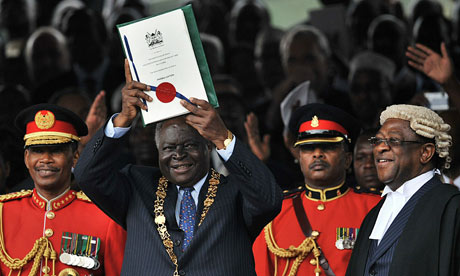
 President Mwai Kibaki officially promulgated the Constitution on August 27, 2010.
Fifteen years after its historic promulgation, Kenya’s 2010 Constitution stands as a landmark achievement in the country’s democratic journey.
Lauded for its bold provisions on civil liberties, devolution, and checks on executive power, the Constitution was designed to address decades of political exclusion, human rights abuses, and centralised governance.
Yet, as the nation marks this anniversary, many observers agree that while the framework is ambitious, implementation has fallen short in key areas.
The 2010 Constitution introduced sweeping reforms that reshaped Kenya’s political and legal landscape. Among its most celebrated successes is the decentralisation of power through the creation of 47 county governments.
This model has brought governance closer to the people, improved resource distribution, and fostered local development.
"The 2010 Constitution is the most progressive in Africa," said Githunguri MP Gathoni Wamuchomba.
“Its greatest legacy is the protection of human rights and the respect for human dignity.”
The Constitution also enshrined an expanded Bill of Rights, guaranteeing freedoms of expression, assembly, and access to information, empowering citizens to participate more actively in governance and hold leaders accountable.
It further created a structure of interdependent governance, with distinct state organs and checks and balances to curb abuse of power.
Despite these achievements, the Constitution’s transformative potential has been undermined by persistent implementation challenges and political inertia.
Public participation, heralded as a cornerstone of the new dispensation, remains poorly defined and inconsistently applied.
“Public participation was hailed as one of the landmark achievements… Yet 15 years later, the country still struggles to define what ‘adequate’ participation means,” noted Mzalendo, a parliamentary monitoring organisation.
Similarly, Siasa Place, a youth-led civic-tech organisation, described public engagement as a "constitutional grey area," with citizens, especially women, youth, and marginalised groups, still struggling to meaningfully influence policy decisions or resource allocation.
The Constitution’s commitment to socio-economic rights such as access to health, housing, clean water, and education remains largely aspirational. While legal protections exist, weak implementation strategies and limited political will have left millions in poverty without adequate services.
Women also continue to face systemic barriers to equality.
The constitutional requirement that no more than two-thirds of elective or appointive public bodies be of the same gender remains unmet in Parliament. Representation of women in leadership remains far below expectations despite legal guarantees.
Wamuchomba acknowledged these setbacks, warning that “there are attempts to limit fundamental rights,” and called for renewed commitment to protecting constitutional gains.
Concerns also remain about corruption and weak oversight of public funds.
Institutions such as the National Government Constituency Development Fund (NG-CDF) have faced criticism, with calls for stronger accountability measures and reforms.
Efforts to curb graft are often slowed by entrenched interests and politicisation of accountability processes.
“There is a clear disconnect between the promise of the Constitution and the lived realities of Kenyans,” said one civil society leader.
“We have the legal tools, but not the political courage.”
The 2010 Constitution was born out of Kenya’s darkest political moment, the 2007 post-election violence that claimed over 1,000 lives and displaced hundreds of thousands. It emerged from an intensive public engagement process led by the Constitution of Kenya Review Commission, seeking to heal the nation through inclusion, justice, and decentralisation.
After receiving the draft, the National Assembly unanimously approved it, and on August 4, 2010 referendum, 68 per cent of Kenyans voted in favour.
President Mwai Kibaki officially promulgated the Constitution on August 27, 2010.
Experts argue that the framework does not require an overhaul but rather the political will to enforce its provisions.
“The Constitution gave us a map,” said a constitutional lawyer.
“It’s now up to us to follow it, not rewrite it every time it becomes inconvenient.”
The road to 2010 was long. The first major push for a new constitution was rejected in the 2005 referendum, after the “Wako Draft” retained a powerful executive and weakened provisions on devolution, sparking dissatisfaction among reformists. About 58 per cent of Kenyans voted against it.
Following that rejection, the disputed 2007 general election intensified calls for reform after violence killed over 1,000 people and displaced hundreds of thousands.
Momentum built around the need for a framework that would address authoritarianism, ethnic marginalisation, and centralised power.
This culminated in the 2010 Constitution—a document still hailed as progressive, but whose true test remains in its full and faithful implementation.
As the country awaits to mark Katiba @15, President William Ruto has officially proclaimed August 27 as “Katiba Day,” an annual event to commemorate the promulgation of Kenya’s 2010 Constitution.
In a proclamation dated August 25, Ruto said the day will be observed every year to remind Kenyans of their duty to uphold, protect, and implement the Constitution.
The first observance will be on August 27, 2025, marking the 15th anniversary of the Constitution.
“I, William Samoei Ruto, President and Commander-in-Chief of the Kenya Defence Forces, by the authority vested in me by the Constitution, do hereby proclaim THAT: 27th August, 2025, and every 27th Day in August forever thereafter shall be observed as "Katiba Day" in commemoration of the promulgation of the Constitution of Kenya 2010,” the proclamation reads.
Ruto said the promulgation of the Constitution of Kenya 2010 marked a defining moment in our nation’s history, heralding a new era of constitutionalism, citizen-centred governance, devolution, equitable development, and the protection of fundamental rights and freedoms
Katiba Day will be marked across Kenya and at all diplomatic missions abroad. It will serve as a national occasion to reflect on constitutional governance and the aspirations of a just, equitable, and prosperous nation.
The President said the day will serve to renew national commitment to the ideals of constitutionalism, governance, and the rule of law through civic activities and dialogue.
“It is befitting for the people of Kenya to commemorate this day as a reminder of our collective duty to obey, preserve, protect, and implement the Constitution,” Ruto stated.
The President said that Katiba Day will remain a working day.
He, however, directed that government institutions, including schools and the two levels of governance, will organise and participate in civic activities that foster constitutional awareness and engagement.
Ruto emphasised that the Constitution represents the sovereign will of the Kenyan people and remains a transformative milestone in the country’s history