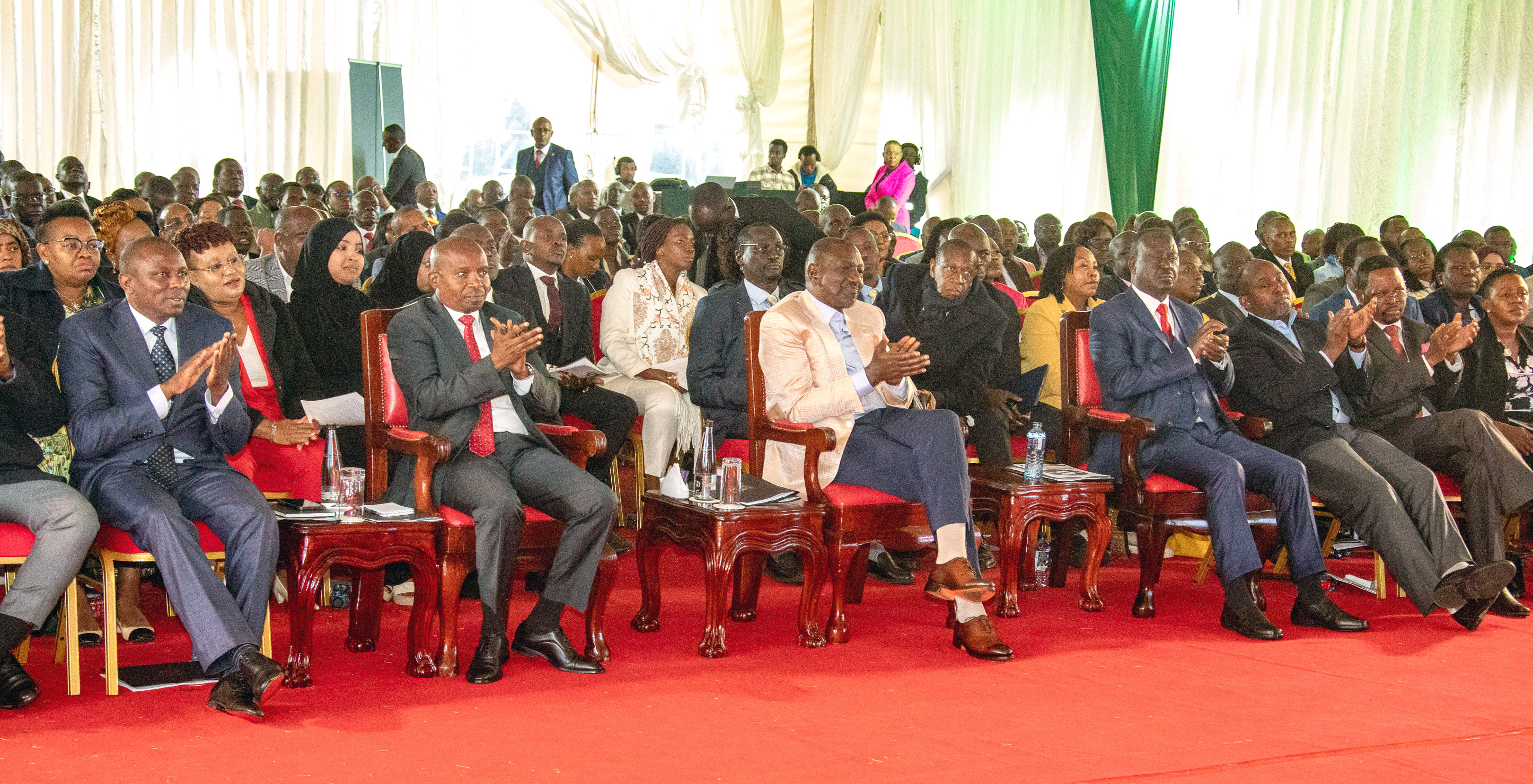
 Majority Leader Kimani Ichung’wa, DP Kithure Kindiki, President William Ruto, ODM Party leader Raila Odinga, Minority Leader Junet Mohamed during the joint Kenya Kwanza and ODM Parties Group meeting at Statehouse, Nairobi /Emmanuel Wanson
At the recent Parliamentary Group meeting at State House, President William Ruto made forthright remarks on the persistence of corruption, including within Parliament itself. The observations provoked strong reactions, with Members of Parliament expressing disquiet on the floor of the House.
Some viewed the comments as injurious to the reputation of the institution, while others argued that the independence of the Legislature had been put into question.
The House, animated with points of order and fiery interventions, became the arena where the President’s words were dissected. Yet, in the rush to defend institutional honour, the central question risks being overlooked: how should Parliament respond to the enduring challenge of corruption in a way that strengthens, rather than weakens, Kenya’s democratic foundations?
Corruption is not an abstract charge. It is the lived reality of citizens who face stalled projects, compromised services, and inflated costs in every sector of life. It is visible in half-built roads, idle equipment rusting at construction sites, classrooms that exist only on paper, and medical supplies that never reach hospitals.
Kenyans encounter corruption as a daily tax on their dignity and livelihoods. When the President spoke candidly about corruption within Parliament, he was not raising a novel accusation but amplifying what is widely spoken in public discourse: that oversight itself cannot be credible if those charged with it are perceived to be compromised. In this sense, the matter is not about the bruising of parliamentary pride, but about the restoration of national confidence in institutions.
It must also be recognised that Parliament has, over the years, been an important actor in shaping the legislative and institutional response to corruption. The enactment of laws establishing the Kenya Anti-Corruption Commission, the Public Procurement and Asset Disposal Act, the Public Audit Act, the Leadership and Integrity Act, and, later, the Ethics and Anti-Corruption Commission (EACC), all passed through the scrutiny of the House.
Through these efforts, Parliament has contributed significantly to embedding anti-corruption provisions within Kenya’s governance framework. These legislative gains deserve acknowledgement, for they form the scaffolding upon which accountability mechanisms stand. What remains in question, however, is whether Parliament has consistently upheld these laws in practice, and whether its internal operations reflect the same commitment it has codified in statute.
History further shows the tension between noble intention and fragile implementation. The Bomas constitutional process, and the eventual promulgation of the 2010 Constitution, sought to enshrine transparency and accountability as core national values
. The Bill of Rights, the establishment of independent commissions, and the entrenchment of devolution were all designed to disperse power and reduce opportunities for graft. Yet, even with this robust framework, corruption scandals have continued to touch every arm of government, Parliament included.
Reports on sugar importation, the misuse of Covid-19 emergency funds, questionable tenders and controversies within parliamentary committees have left the public sceptical. These episodes reinforce the reality that laws alone are not enough. What matters is the political will to enforce them and the moral conviction to practise what has been legislated.
This brings into sharp focus the reflections of Alexis de Tocqueville in Democracy in America (1835). His warning on the “tyranny of the majority” remains instructive. He observed that democratic institutions risk degeneration when the majority, secure in its numbers, employs its power to advance private interest at the expense of the common good.
Parliament, as the embodiment of the people’s sovereignty, must guard against this temptation. It cannot become an end unto itself, where numerical dominance is used to insulate misconduct or dilute accountability. Instead, it must stand as the forum where the collective interest of the nation triumphs over narrow calculations of self-preservation.
Yet, one must ask why the common good remains elusive in Kenya’s governance journey. Why is it that initiatives meant to strengthen accountability so often encounter resistance, not only from vested political interests but also through legal challenges?
The recent case in which courts halted the multi-agency anti-corruption team established by the President just two days ago, illustrates this dilemma. In a nation struggling under the weight of systemic graft, why should institutional energy be consumed in jurisdictional disputes instead of collaborative problem-solving? Citizens rightly wonder why the fight against corruption appears perpetually entangled in procedural contestations, while the real costs are borne by households, businesses and communities.
The way forward lies not in blame-shifting but in shared responsibility. Parliament and the Executive must pursue reforms that go beyond the symbolic to the structural. Strengthening procurement laws to close loopholes, reforming parliamentary committees to minimise conflicts of interest, and granting independent audit institutions robust enforcement capacity would signal serious intent.
Equally, insisting on transparency in all major expenditures and tenders would ensure that public resources are seen and treated as a trust, not a privilege. These measures are not merely technical adjustments but essential steps towards restoring public confidence in the governance of the Republic.
Kenya’s history demonstrates that anti-corruption efforts falter when they are fragmented, politicised, or left at the mercy of episodic zeal. A unified resolve across the arms of government offers the best chance of entrenching accountability as a permanent ethos of governance.
If the Executive and the Legislature choose partnership over confrontation, this Parliament could be remembered as the one that consolidated the gains of the 2010 Constitution by embedding integrity as the central tenet of public life.
The test of leadership will not be found in the decibels of parliamentary exchanges or the ferocity of rebuttals. It will be found in whether leaders at this moment have the courage to rise above institutional sensitivities and pursue the harder path of reform. The measure of this Parliament will be whether it embraces the President’s challenge not as a provocation, but as an opportunity to leave a legacy.
Kenya requires a Legislature that affirms its independence through integrity, that strengthens its oversight by practising accountability, and that partners with the Executive not in subservience but in shared responsibility.
To seize this moment is to transform public trust from an aspiration into a reality. To squander it is to perpetuate the very frustrations that have defined Kenya’s governance struggles for generations. The choice is clear: to resist is to retreat into the familiar; to collaborate is to build history.