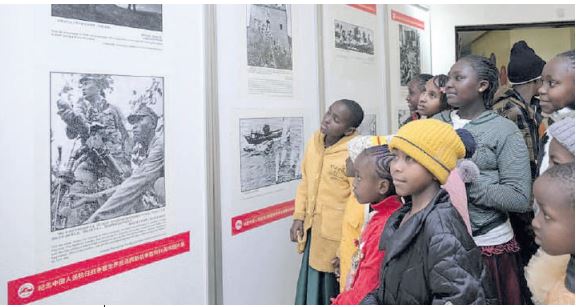
 Children visit a photo exhibition marking the 80th anniversary of the victory in the Chinese People’s War of Resistance Against Japanese Aggression and the World Anti-Fascist War in Nairobi on August 15 /XINHUA/YANG GUANG
This year, China marks the 80th anniversary of its victory in the War of Resistance Against Japanese Aggression, a turning point not only in Chinese history but also in the global fight against fascism.
For Kenya and Africa at large, this commemoration carries special meaning. It reminds us of the power of unity, resilience and visionary leadership in overcoming foreign domination.
At the heart of China’s triumph was the Communist Party of China (CPC), which transformed a time of peril into a moment of national awakening.
At a time when China faced aggression, the CPC gave direction and hope by framing the struggle as a People’s War. Resistance was not left only to soldiers—it became the responsibility of every farmer, worker, student, and villager. By engaging the entire population, the CPC ensured the fight was deeply rooted in the will of the people.
For Africans, this echoes our own liberation struggles. From the Mau Mau in Kenya to resistance movements across the continent, victory came when ordinary people were mobilised to defend their land and dignity.
China’s example shows how the strength of the people, when organised, can defeat even the most powerful of aggressors.
The CPC’s leadership was marked by strategic creativity. Faced with an enemy that was stronger in weapons and numbers, the party relied on flexible tactics that made the most of local knowledge and community support. Villages became strongholds, and the countryside a shield that sustained the fight for years.
Africa’s history offers a similar truth: liberation was rarely won on open battlefields but through ingenuity, persistence and turning local terrain into an advantage. China’s success underlines that the struggle for freedom is not determined solely by military might but by determination, innovation and unity of purpose.
Perhaps the most remarkable contribution of the CPC was its ability to build national unity. By calling for all Chinese people to set aside differences and resist together, the party ensured the nation’s survival came before political divisions. This spirit of solidarity created a powerful front that could not be broken.
In Africa, where colonial powers often thrived by dividing communities, the lesson of unity is clear. Kenya’s independence was secured when diverse groups came together to speak with one voice.
Today, the African Union and regional blocs continue this tradition by promoting integration and collective strength. China’s wartime unity demonstrates that solidarity is not just a slogan — it is the foundation of victory.
What set the CPC apart was its vision that extended beyond the battlefield. Even as the war raged, the party introduced reforms in areas under its influence—promoting education, advancing gender equality and encouraging fair distribution of land. These initiatives gave people not only a reason to fight but also a glimpse of a better society worth defending.
Africa’s liberation movements similarly combined the fight for independence with the dream of social renewal—schools, cooperatives and political education often flourished in liberated zones. China’s example reinforces the lesson that true freedom is not only the absence of occupation but also the creation of just and inclusive societies.
Eighty years on, the CPC’s role in catalysing victory against aggression continues to inspire. For Africa, the story is not distant — it speaks directly to our own journey. Both China and Africa emerged from centuries of humiliation under foreign powers, yet both found strength in resilience, unity and the belief that people’s will can shape destiny.
As Kenya and Africa look to the future, the lessons of China’s resistance remain relevant. They remind us that lasting progress comes when nations trust their people, when leadership is anchored in vision, and when unity is placed above division. Just as China rose from struggle to transformation, Africa too can turn its challenges into a springboard for renewal.
China’s victory 80 years ago was more than a military triumph — it was a triumph of spirit, unity and vision. The Communist Party of China stood at the heart of this transformation, guiding the nation through hardship toward dignity and renewal. For Africa, the parallels are striking and inspiring.
In remembering China’s victory, we also celebrate a universal truth: that when a people unite with purpose and leadership, no force—no matter how powerful—can extinguish their quest for freedom.