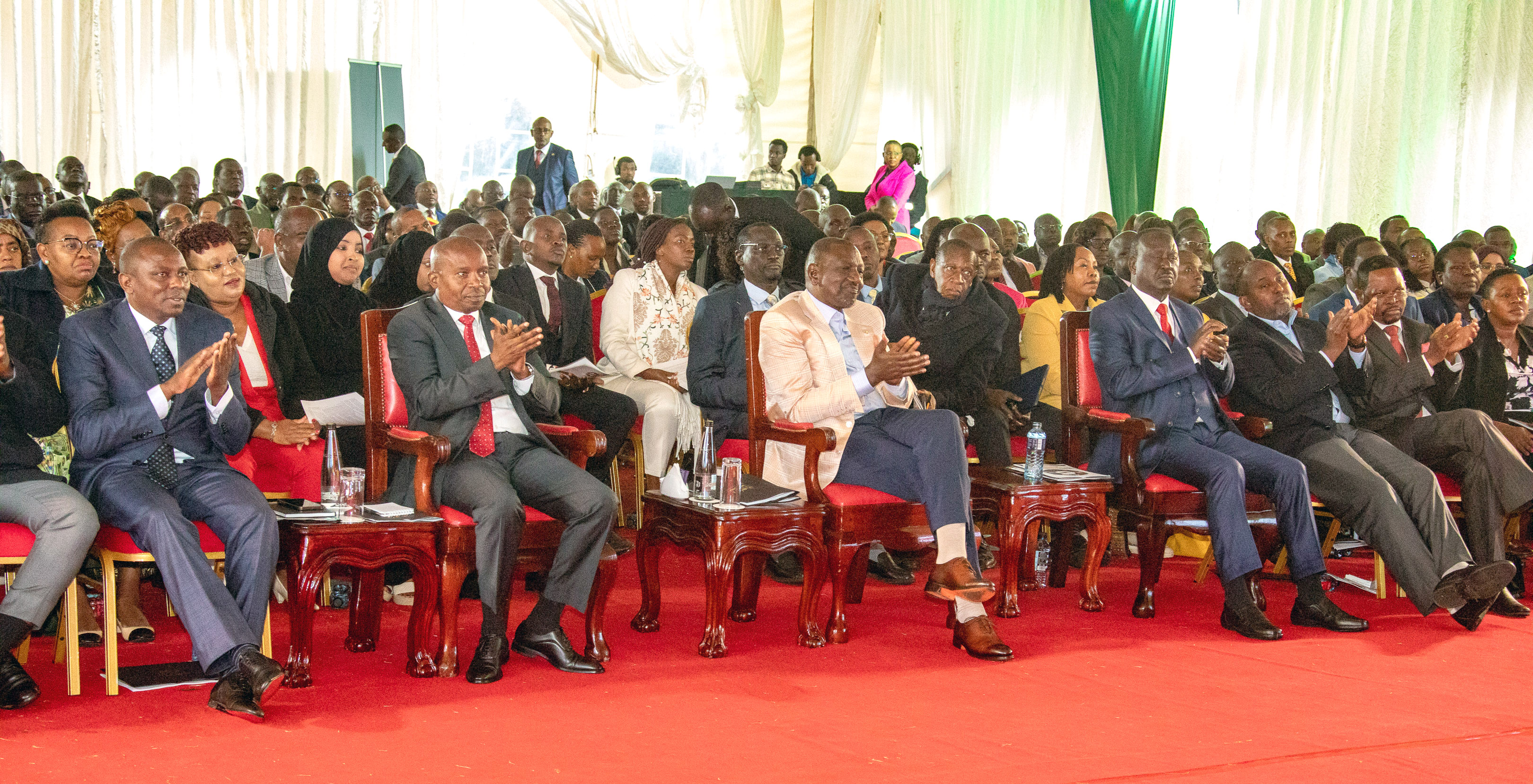
 Majority leader Kimani Ichung’wa, DP Kithure Kindiki, President William Ruto, ODM Party leader Raila Odinga, Minority Leader Junet Mohamed during the joint Kenya Kwanza and ODM Parties Group meeting at Statehouse, Nairobi /Emmanuel Wanson
On Monday this week, President Ruto and his political partner, ODM boss Raila Odinga, along with their surrogates in the legislature, trooped to Karen for a much-anticipated, if not unnecessary, joint parliamentary group meeting.
At face value, the gathering appeared to have no real objective, other than the usual optics of a supposedly rosy “national unity” marriage between the two political formations.
But despite the President declaring at the meeting that he is a regular consumer of national intelligence, reports of disenchantment expressed by legislators at the Karen congregation indicated there had been weak intelligence over the level of MPs’ rebellious streak, or indeed over the talking points delivered by the two principals. Word out of the joint PG confirmed that on the day, and in keeping with football parlance, the two gentlemen lost the dressing room.
Ahead of the gathering, the media seemed disproportionately focused on who would skip the meeting, with too much emphasis laid on the ODM secretary general, Edwin Sifuna, a thorn in the flesh of the Ruto regime, whose absence was a foregone conclusion.
Ultimately, many more prominent legislators, on both sides, failed to turn up. But for purposes of sensationalism, their absence wasn’t as juicy, in terms of newsworthiness, as that of the youthful Nairobi Senator.
As fate would have it however, the reported boos and heckles directed at both the head of state and the ODM chief made bigger news. The anger by the MPs emanated from what they apparently considered to be “lectures” directed at them by the two leaders.
The so-called lectures were in fact matters to do with two sticking issues within the legislature; one being corruption and the other the MPs’ control of the National Government Constituency Development Fund (NGCDF).
Ruto sounded the alarm on the former, while Raila has been consistent that the latter must be removed from parliamentary control so that members stick to their oversight role.
In going gung-ho on parliamentarians over these two delicate matters, the President and the ODM boss unwittingly achieved the opposite effect of their initial intention. Instead of a strong Kenya Kwanza-ODM legislative platform, they unwittingly emboldened MPs to rebel.
For the President especially, the MPs, in not many words, appeared to be saying that he isn’t the right person to discuss corruption, because of perceived executive excesses, with regard to state resources, in his regime. Besides, if indeed members of the executive routinely give bribes to parliamentarians for friendly reports, then cracking down on the two-way tango must be done against both sides; the giver and the taker.
With just two years to the next general election, the spectacle of elected leaders staging a rebellion against their principals isn’t what the two leaders need right now. For Ruto, it isn’t a totally bad thing though. With unfettered access to state largesse, he can simply create a new breed of legislators by sponsoring malleable candidates across the country, as he has done before, in order to structure a new legislature “in his image” ahead of an anticipated second term.
For Raila, things are a bit more complicated. Part of the power he holds over his base and party emanates from the perennial promise of a coming presidency, with him having been the party’s sole presidential candidate for the entire 20 years that he has led it.
If he is not on the ballot in 2027, the authority he exercises over his party and both its elected leaders as well as upcoming aspirants, may just wane dramatically.
For the ODM chief, the bigger dilemma, in my view, is whether he wants to wait on the scene long enough to watch himself become relatively irrelevant, or he wants to oversee a transition to a new dispensation within his party, before retiring to watch all the politics from a distance.
Truth be told, on the matter of the contentious NGCDF, Raila’s position has the backing of a large section of the population.
There is general consensus in the country that the fund has given rise to “leadership by tenders”, where MPs dabble in construction contracts, while also using CDF as a tool for control and manipulation. There is a valid argument that the result of this is that the quality of representation and legislation, key components of the duties of the members, has fallen over the years, because of too much focus on NGCDF projects.
But the ODM leader’s demand that the fund be transferred to counties doesn’t resonate well with the people, especially when he adds the rider that the legislature should keep its hands off governors and let any oversight of the county chiefs be done by the county assemblies. The general feeling is that the governors and the national government’s executive are “eating too much” and therefore, the two principals can not single out legislators, leaving the others “eating alone”.
President Ruto’s accusations directed at the legislature, attributed to intelligence reports, no less, have dented the image and prestige of Parliament. Members are within their rights to demand that he names the said bribe takers and sends in investigative and prosecutorial agencies for further action.
If these reported bribes, especially on the side of the Senate, are said to revolve mostly around impeachment proceedings, it would be interesting to especially hear and see details around the impeachment of former DP, Rigathi Gachagua, because the country has a pretty good idea who wanted him gone the most.
Be that as it may, the fallout from the joint PG is a good thing, overall, for the nation. First, it exposed the delicate fault lines within the broad-based arrangement, where most actors have recently turned themselves into mole-hunters, running the “with us or against us” narrative in an attempt to herd everyone into the cooperation corner.
The reaction to the legislators has confirmed that when self-interest is at risk, everyone fights in their own corner, regardless of the prevailing view.
Secondly, the ripple effect from the Karen meeting, with MPs protesting bitterly about being accused of receiving bribes to pass bills and write favourable reports, will most likely awaken Parliament to a new era of integrity. In a country where corruption is a cancer that defies any attempts to slay it, I am certain that MPs, now carrying the burden of this accusation, will have a point to prove.
Even more importantly, this may usher in an era where bills emanating from the Executive will receive greater scrutiny than previously, with all attendant improved quality.
As for President Ruto and Raila, for calling a joint PG that they didn’t really need to, and following this open rebellion against them, they have made their bed and must lie in it.
There is even a level at which one can say that the manner in which legislators have been emboldened against the two, may be a pointer to a growing feeling among elected leaders that political dynamics are changing in the grassroots, and they may not necessarily need the two to assist with their re-election.
If this holds true, then the cooperation framework itself is in danger. Which is why I believe that both Raila and Ruto should quietly carry forth the façade without summoning unnecessary meetings which end up exposing the truth.