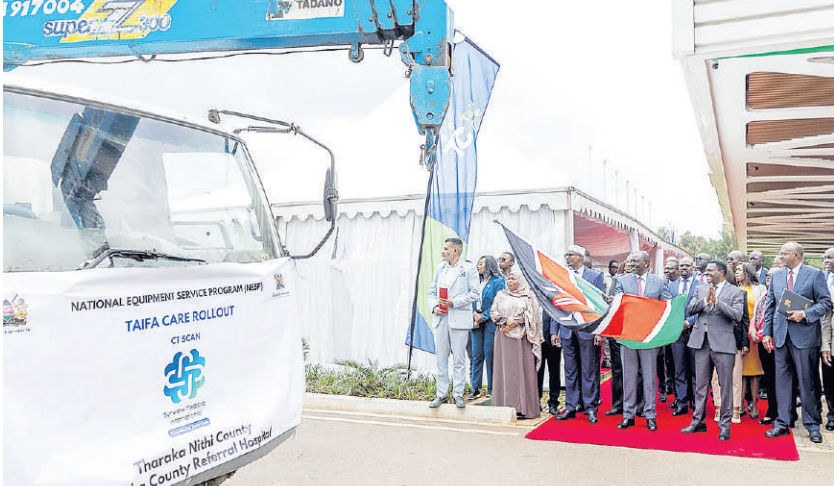
President Ruto
flags off the
delivery of 14
CT scanners,
two ultrasound
machines,
30 dialysis
machines and
digital X-ray
systems
to various
hospitals in the
counties on
August 7 /PCS
Up
to 90 per cent of the fees counties collect from patients for using medical
equipment supplied under the new National Equipment Service Project will go to
the vendors.
President
William Ruto launched NESP to replace the controversial Managed Equipment
Service scheme, which Parliament condemned as exploitative and conceived as a
“criminal enterprise.”
Advertisement
Advertisement
The
Star has established that counties, vendors and the Social Health Authority
have signed a seven-year tripartite agreement under which counties will pay for
the equipment – through SHA—based on actual usage.
In
this fee-for-service arrangement, praised by governors but seen by critics as
resembling MES, counties will retain only 10 per cent of revenues from
patients’ use of the equipment.
“NESP
is like a service contract and partnership where you share proceeds between the
vendor and the county. In this case, the vendor is taking nearly 90 per cent,”
Makueni Governor Mutula Kilonzo Jr said.
Under
the deal, county governments bill SHA for services delivered using the
equipment. The vendors supply, install, maintain and upgrade the machines at no
upfront cost to counties.
“The
vendor comes and places the machines. It is envisioned that when people are
being dialysed, they are under the SHA, so the SHA pays us,” Mutula said.
“Once
they pay us, we pay a certain amount for that machine. Ideally, somebody should
look at it from the perspective of the service,” he added.
The
list of equipment includes CT scanners, ultrasound machines, dialysis units,
renal machines and digital X-ray systems.
Council
of Governors chair Ahmed Abdullahi defended the formula, saying the tariffs
were thoroughly negotiated to cover equipment supply, maintenance and
consumables.
“These
were negotiated tariffs between what the vendor takes for the supply of the
equipment, which also includes maintenance of the equipment and consumables,”
Abdullahi said.
Counties,
he noted, provide personnel, installation space and utilities such as
electricity and water.
Billing
is done at the facility level by medical staff, with the information relayed to
SHA. The process is automated—the equipment has in-built meters to track usage.
This
model differs from MES, which required counties to pay Sh200 million annually
to vendors, deducted directly by the Ministry of Health through conditional
grants.
Critics
of MES argued that it involved coercion, lacked feasibility studies and often
resulted in unused equipment due to missing infrastructure or skilled staff.
"Under
MES, it was total coercion. No feasibility studies were done. The equipment
were dumped there. There was no consultation," Mutula said.
He
added, “Under MES, we used to pay for maintenance and consumables. But in this
new programme, all that is done by the vendor.”
Abdullahi
said 45 of the 47 governors have already signed up and that participation was
voluntary.
“There
is still an opportunity for the remaining two counties to sign. This was a
voluntary process. It was not a requirement for any county to sign up,” he
said.
The
Wajir governor described the programme as a game changer in the provision of
health services in public hospitals, saying that no single county can procure
the health machines directly from its budget.
“This
is a classic case of conceptualisation of a good idea between the counties and
the national government, which leverages private sector resources to deliver
services to the people,” he said.
Launching
the programme at State House, Nairobi, two weeks ago, President Ruto said, “Our
private sector partners will bear the cost of installation, servicing and
maintenance, placing no financial burden on public health facilities.”
He
called NESP a cost-effective alternative to MES, eliminating large upfront
costs and ensuring consistent maintenance to guarantee continuous service.
Through
the new programme, the President said Kenya is shifting from a fragmented and
costly medical equipment supply system to a smart and collaborative approach to
healthcare delivery.
“This
cost-effective and sustainable model guarantees that equipment is not only
installed, but also consistently maintained, thereby ensuring continuous and
reliable service,” he said.
Ruto
flagged off the delivery of 14 CT scanners, two ultrasound machines, 30
dialysis machines and several digital X-ray systems to counties.
Within
two months, the government expects to deploy an additional 58 digital X-rays,
65 ultrasound machines, 19 CT scanners, 100 theatre units and 100 laboratory
systems.
The
Ministry of Health says NESP is built on lessons from MES and aims to provide
equitable access to modern medical equipment across Kenya.
The
MES programme, launched under the previous administration, was heavily
criticised.
Governors
lamented that they were coerced into signing contracts without being consulted
on the specific needs of their facilities.
As a result, much of the equipment delivered
under MES remained unused due to a lack of infrastructure, electricity or
trained personnel.
“We
signed it under duress because the pressure was too much. When I signed it, I
didn’t even want to read it because the equipment was already there—they were
delivered on a Saturday night,” former Kakamega Governor Wycliffe Oparanya
said.
The
Star established that the MES equipment, some of them now obsolete, is still
choking county hospitals with governors grappling to dispose of them.
For
the few functional ones, the counties have been forced to factor their
maintenance cost into their budgets.
However,
the counties are no longer paying the contractors for the equipment after the
contracts ended.
The
Ministry of Health states that it is designed to provide consistent access to
medical equipment nationwide, building on lessons learned from MES.
INSTANT
ANALYSIS
Under
the FFS model, suppliers invest in and place medical equipment in county health
facilities at no upfront cost, then receive payment based on services
delivered. SHA reimburses facilities according to gazetted tariffs. This
approach enables counties to focus resources on patient care while vendors
handle supply, maintenance and upgrades. The new programme replaces the Medical
Equipment Scheme, which required significant upfront capital and lacked clear
service agreements, leading to frequent downtimes and compromised care.