

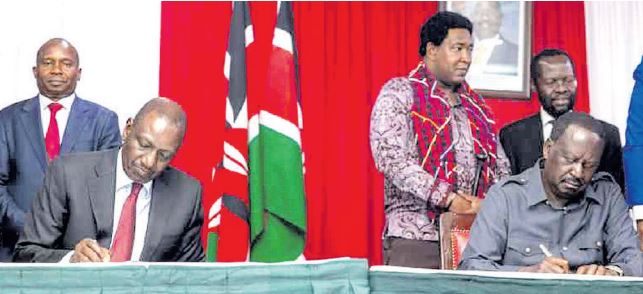
 President William Ruto and ODM leader Raila Odinga sign the MoU between UDA and ODM at KICC in Nairobi on March 7 /FILE
So the President and his (now) chum, Raila Odinga, have formed a committee of fivedistinguished people to discuss (and consult the people on) implementing 10 points agreed by“the Principals” in March.
Points 2 to 10 are mostly about implementing the constitution. Inclusivity (Article 10),devolution (Chapter 11 particularly, and Schedule 4), promoting the livelihood of the youth(Article 55), leadership and integrity (Chapter 6), right to peaceful assembly (Article 37) andcompensation for victims (topic for a future article), national debt (touched on in various waysincluding Article 10 mentioning “sustainable development”, corruption (a theme of theconstitution), wastage of resources (the aim of Chapter 12 and specifically mentioned in Article201(d)), the sovereignty of the people (Article 1), the rule of law (Article 10) andconstitutionalism (respecting the constitution).
We elect a government (paying them extravagantly) and employ a civil service, Judiciary, etc., whoshould have been doing all this for the last 12 years. And now five people are to recommendhow it should be done?
Nadco
Point 1 is about implementing the 2023 National Dialogue Committee agreement,between Kenya Kwanza and Azimio. Though having some policy issues relevant to the currentsituation – such as cost of living – a major thrust was about amending the constitution (it includes aconstitution amendment bill, and bills to amend other laws). Nadco has introduced nine bills.
Let’s look at a few of the more substantial of those recommendations. Most are quick fixes, notwell thought through, creating as many problems as they solve.
A Prime Minister
Prime Ministers vary greatly – they include the heads of government in India, Australia, Canadathe UK and various European countries.
Nadco’s Bill would not put the proposed PM in Parliament so he/she could not be – like theTanzanian or Ugandan PM – “Leader of Government business” in the Legislature.
Nadco’s proposed PM would assist the president and deputy in coordination, supervision andimplementation of government programmes, and “coordinate government’s legislative agendaacross departments”. The latter is obscure. The first gives the PM very little real authority.This (designed for Raila?) would be probably the weakest “prime ministerial” position anywhere.
It is fundamentally like the “Prime Cabinet Secretary” position held by Musalia Mudavadi: anopportunity for a president to give lucrative recognition to a politician who has broughtsubstantial benefits in terms of votes. No amendment to Article 152 on the makeup of theCabinet is proposed, so could a “Prime Minister” be a member?
Leader of the Opposition
Another odd idea is recreating the office of Leader of the Opposition (LOO). The Bill says the LOOwould be leader of the second largest party/coalition in the National Assembly. It is not entirely clearwhether the LOO (plus two deputies – chosen how and doing what?) would come from Parliament or ifnot (maybe because they vied for the presidency) would come into Parliament after appointment.
The report says Parliament should elaborate the LOO role, and include providing alternativepolicy agendas, fostering cooperation between government and opposition and promoting goodgovernance. And what would be the role of the Minority leader?
The Bill would not make the LOO a “state officer”. So the Salaries and RemunerationCommission couldn’t fix their salary. Who would?
Maybe a better approach would allow people to stand for election to the National Assembly aswell as president, so if a presidential loser wins a parliamentary seat, they have a job and salary tofall back on, if that is the real concern.
Equitable share
At least 15 per cent of the revenue raised nationally (in the most recent year for which the NationalAssembly has approved the audited accounts) must be allocated to counties annually. Raila andothers have suggested the figure should be 35 per cent or even 45 per cent. The Bill would raise it to 20per cent, yet in no year has that share gone below 20 per cent so this change would do nothing, unlessthings change radically.
Disobeying court orders
Nadco proposed a constitutional provision that all state and public officers must obey courtorders, and empower courts to impose a penalty for disobedience. But this is already the law,including penalties for contempt of court. What is needed is for the other parties and courts toensure that orders are directed at the right people, and there is persistence in applying the existingpenalties.
If the offender is the president, he cannot be penalised in this way, at least while in office.Walter Khobe, a legal counsel in the Office of the Chief Justice, has pointed out that the Ghanaian constitution makes such disobedience a “high crime” with a penalty of imprisonment without fine, andexclusion from office for 10 years!
Elections
Having six elections on one day is unusual and very challenging. Nadco proposed the IEBC“consider” a change in the constitution on this issue. Clearly the constitution drafters setpresidential and parliamentary elections on the same day to minimise the risk of conflicts.
Should we have presidential and parliamentary elections (four) on one day and county elections(governors and MCAs) on another?
The Bill proposed extending Senate’s term to seven years. This is supposed to make the Senatemore independent and strengthen its role in lawmaking – presumably by virtue of itsaccumulated experience. It is not clear that this makes any particular sense here. And would it bedesirable to have Senate of a different political persuasion from the National Assembly?
Gender in Parliament
Nadco did not include the gender issue in their Bill, leaving the task to a Working Groupappointed by government. However, Nadco put forward its own ideas. First, use the countyassembly approach: extra women from party lists, but giving preference to candidates who stoodfor election for a constituency, and within that, those who received the most votes.
The Working Group took this approach but without the second part about preference forcertain candidates.
Alternatively, Nadco suggested doubling the county women representatives, plus top-up if necessary (infact, it might well not be necessary). But 94 women reps? Their roles are already unclear.And their existence already distorts the relationship between votes and seats in Parliament.The Working Group did not take this approach.
Party hopping
Nadco wanted procedures for resigning or being sacked from a political party (already in thePolitical Parties Act) included in the constitution. The constitution, it says, should provide that,once a person leaves a party, he or she loses any post, elected or appointed, which they hold byvirtue of that party membership.
How easy would it be to prove that someone holding an appointed position does so by virtue oftheir party membership? People would argue, “I was appointed for my personal qualities notbecause I was a member of a certain party.”
CDF, etc
Nadco wanted the National Government Constituency Development Fund, the women reps’Affirmative Act Fund and the even odder Senate Oversight Fund to be included in the constitution to protectthem from the courts – the Supreme Court having decided the first is unconstitutional.
Finally
Is the Committee of Five to choose between alternatives in the Nadco proposals, or even to amendthem, perhaps taking account of other existing bills, proposals and comments? For example, theBill about the CDF currently pitting the two Houses against each other. How about the publicrejection of a recent Bill seeking to give all parliamentarians, and the president, seven-yearterms? And what about Senate’s demand for more powers? Are they to take account of the criticalcomments on the Nadco Bill in Parliament? And how about Raila’s recent rejection ofconstitutionalising the CDF, etc.?
The committee has a deadline of March 2026 – probably not time enough to amend theconstitution before the 2027 election. Is this – as committees often seem to be – a way oflooking as though something is being done but not really doing anything?






