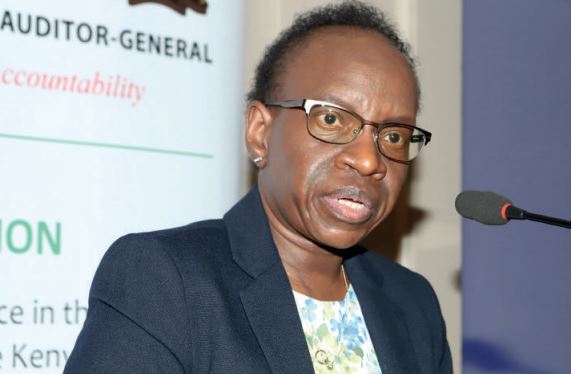
COUNTY governments are losing millions of shillings through systematic payroll manipulation, excessive hiring, and the payment of ghost workers, new reports by the Auditor General reveal.
The special audits on payroll management for all 47 counties, covering the 2021-22, 2022–23 and 2023–24 financial years, expose potential widespread fraud and mismanagement.
They detail cases where county workers share bank accounts, receive allowances they do not qualify for, and falsify their birth dates to delay retirement.
In some cases, counties remitted more money to banks for salary payments than the amounts recorded in their payrolls, resulting in excess expenditure.
Many still rely on manual payrolls, which are easily manipulated to inflate worker numbers and process irregular wages.
In Baringo, the auditor uncovered suspected cases of date of birth falsification by 79 employees, raising concerns of manipulation.
“Interviews with 96 employees and verification of their identification documents established that the data recorded in the IPPD System for 79 employees differed from their birth certificates,” the report states.
In another shocking finding, 28 casual workers shared 14 bank accounts, while two workers shared a single account.
These workers received total gross salaries of Sh1.98 million and Sh181,526, respectively.
The report also highlighted potential cases of ghost workers drawing salaries from the county government.
The auditor had requested physical verification of 40 employees, but five failed to present themselves.
During the reviewed period, these five staff were paid a total of Sh23.42 million.
“The employees who did not present themselves for physical verification may not exist, raising the risk of irregular or fraudulent payments,” the report notes.
In another suspected fraud, the county executive paid health workers' extraneous allowance arrears amounting to Sh500,410 in the 2022-2023 financial year.
However, the officers involved were neither health workers nor deployed in any health facilities.
During the period under review, the county wired Sh16.05 million more to the bank for payment of salaries than the net salary captured in the payroll.
In Bomet, the wage bill stands at 39 per cent of its revenues, exceeding the limit of 35 per cent. The county lacks annual recruitment plans, leading to haphazard hiring.
The special audit identified 141 employees with inconsistent dates of birth.
“Interviews with 94 of the employees and verification of their identification documents established that the dates captured in the IPPD System and the HRIS-Ke for 52 employees were different from those in the employees' birth certificates,” the report shows.The county has also retained in its payroll officers who are earning salaries from more than one government entity.
In the 2023- 2024 financial year, four employees were engaged by both the Bomet county executive and the Teachers Service Commission.“During the period of dual engagement, the officer received a gross salary of Sh907,164 from the county executive and Sh581,468 from TSC,” the report says.
Further, the report cast doubts on the authenticity of staff captured in the payroll.
The special audit requested 93 employees from the county executive to present themselves for physical verification.However, 10 employees did not appear for the exercise, despite multiple attempts to reach them.
The 10 employees collectively received a gross salary amounting to Sh19.22 million.“These employees may not exist, presenting the risk of irregular or fraudulent payments,” the report says.
The report flagged appointments and re-designations of 15 employees without meeting the requirements set in the respective schemes of service.
In addition, the report faulted the county for circumventing payroll controls to pay irregular salary arrears to several staffers.A similar situation was found in Bungoma, where the auditor flagged lack of annual recruitment plans and the absence of staff establishment to guard against excessive and irregular hiring.
Similarly, Gathungu cast doubt on the integrity of date of birth records in the payroll systems, as 19 employees had contradicting dates.
The county has retained manual payment, processing salaries amounting to Sh297.55 million during the year under review.
“The use of manual payroll systems for salary processing is vulnerable to fraudulent payments due to a lack of proper verification and audit trails,” the report says.
In Busia, the auditor flagged lack of recruitment and staff establishment, and raised concerns about the integrity of date of birth records. Some 59 employees had inconsistent dates of birth.
Further, the auditor cast doubt on the existence of 21 employees who earned a gross salary of Sh71.09 million during the year under review.
The county processed salaries amounting to Sh220.68 million through a manual payroll, which is susceptible to manipulation.
“The use of manual payrolls poses risks, including a high likelihood of errors and omissions in salary calculations, increased vulnerability to fraudulent payments due to lack of proper verification and audit trails,” the report states.
The auditor also flagged instances where employees were paid less than a third of their monthly salaries.
An analysis of the staff payroll as of June 30, 2024 found that 1,520 employees received net salaries less than one-third of their basic salaries.
“The employees earning less than one-third of their basic salary may be unable to meet their financial obligations.
This could negatively impact their productivity, decision-making, and ability to effectively safeguard county interests,” the report elaborates.In Embu, the auditor highlighted irregular establishment of positions in the public service, further worsening the county’s situation, with its wage bill exceeding 42 per cent.
The county irregularly created the offices of the county chaplain and health adviser to the governor.
The report flagged irregular allowances, cast doubt on the accuracy of birth records, pointed out the lack of recruitment plans, identified overpayment of wages, and noted the use of manual payrolls.Additionally, the county has retained officers on its payroll who have surpassed the retirement age.
“The special audit established that there were nine active employees in the payrolls for the financial years 2021-2022 and 2022-2023, and 57 employees in 2023-2024, who had reached the retirement age of 60 years,” the report states. The total amount paid for these extra years was Sh49.29 million.In Homa Bay, Gathungu flagged an excessive wage bill, the absence of annual recruitment plans, concerns over the integrity of birth records, and questions regarding the authenticity of staff in the payroll.
Out of 93 employees scheduled to undergo physical verification, 40 did not present themselves. Of these, six had since left the service.
The remaining 34 officers collectively received gross salaries amounting to Sh12.77 million. The auditor also uncovered irregular payments of allowances, special salaries, and irregular promotions.
In Kajiado, the auditor identified significant weaknesses in the hiring of casual workers, lack of a staff establishment, retention of employees already drawing salaries from other government entities, and excessive recruitment of advisers.
“Non-adherence to SRC guidelines in the engagement of individuals in advisory positions may lead to unnecessary and unbudgeted financial expenditures and non-compliance with public service regulations,” the report states.
In Machakos, nine employees earning a gross pay of Sh6.51 million were also receiving salaries from other government entities.
The report further raised concerns about the suspected presence of ghost workers, irregular payment of allowances, and failure to remit statutory deductions.