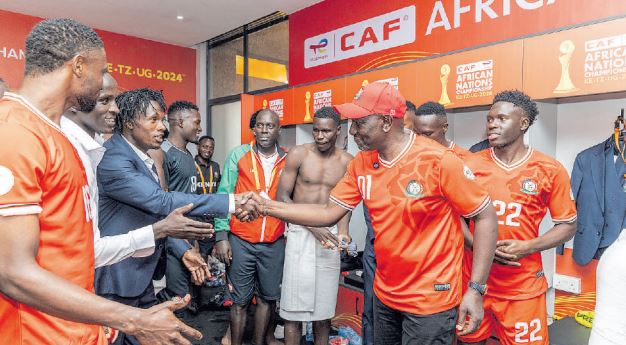
 President William Ruto interacts with Harambee Stars’ players at Kasarani in Nairobi on August 3 /PCS
The week started on a high note, with Kenya’s 1-0 win over the DemocraticRepublic of Congo in the CHAN tournament on Sunday.
As fate would have it, President William Ruto promised a hefty payout to theteam. Come Sunday, the excitement was palpable. And they didn’t disappoint.From field to bench, Harambee Stars were elated, fans celebrated, the mood was electric.
Ruto swiftly honoured his promise to reward the team, reportedly disbursingSh42 million to the players and technical staff.
While this generous gesture inappreciation of our national pride is not in itself a bad thing, it brings atroubling pattern to the surface. Beneath the fanfare lies a troubling pattern inKenyan politics: the reliance on tokenism over tangible, systemic change.
Tokenism in politics is the practice of offering symbolic rewards or superficialconcessions while avoiding substantive reforms. It creates the illusion ofprogress without addressing the root causes of problems.
In Kenya, this oftentakes the form of high-profile cash rewards, ceremonial appointments, andshort-term empowerment programmes—all designed to generate positiveoptics rather than lasting impact.
The President’s payout is just the latest example. While the players deserverecognition, the gesture raises critical questions. Why does the governmentfind millions for a one-time reward while the football infrastructure remains inshambles?
Why do athletes still struggle with poor training facilities, unpaidallowances and lack of post-career support? The same pattern repeats acrossdifferent sectors, where publicity stunts replace policy.
Kenyan leaders have long used tokenism as a political tool. Former PresidentMwai Kibaki was celebrated for rewarding athletes like Olympic championEzekiel Kemboi with cash and land.
Yet, despite these high-profile gestures,the sports industry continued to suffer from chronic underfunding andmismanagement. Stadiums remained dilapidated and many retired athletesfaded into obscurity without pensions or healthcare.
Under Uhuru Kenyatta, the trend continued with initiatives like Kazi Mtaaniand the Access to Government Procurement Opportunities programme. These were marketed as empowerment schemes for youth andwomen, but in reality, offered temporary, low-value opportunities rather thansustainable economic solutions. The infamous wheelbarrow and car-washingmachine donations became symbols of a government more interested inphoto ops than real job creation.
Now, under Ruto, we see a similar approach. The Hustler Fund, whileproviding much-needed microloans, does little to address the structural issuesof unemployment and exploitative lending. It is heartbreaking that a hustlerwould recently get Sh500 for a loan. Under the current economic conditions, itis hard to imagine what substantive business the hustler will initiate with thatamount of money, make profit and pay back the loan within 14 days.
Another disturbing theme is the call to rally behind the government in order tobenefit from developmental projects. Talk of a region or community risking“being left behind” for not toeing the line has no place.
The era of sideliningcertain parts of the country as punishment for calling out the ruling regimeended with Daniel Moi’s reign. Besides, devolution and the Equalisation Fundwere introduced to, among other things, ensure equitable distribution ofresources across the country.
When politicians stage “empowerment programmes” in the full glare ofcameras as opposed to channeling funds to support necessary infrastructurein their areas of representation, it points to a lack of political goodwill and alow level of development consciousness. Worse, few of these programmesmake it beyond a political term, disappearing after elections and leavingbeneficiaries stranded.
With these one-off awards instead of fixing the broken education fundingsystem, training facilities, healthcare, coaching programmes and job creation,the government prioritises short-term gratitude over long-term solutions.
To move beyond tokenism, leaders must shift from symbolic gestures toinstitution building.
First, sports development needs structured investment. Instead of sporadicrewards, the government could allocate consistent funding for stadiums,academies and grassroots programmes. Athletes deserve pensions,healthcare, and career transition support – not just fleeting moments ofrecognition.
Second, economic empowerment must be systemic. Rather than distributingwheelbarrows, policies should focus on affordable credit, industrial parks andskills development. Youth need real jobs, not temporary gigs or exportedlabour.
Third, accountability must be enforced. If the government can spend millionson a single football match reward, why not commit to annual sports budgets,transparent empowerment funds and long-term education financing?
The preference for quick wins over hard reforms must be put aside. Trueleadership is not about handouts and photo ops—it’s about building systemsthat uplift everyone, not just a select few. Until politicians move from symbolism to substance, progress will remain an illusion.
The question is: will we keep falling for the spectacle, or will we startdemanding real change?