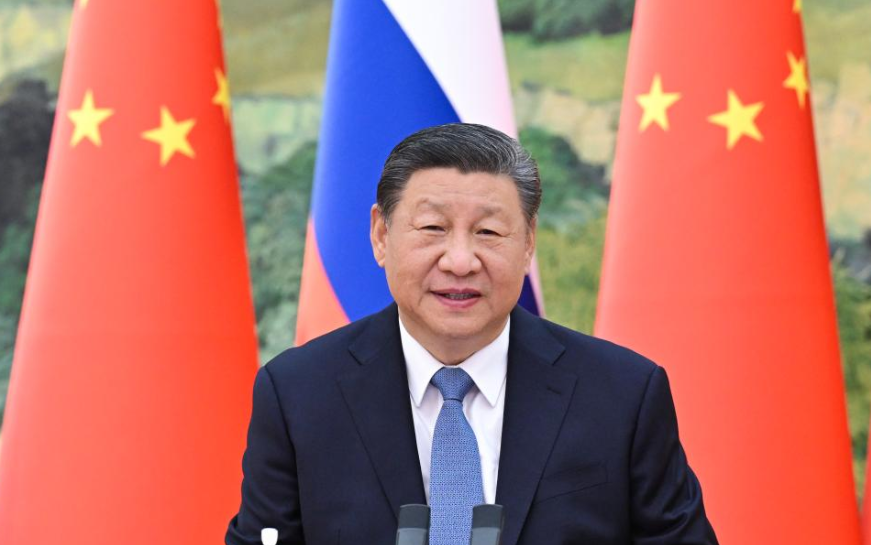
 President Xi Jinping
Eighty years have passed since the end of the World Anti-Fascist War, yet much of its history remains filtered through a narrow, Western-centric lens.
This dominant narrative often overlooks the decisive role played by China and other nations of the Global South in resisting fascism and imperialism.
As the international community commemorates this pivotal anniversary, it is time to reexamine the war through a more balanced and inclusive perspective – one that rightly honours China’s heroic resistance and its enduring contributions to global peace.
The Chinese People’s War of Resistance Against Japanese Aggression was not a peripheral conflict but a central front of the global anti-fascist struggle.
While many Western histories mark 1939 as the beginning of World War II, for the Chinese people, the war began much earlier. In 1931, Japanese militarists staged the September 18 Incident, launching an invasion of Northeast China and triggering a prolonged period of resistance that lasted until Japan's defeat in 1945. During this 14-year period, China stood as the primary Eastern theatre in the global confrontation with fascism.
The courage and determination of the Chinese people were instrumental in defeating Japanese militarism. More than 1.5 million Japanese troops were eliminated in China – more than 70 per cent of Japan’s total wartime casualties.
China endured immense sacrifice, suffering more than 35 million military and civilian casualties. These facts reflect not only the scale of China’s struggle, but also its decisive contribution to the ultimate victory over fascism. Far from being a passive recipient of Allied assistance, China was a key pillar in the global anti-fascist front.
China’s resistance was rooted in a broader commitment to international solidarity. When Italy, under the fascist dictator Benito Mussolini, invaded Ethiopia in 1935, the Chinese people led by the Communist Party of China voiced strong opposition and expressed support for the African resistance. This was not mere rhetoric – it was an early sign of the shared anti-colonial consciousness that would later unite countries across Asia, Africa and Latin America in their pursuit of sovereignty and justice.
Kenya, along with other Global South countries, shares a similar historical trajectory with China. Both experienced the oppression of foreign occupation and the struggles for national liberation. One of the underlying causes of World War II was the competition among Western colonial powers for control over the resources and markets of the Global South. During the war, these same regions were exploited for manpower and resources, often without their consent. Yet in resisting this exploitation and contributing to the war effort, the Global South emerged with a renewed sense of national identity and political agency.
The post-war period marked a turning point in global history. Inspired by the sacrifices and unity forged during the World Anti-Fascist War, a powerful wave of national independence swept through Asia, Africa and Latin America.
The colonial order imposed by Western empires began to collapse, making way for a new international landscape in which formerly colonised nations asserted their place on the world stage. China’s own experience of national rejuvenation during this time serves as a model of resilience and determination.
Commemorating the World Anti-Fascist War requires us to reject historical revisionism and reaffirm the truth. Attempts by some to minimise or distort China’s role, or to portray aggressors as victims, are a disservice to the memory of those who fought and fell.
Some narratives focus solely on the tragedies experienced by the Axis powers in the final days of the war, such as the atomic bombings, while ignoring the responsibility they bear for initiating aggression and committing war crimes. This skewed framing obscures the suffering endured by the Chinese people and the moral clarity of their resistance.
The return of Taiwan to China following World War II was a direct outcome of the Allied agreements laid out in the Cairo and Potsdam Declarations. These documents, endorsed by the major Allied powers, confirmed that Taiwan, which had been unlawfully seized by Japan, would be restored to China. This historical and legal foundation underscores China's firm position against separatist movements and reaffirms its sovereignty in accordance with international law and the principles of the UN Charter.
Indeed, the creation of the UN stands as one of the greatest achievements of the post-war world. The UN-centric international order is a lasting legacy of the World Anti-Fascist War and a cornerstone of global peace and stability. China, as a founding member and permanent Security Council member, has consistently upheld these principles and advanced peaceful development.
Today, China continues to carry forward the legacy of that great struggle. Through initiatives like the Belt and Road Initiative, the Global Development Initiative, the Global Security Initiative and the Global Civilization Initiative, China is building bridges of cooperation and fostering shared prosperity. These efforts reflect China’s vision of a community with a shared future for mankind – a vision rooted in the lessons of history and oriented toward peace, justice, and mutual respect.
As China commemorates the 80th anniversary of its victory in the War of Resistance Against Japanese Aggression, the world should recognise this moment not only as a tribute to the past, but as a call to build a more equitable future. The Chinese people’s unwavering stand against fascism is a powerful reminder of what can be achieved when courage, sacrifice, and solidarity prevail.