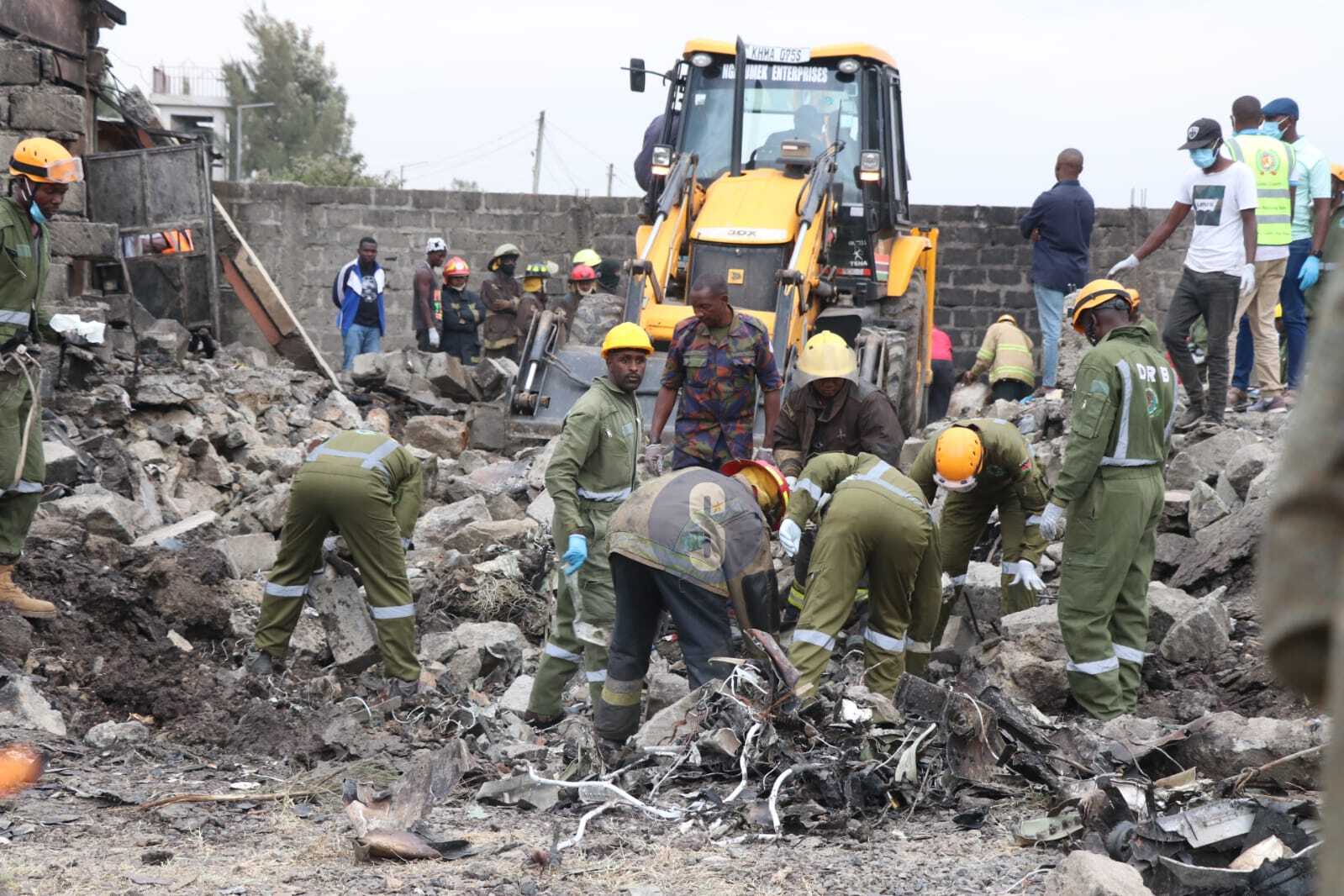
 Aircraft Crash in Mwihoko, Kiambu/LEAH MUKANGAI
When a plane crashes near a populated area—be it a school, residential neighbourhood, or public space—the first people to arrive at the scene are often ordinary citizens rather than trained emergency responders.
In such moments, what you do or don’t do could help save lives, prevent further injuries, or aid official investigations.
On August 7, 2025, Kenyans witnessed such a tragedy when an AMREF Flying Doctors aircraft crashed into a home in Mwihoko, Githurai 45, Nairobi shortly after takeoff from Wilson Airport.
Six people were confirmed dead, four aboard the aircraft and two residents in the house it hit.
The air ambulance had just taken off en route to Lodwar when it lost radio and radar contact only three minutes into the flight.
It later plunged into the Mwihoko estate, bursting into flames, claiming lives and damaging property.
According to the Kenya Civil Aviation Authority (KCAA), an investigation is underway to determine the cause of the crash, led by the Aircraft Accident Investigation Department (AAID).
The incident sparked widespread concern and raised an important question: What should civilians do if they’re first on the scene of a plane crash?
The first and most important rule, based on international and national guidance, is to prioritise your safety. The instinct may be to rush toward the crash site, but doing so without caution could endanger your life.
Aircraft wreckage can involve fire, explosions, sharp debris, or toxic fumes.
At Mwihoko, eyewitnesses reported a loud explosion followed by a fireball. To stay safe, keep a safe distance, move away from any burning wreckage, and avoid entering buildings or areas that may collapse.
The KCAA’s National Aviation Safety Plan advises that untrained persons should always allow professionals to assess risk before approaching crash zones.
Next, immediately contact emergency services. You can dial 999, 112, or 911 from any mobile phone—these are recognised emergency numbers in Kenya, as outlined by the Communications Authority of Kenya (CA).
These numbers are operational countrywide and connect you to police, ambulance, or fire services.
Alternatively, you can reach the Kenya Red Cross via their toll-free line 1199 for urgent assistance.
When calling, the Kenya Red Cross and other disaster response agencies advise that you remain calm and speak clearly.
State that there has been an aircraft crash, describe your exact location using visible landmarks or GPS if available, and highlight any immediate dangers such as smoke, fire, leaking fuel, or injured persons.
During the Mwihoko crash, fast alerts allowed the Kenya Red Cross, police, military personnel, and other emergency services to respond appropriately
The Kenya Red Cross confirmed its teams arrived en route to support recovery and medical efforts.
"A chopper has reportedly crashed in a residential area in Mwihoko, Kiambu County. Response teams are en route to the scene," they said.
It is equally important not to touch or disturb the crash site.
While it may seem helpful to take photos, move debris, or check wreckage for survivors, these actions can compromise safety and investigations.
Unless someone is in immediate danger, such as in a fire, leave everything as is.
Tampering can hinder the work of investigators, contaminate evidence, and violate aviation regulations.
Under the Civil Aviation (Air Accident and Investigations) Regulations, 2024, the site of an aircraft accident is a protected area, and only officers from the AAID or the Aeronautical Rescue Coordination Centre (RCC) are authorised to examine the wreckage.
“Subject to subregulation (2), where an accident or incident occurs, no person shall, unless authorised by the Investigator-in-Charge or the Authority, have access to the aircraft involved, or the contents thereof, or the site of the accident or incident
And no person shall move or interfere with the aircraft, its contents, or the site of the accident or incident, except to the extent necessary to rescue persons, prevent destruction by fire or other cause, or to remove any persons or animals from the wreckage,” the Act states.
If you are trained in first aid, you may assist within safe limits.
This could include reassuring injured survivors at a safe distance, helping guide emergency teams to the crash site, or assisting with crowd control to prevent chaos.
Bodies such as the Kenya Red Cross Society train community members in first aid to empower them to save lives in emergencies before professional help arrives.
Another critical rule is to avoid sharing graphic images or misinformation.
In the age of social media, many people rush to post photos and videos of crash scenes.
However, doing so can be deeply traumatic to families, mislead the public, and obstruct official communication, violating CA online safety guidelines.
It's crucial to wait for verified updates from credible outlets.
Once emergency responders arrive, KCAA advises orderly response coordination and public safety at crash sites.
Law enforcement will likely secure the area quickly to begin investigations.
If later contacted as a witness, be honest and clear in your statements to support the investigation process. Your input could be vital in preventing similar tragedies in the future.
To summarise, if a plane crashes near you: stay safe and keep your distance; call emergency services; avoid touching or moving anything at the site; offer help only if trained; avoid sharing graphic content; and always cooperate with authorities.
The Mwihoko tragedy was devastating, but it also reminded Kenyans of the critical role civilians can play, safely and responsibly, in disaster situations.
What you do in those first moments could help save lives, uphold justice, and ensure that the memory of those lost is treated with dignity.