
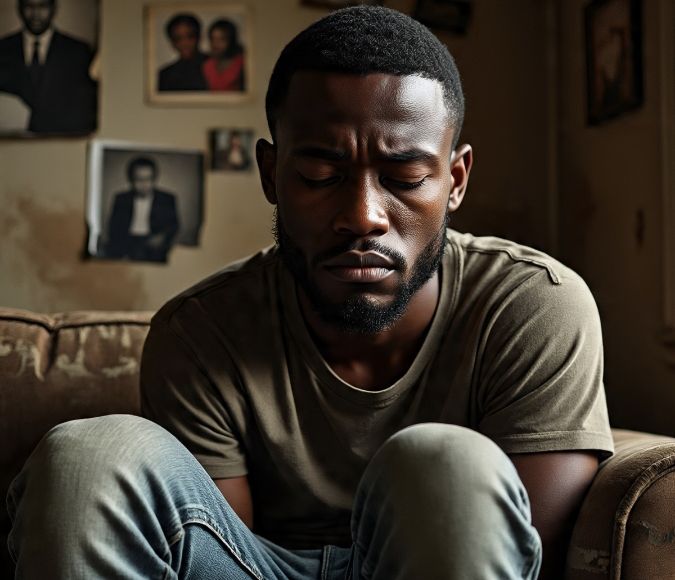
Life was never the same for 25-year-old Ryan Kimani from Ruiru after his father succumbed to high blood pressure.
He was 6 years old when he was abruptly called to the principal’s office on a random Monday morning with the tragic news that his father had passed away.
His mother was no better, as she reeled in the grief of losing the love of her life and the breadwinner of their close-knit family.
Even before they were done mourning their loved one, family wrangles emerged as a section of relatives demanded possession of a house their father had built for them.
Accusations of promiscuous behaviour were levelled against his mother in a spirited attempt to rob her of the right to inherit his father's properties.
The escalation of these family wrangles pushed Kimani and his mother to live in a small metal shanty in Kibera.
With no source of income, Kimani and his mother faced challenging moments as they navigated daily hurdles of life to put food on the table.
His mother initially tried several business ventures, including being a mama mboga, hawker, and clothes vendor in Gikomba.
However, all these pursuits epically failed. His mother eventually ventured into prostitution.
“Because of the nature of her work, my mum never had time for me. I had nobody to talk to and consult on issues affecting me,” he said.
“Left to do as I pleased, a life of making morally ambiguous decisions steadily unfolded. I believe my father would have curbed this immediately.”
A few kilometres from Kimani’s residence, 32-year-old Samson Sakwa paints a picture of what being raised in a family dogged by wrangles looks like.
Even though their family was extremely dysfunctional, he was willing to be caught in the crossfire as long as the family stayed together.
The news that his parents had decided to divorce sent him into hysterics.
For months, he went above and beyond trying to convince his parents to look for an alternative. This was all in vain because, after a year, the divorce was finalised.
At the age of 12, he had to painfully watch his father pack his bags and leave the family home. Being close to his father, this was a stab in his heart.
For months, there was cricket silence from his father’s end. Calls made and text messages sent were ignored.
When his father failed to show up for his 13th birthday, it finally dawned on him that his father had chosen to pursue a different life away from him.
Assuming that his mother was the one who had pushed his father out of his life, his rebellion phase began.
From truancy and talking back to authority figures to coming back home at odd hours of the night, he was headstrong in being the epitome of his mother’s worst nightmare.
By the time he turned eighteen, his rebellion snowballed into petty theft in the Nairobi streets.
“I narrowly escaped an angry mob set on lynching me in town. That is the only reason why I snapped out of my rebellion antics,” Sakwa stated.
For Wilfred Musili, a small café operator in Westlands, growing up without a father made his childhood tumultuous.
He lost his father at the tender age of 3, and he still felt like there was a void in his life.
“Looking at how my friends interacted with their fathers, I could not help but envy them,” he said.
At 11, his mother began dating. Initially, he was elated because this meant that he would finally have a father figure who could fill the void in his life.
However, after a year of his mother dating, he soon realised how naive he had been.
His mother did not take the time to fully assess her dates. An array of men were constantly in and out of their home.
One evening after school, he found a strange man seated in the sitting room. Completely appalled, he later found out that the strange man was his mother’s recent boyfriend, and he had moved in with them.
Trying to make light of the situation, he deluded himself into believing that this situation was temporary. However, after three months, his hope dwindled, forcing him to face the hard reality.
Even more disheartening, this relationship was the genesis of the darkest phase in his life—of physical abuse that he endured for years silently.
“Bearing the brunt of inadequate father figures throughout my childhood, it is no surprise that I decided to steer clear of romantic relationships,” Musili added.
Sophie Wambui, a therapist in Nairobi, avers that a man growing up fatherless can bring a complexity of pain, confusion, and questions about identity and masculinity.
Whether your father left, passed away, or was emotionally absent, that absence leaves a mark,” Wambui said.
She adds that many men tend to bury the wound to appear strong, but unspoken pain doesn’t go away.
She adds that if left unaddressed, it transforms into anger, numbness, perfectionism, or disconnection.
“It is vital to redefine masculinity on your own terms. Without a father, you may have felt forced to figure out manhood by watching what is depicted on television, mimicking friends, or absorbing toxic ideas from older men like ‘never crying’,” she adds.
“If you do not take the time to properly define your masculinity, you will end up going through life as an emotionally unstable person who leaves destruction in his wake.”






