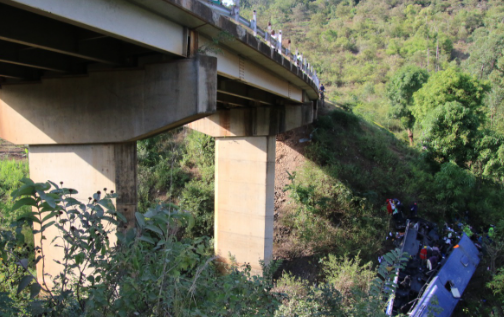
Nithi Bridge in Tharaka Nithi County continues to claim lives, maintaining its grim reputation as a deadly blackspot despite repeated promises from successive governments to take action.
Located along the Embu–Meru road, the bridge has claimed hundreds of lives over the years.
Known among locals and motorists alike as the “killer bridge,” Nithi has become synonymous with tragedy.
Constructed in the early 1980s, the bridge's dangerous design, combined with poor signage, missing guardrails, and inadequate road markings, has made it a recurring site of horror, with accidents that continue to traumatise survivors and devastate families.
Vehicles often speed downhill toward sharp bends and erratic bumps, with little room for error.
The 40-metre drop into the Nithi River below offers no mercy to those who veer off the road.
According to road safety experts, this structural positioning alone is a disaster waiting to happen, and it has, repeatedly.
“Even the most careful drivers are vulnerable here,” a road engineer familiar with the area told the Star.
“The design does not allow for safe braking, especially for heavy vehicles.”
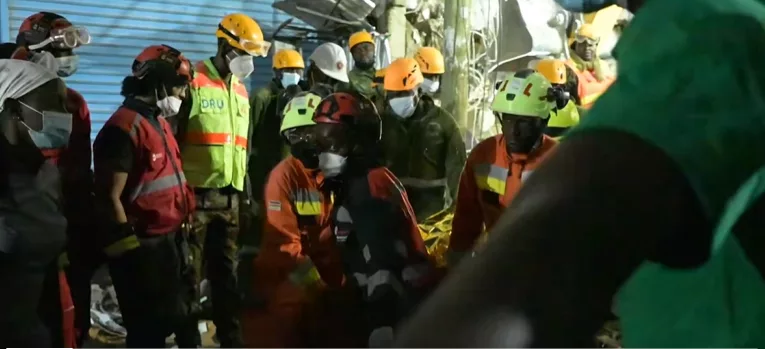
In July 2022, a bus carrying 45 passengers fell off the bridge’s weak guardrails. Thirty-three people died, while the survivors suffered horrific injuries.
The event echoed another national tragedy in 2000, when over 45 lives were lost in a similar accident at the same spot.
More recently, in April 2024, a Nairobi-bound bus rolled over at the blackspot, killing four and seriously injuring eight others.
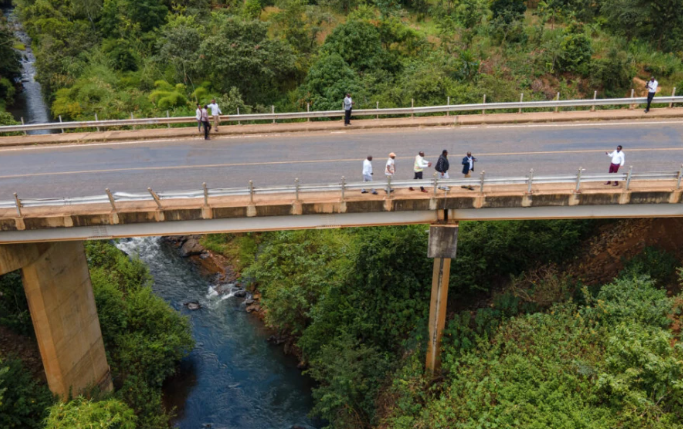
Nithi Bridge
On August 31, 2024, a head-on collision between a public van and a miraa pick-up left 12 people dead, further amplifying public outrage.
Despite these incidents, little action has followed beyond political speeches and declarations.
Successive governments have pledged to fix the bridge, especially after tragedies, but no tangible steps were taken for decades.
From President Daniel Arap Moi’s Nyayo regime, through Mwai Kibaki and Uhuru Kenyatta administrations, the Nithi Bridge has featured more prominently in campaign manifestos than in engineering blueprints.
Each time, leaders have promised to redesign or reconstruct the bridge, especially in the heat of election cycles, only for those commitments to disappear after the ballots are counted.
In 2022, while campaigning for the presidency, William Ruto made a bold promise: fix the Nithi Bridge within 180 days of assuming office.
“You told me that we shall have a fallout about this Nithi Bridge,” President Ruto recalled during a meeting with Tharaka Nithi leaders on August 4, 2025.
“You told me to either fix the bridge or we will fall out. I heard you, and I will fix it.”
In April 2025, the Ruto administration announced a breakthrough: the Kenyan government had secured financing for the Nithi Bridge project through a partnership with China, following the President’s official visit to Beijing.
State House spokesperson Hussein Mohammed named the bridge as one of the flagship outcomes of the trip, noting that China would co-finance and collaborate on the design and construction of a safer, modern bridge.
While this is the most concrete action taken in years, citizens and local leaders remain cautiously optimistic.
Road agencies have identified Nithi as a critical blackspot, yet basic upgrades such as clear signage, better barriers, or well-placed speed bumps have not been consistently implemented.
Experts argue that in addition to redesigning the bridge itself, the approach road needs full re-engineering to reduce the steep decline.
They say proper speed control measures, well-lit signage, and reinforced guardrails should also be part of a comprehensive safety plan.