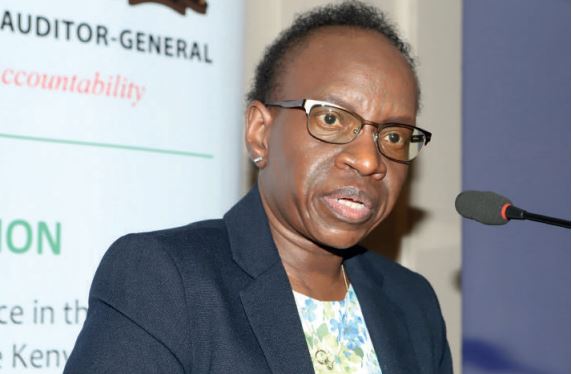
 Auditor General Nancy Gathungu./FILE
Auditor General Nancy Gathungu has revealed key reasons why counties continue to fall short of their own-source revenue targets, contributing to their persistent cash flow challenges.
In her report on County Revenue Funds for the 2022–2023 financial year, Gathungu highlighted a mix of structural weaknesses and systemic inefficiencies that are stalling revenue growth.
Chief among the challenges are outdated revenue collection systems, illegal revenue waivers, obsolete valuation rolls, and reliance on outdated finance laws.
Additionally, counties are grappling with poor revenue management, weak enforcement mechanisms, instances of non-disclosure of collected revenue and irregular spending of revenue.
Despite over a decade of devolution, counties have persistently underperformed in OSR, forcing them to depend heavily on allocations from the exchequer.
The report reveals that some 16 counties had weak revenue collection systems during the year under review, undermining their capability to realise their revenue potential.
“The weaknesses included a lack of an automated revenue collection system where revenue collection was done manually, a partially automated revenue collection system where some modules were missing,” the report states.
In several counties, Point of Sale (POS) machines were faulty, housing inventories were incomplete or missing, and other critical control gaps persisted.
Counties cited for having weak revenue systems include: Tana River, West Pokot, Vihiga, Busia, Migori, Garissa, Mandera, Meru and Embu.
Others are Machakos, Kirinyaga, Kiambu, Kisii, Nairobi, Lamu and Wajir.
Additionally, six county governments—Taita Taveta, Wajir, Uasin Gishu, Garissa, Bomet, and Tana River—collected own-source revenue totaling Sh1.82 billion without enacting the requisite Finance Acts for 2022, in violation of Sections 132 and 133 of the PFM Act, 2012.
This meant they relied on outdated legislation, undermining legal and fiscal accountability.
The Act requires county Finance executives to announce revenue-raising measures annually and for County Assemblies to approve corresponding Finance Bills within 90 days after passing the Appropriation Bill.
The Counties which did not enact Finance Acts include Taita Taveta, Wajir, Uasin Gishu, Garissa, Bomet and Tana River.
Counties also lost billions through irregular waivers.
In just four counties, Sh5.86 billion in waivers was granted without legal backing, in breach of Section 159(1) of the PFM Act, which mandates that any waiver must be supported by county legislation or national law.
The amount comprises medical expenses waivers totalling Sh13.11 million granted by the management of two Level 4 hospitals in two counties.
The other waiver was granted on land rate amounting to Sh5.84 billion granted by the Management of two counties.
The report states that the waivers were granted contrary to the provisions of Section 159(1) of the Public Finance Management Act, 2012.
The provision stipulates that the County Executive Committee member for finance may waive a county tax, fee or charge imposed by the county government and its entities.
However, such a waiver has to be authorised by an Act of Parliament or county legislation.
In Murang’a, Murang’a Level 4 hospital granted waivers amounting to Sh11.83 million, while in Laikipia, the county granted land rates waivers amounting to Sh5.84 billion.
In Kisumu, the county government granted waivers amounting to Sh4.33 million, while in Lamu, Medical charges amounting to Sh1.27 million were waived at Mpeketoni Level 4 Hospital.
The report highlights that 34 counties had uncollected revenue totaling Sh1.58 billion at the start of the year and Sh1.47 billion at year-end—primarily due to long-standing receivables in streams like rent and land rates.
The affected counties are Nairobi, Kilifi, Trans Nzoia, Kajiado, Nakuru, Kiambu, Kakamega, Uasin Gishu, Nyeri, Kisumu, Kitui, Kirinyaga, Nyandarua, Laikipia, Embu, Kisii, Siaya, Bomet and Nandi.
Others are Bungoma, Makueni, Baringo, Elgeyo Marakwet, Kericho, Samburu, Murang’a, Migori, Tharaka Nithi, Busia, Vihiga, Kwale, Meru, Turkana and Lamu.
Some counties have failed to disclose revenue collected, especially in hospitals and liquor license fees.
In what the Auditor General termed a breach of accountability, some counties failed to remit collected funds to designated County Revenue Fund accounts.
Instead, funds were spent at source—especially in health facilities and on liquor license fees—contravening Regulation 63(4) of the Public Finance Management (County Governments) Regulations, 2015.
Meru, Bungoma, Siaya, Homa Bay, Migori, Embu, Makueni, Trans Nzoia, Narok and Garissa spent revenue at source.
A total of Sh2.35 billion collected by facilities and departments in these counties was spent at source, raising serious transparency concerns.
Further, some 21 County Governments used old and outdated valuation rolls inherited from the defunct local authorities to collect plot rents and land rates revenue.
This was contrary to Section 3 of the Valuation for Rating Act (Revised 2015).
The Act provides that at least once in every ten years or such longer period, a valuation is to be made of every rateables property in respect of which a rate on the value of land is, or is to be imposed, and the values to be entered in a valuation roll.
The counties using outdated valuation rolls are Trans Nzoia, Lamu, Taita Taveta, Mandera, Marsabit, Embu, Nyeri, Murang’a, Uasin Gishu, Nandi and Laikipia.
Others are Kajiado, Kericho, Bomet, Bungoma, Siaya, Kisumu, Homa Bay, Kisii, Nyamira and Tana River.
INSTANT ANALYSIS
The objective of County Revenue audits was to determine whether the County Governments receive and manage public funds per the law. Review of revenue statements and financial statements for the revenue recipient and county revenue funds, respectively, revealed accountability gaps that need to be addressed in areas such as budgetary control and performance, financial reporting, compliance, internal control, and governance. Some of the key issues identified in budgetary control and performance included 42 counties experiencing shortfalls in revenue collections, while only four counties exceeded their budgeted receipts. Cases of underutilisation of fund balances were observed in 19 counties, which may have adversely affected service delivery to the public.