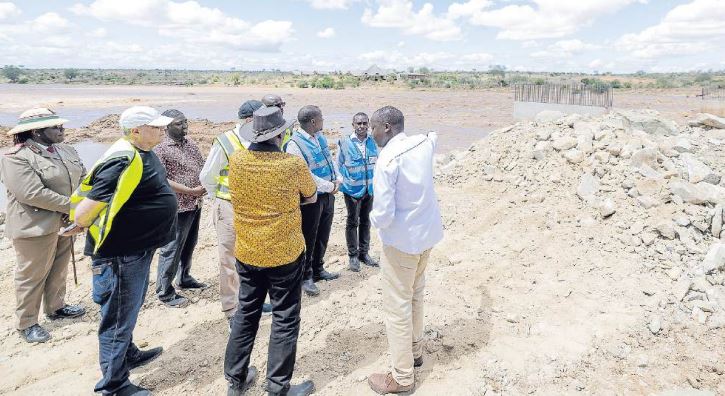
 President William Ruto inspects the Galana-Kulalu food security project in Kilifi and Tana River counties on May 16 /PCS
President William Ruto's administration has breathed new life into the stalled infrastructure agenda, with documents revealing how road maintenance funds have unlocked 580 paralysed projects across the country.
The revived projects, top among them urban interchanges, highways, and rural connectors, were revived through the repayment of Sh175 billion debts owed to contractors.
The documents exclusively in our possession show the full scope of the infrastructure revival that aims not only to reconnect communities but also to reshape the country’s political landscapes ahead of the 2027 election.
Faced with a tight fiscal space, the government opted to pay Sh7 out of Sh25 of the road maintenance levy to fund the projects, mostly inherited from President Uhuru Kenyatta's administration.
It is emerging that Sh65 billion in contractor payments has been released already, with most of them mobilising work crews back to sites nationwide.
It is projected that by mid-August, 80 per cent of the pending bills owed to road contractors will have been cleared.
The Ruto administration has prioritised roads in opposition strongholds in what observers hail as a strategy to weaken opposition narratives of neglect.
Works have resumed on, among others, the Upper Hill-Haile Selassie Interchange, part of which includes an overpass connecting to Ngong Road.
Critical transport arteries are springing back to life, including the James Gichuru-Rironi highway, the Mombasa-Kwa Jomvu corridor, and the long-stalled Kitale-Suam route.
Contractors executing various roads in Banisa, Bute, Kirinyaga, Eldas, Homa Bay, Mandera, Kajiado, Narok, and Kisii towns are also back on site.
A brief by the Kenya Urban Roads Authority shows that construction of Ngong Road footbridges has also resumed, so will the establishment of the Bus Rapid Transit line (Line 5).
The contractor building the James Gichuru-Rironi highway is also expected back on site, and so is the one building the Mombasa-Kwa Jomvu stretch.
The papers further show that work on the Kibwezi-Kitui road has also resumed, as well as the Kitale-Suam, which has remained outstanding for years.
The Mau Mau road network, which is envisioned to open up the Mt. Kenya region, is seeing renewed activity after months of delay.
Documents show that work would resume on the Mau Mau Lot 1B project, Kenol-Sagana-Marua, and Mau Mau Lot 2.
Also featured in the Kenya National Highways Authority-led projects are the Mamboleo-Chemelil road, the Ugunja Nyadorera-Rwambwa and Garissa-Isiolo road, as well as Enziu bridge.
Other roads are underway in Nyandarua, Marsabit, Turkana, Homa Bay (Mbita-Sori road), Kitui, and Kwale—connecting to Kinango, Bamburi, Ngong-Suswa, Soy-Turbo, and Kakamega-Musikoma (Bungoma).
For the Kenya Kwanza administration, the unlocking of the 580 stalled projects would “breathe new life into communities, businesses, and livelihoods that had been left in limbo.”
The resumption of roadworks is also envisioned to bring back thousands of jobs for contractors, engineers, suppliers, and casual laborers.
For many families, it means restored incomes, dignity, and the ability to meet daily needs, sources aware of the deliberations on the road projects say.
“Road resumption will boost local economies, enable access to markets, and reduce post-harvest losses, especially in agricultural counties,” one project assessment reads.
"Where roads were incomplete and impassable, renewed construction has improved access to schools, hospitals, and trading centers.”
The non-payment of the outstanding contractual amounts saw many contractors shut down operations, a situation the state hopes would change with the payments.
The resumption of roads is expected to create thousands of jobs, rejuvenate the construction industry and unlock stalled infrastructure investments.
While critics like Kiharu MP Ndindi Nyoro have dismissed it as a risky financial manoeuvre, it is the opinion of the top decision-making organs that the policy has tangible outcomes.
“These measures have resolved long-standing financial obligations, improved contractor cash flow, and ensured continuity in infrastructure development nationwide,” a Cabinet brief reads.
During a meeting at his Irunduni home this week, Deputy President Kithure Kindiki said the tough economic times slowed down the projects.
“Some of these have stalled since 2019, some of which I lobbied when I was Senate Majority Leader…we are glad the contractor is back on site,” he said.
“All the roads that stalled will now be kick-started. Where the contractors are yet to resume work, they are just on their way. There is no excuse about debts anymore.”
Some of the road bridge projects were among those approved by the Cabinet during its meeting on Tuesday, the DP revealed that among them was the Nithi bridge.
The project is among those President Ruto promised to deliver, and the latest moves show a commitment to deliver tangible results ahead of the 2027 electoral cycle.
The government has also announced the expansion of Kiambu Road into a four-lane dual carriageway with two service lanes on either side.
The major connector for Kiambu and Nairobi commuters would be funded through the China Exim Bank and will cover Pangani-Muthaiga-Ndumberi.
Details show it would also have spurs like Ridgeways, UN Avenue, and access to Thika Road.
“The road will include new interchanges, six pedestrian bridges, bus bays and lanes for non-motorised transport,” a brief on the anticipated expansion reads.
It is envisioned to ease congestion in Nairobi and improve mobility as well as road safety.
While Nyoro questions the financial mechanics, the administration frames the new government policy as an innovative solution to the chronic cash problem.
"It stands as a bold and practical solution to a long-standing challenge," one policy document asserts, emphasising the tangible benefits now reaching communities.
With the dust settling on construction sites across Kenya as bulldozers and tarmac crews return, the revivals are viewed as evolving into campaign messages.
In the face of 2027 on the horizon, the roads are being paved with both economic potential and political calculation. The geographic distribution of these revivals tells its own story.