 Deputy President Kithure Kindiki during the Ruiru constituency economic empowerment engagement at Ruiru Technical and Vocational College in Kiambu county/ DPCS
Kenya’s economic stability relies heavily on the growth and strength of the micro, small and medium enterprises, which generate income for at least 17.4 million people, according to the 2025 Economic Survey by the Kenya National Bureau of Statistics.
With this huge number, there is no question from where the nation’s economic heartbeat emanates, considering that only 3.4 million are formally employed, which translates to only six per cent of the population.
The empowerment drive spearheaded by Deputy President Kithure Kindiki has touched hundreds of groups in more than 50 constituencies so far.
It is meant to give a shot in the arm to those at the bottom of the economic structure. Therefore, it should not be misconstrued as bribery in exchange for political support.
The DP has been clear that this is not aimed at raising money to be shared among individuals. But it is a timely endeavour, being carried out in broad daylight and in front of thousands of people to prevent misconceptions that it favours individuals with immediate cash. In fact, it empowers existing self-help groups or Saccos keen to expand their hustles and businesses.
Millions of shillings have been raised in these events, with the DP calling on those in charge of the groups to ensure prudent investment to benefit their members in the long run.
Of course, the DP is acutely aware the money will have little or no impact if, say, a group receives Sh200,000 and it is split among 200 members, each going home with Sh1,000.
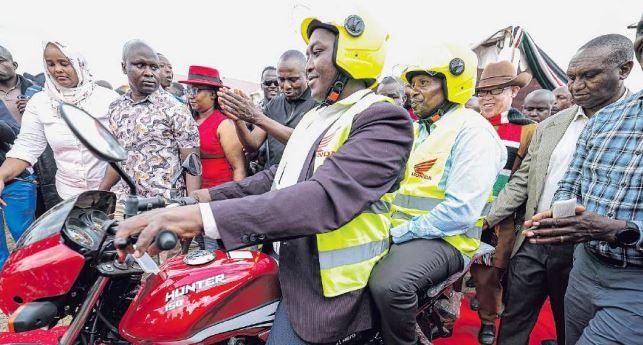
Comparatively, if this amount is invested in two boda bodas, each fetching Sh1,000 a day, it will come to Sh60,000 a month and about Sh720, 000 a year. Chopping expenses, you remain with at least Sh500,000.
This amount could further be invested in more boda bodas or even in Treasury Bills, establishing a firm financial foundation for members to tap into for many years in the future.
Members must reject the desire for quick gratification and must invest in patience for long-term satisfaction so that they earn more from this initiative.
It is wrong, therefore, to reduce this effort to a mathematical calculation by a few misguided people.
The Sh10 million raised in most events cannot be reduced to anything near a tiny Sh64 under the false narrative that being wrongly being pushed by some quarters.
A quick look at the outcome of the empowerment forums held so far clearly shows the financial strength that can be drawn from them.
For instance, following a successful event in Taveta constituency organised by MP John Bwire and attended by DP Kindiki, a number of women’s groups received Sh1 million each to boost their hustles and improve their earnings.
Critically, this empowerment is a complementary gesture because the government is also rolling out structured programmes.
These include the National Youth Opportunities Towards Advancement, which aims to financially aid 70 micro and small enterprises in each of the country’s 1,450 wards. The aim is to give Sh50,000 in grants to each. Together with help from the World Bank, beneficiaries will also receive training on improving their businesses.
There are many other empowerment initiatives, such as the Hustlers’ Fund. Their objective is to make cheap mobile loans easily accessible to those at the bottom, without the default baggage or being taken through many bureaucratic processes.
The recently launched Climate WorX is another grounded initiative that will involve thousands of young people in environment regeneration activities across the country. They will receive weekly wages.
Directly and indirectly, more than 300,000 young people already in the affordable housing project are being empowered through on-site skills transfer to aid their economic earning power later.
Again, it should be made clear that the money raised through empowerment engagements is not free money to be splashed recklessly. It is meant to power up existing businesses and enterprises with the potential for growth, capacity to earn more for the owners, and create more job opportunities at the grassroots.
The empowerment initiative fits perfectly into the realisation of the Beta objectives because the main target is the thousands of MSMEs in need of more capital for better returns.
The writer is a communication specialist, [email protected]