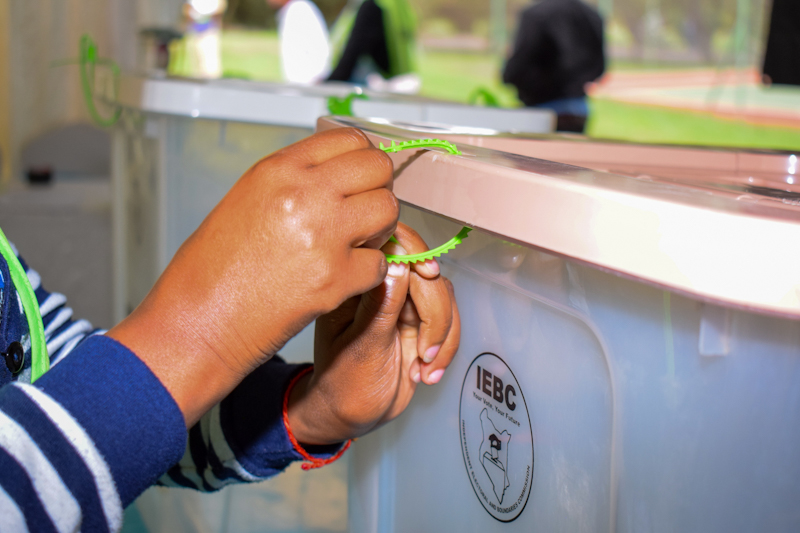
 Voting during election / FILE
The electoral agency is facing a critical dilemma—balancing the practical feasibility of conducting a boundary delimitation exercise with the legal implications of failing to do so.
This comes as the newly appointed commissioners of the Independent Electoral and Boundaries Commission prepare for at least 23 by-elections and the 2027 general election, now just 24 months away.
This test comes amid mounting political tensions as leaders from Kenya Kwanza and the opposition are sharply divided over whether the IEBC should undertake the boundary review ahead of the polls.
Constitutional timelines for boundary delimitation lapsed in March last year due to the absence of IEBC commissioners, throwing the country into what some have termed a constitutional crisis.
Constitution Articles 84(4)(c) and 89 mandate the electoral commission to review constituency boundaries every eight years, concluding reviews at least 12 months before a general election for Members of Parliament.
The last delimitation, or fixing of the boundaries, was carried out in 2012.
Newly appointed IEBC chairman Erastus Ethekon, whose team is still undergoing orientation, said the commission is yet to take a position on the issue as it continues to gather facts.
“We are barely 14 days into office. We need to study the situation thoroughly and make decisions based on concrete information and well-laid plans,” Ethekon told the Star.
He said the commission would keep the public informed at every stage of the process, once a decision is reached.
At the heart of the debate is whether the remaining two years before the next general election are sufficient for such a complex and politically sensitive exercise.
It can benefit some politicians and parties and set back others; it can also split some communities and clans, merge constituencies, or hive off sections of them. The number of constituencies is fixed by the constitution at 290, but their composition could change.
Boundary delimitation is a deeply emotive process demanding extensive consultations, transparency, and public participation to achieve consensus.
Legal experts warn that failure to delimit boundaries could expose the 2027 election to legal challenges. Lawsuits could include petitions seeking to nullify the results on grounds the commission violated the constitutional right to fair representation.
To resolve the impasse, the IEBC has already sought an advisory opinion from the Supreme Court. It asks whether it can legally proceed with delimitation, despite missing the constitutional deadline.
Former Deputy President Rigathi Gachagua’s Democracy for the Citizens Party has applied to be enjoined in the case.
“We have requested guidance on whether the commission can lawfully proceed with the boundary delimitation despite the lapse in the constitutional timeline,” Ethekon said.
He emphasised that once the Supreme Court renders its advisory, the commission will engage relevant stakeholders—including the public—to determine the most appropriate way forward.
Meanwhile, in Parliament, the National Assembly’s Justice and Legal Affairs Committee—tasked with resolving legal uncertainties such as this—has ruled out the boundary review before the 2027 polls.
JLAC chairman George Murugara, a close ally of President William Ruto, said the commission should now focus on preparing for the next polls.
“Boundary review cannot be done before the next election. There is a problem, but it will have to be resolved either by Parliament or the courts,” Murugara told the Star.
He said the review would require significant resources—both time and funding—which are not feasible within limitations of the current electoral calendar.
“As far as delimitation of boundaries is concerned, we have not embarked on that as a committee. We are on the electoral pathway to ensure readiness for 2027,” Murugara said.
Opposition legislators, however, rejected the notion that the commission has completely run out of time for the delimitation.
Makueni Senator Dan Maanzo—a close ally of Wiper leader Kalonzo Musyoka—and Gatanga MP Edward Muriu—an ally of Gachagua—warned that the commission would be treading on dangerous ground if it fails to review the boundaries, practicalities notwithstanding. Both lawmakers are lawyers.
Maanzo said while the commission might be pressed for time, boundary review does not necessarily entail altering boundaries or creating new constituencies.
“We did not, and we do not expect the IEBC to create new constituencies beyond the 290 provided for in the Constitution,” the senator said.
The veteran lawmaker said the review also involves solving boundary disputes and realigning overlapping polling stations, among other issues.
“The IEBC can still do the review. They can check whether there are problems that can be solved. They cannot add the number of constituencies because that would require a referendum [to change the Constitution],” he said.
The Wiper legislator added, “We might have small issues like overlapping polling stations and small boundary disputes, which they can resolve.”
Muriu warned that the 2027 polls risk being nullified should the IEBC fail to undertake the crucial exercise.
The MP said political rights and the right to fair representation are enshrined in the constitution and forms a strong basis for annulling elections.
"The most important thing is that by the time of the 2027 elections, will there be fair representation of every citizen in this country?” he said. “If not, then there will be a transgression of justice, and that can be one of the grounds for petitions in the upcoming election.”
Muriu said the purpose of delimiting boundaries is to provide fair representation, based on the scientific ratios outlined in the constitution.
"If we proceed to the next election without delimitation, there will definitely be unfairness and a violation of the constitution in terms of ensuring everyone is fairly represented,” he said.
"Constituencies cannot change. They remain at 290. What will happen, for example, in Murang’a, where there are two protected constituencies, Kangema and Mathioya? They have fewer people than what is specified in the constitution.”
“The neighbouring constituency of Kiharu has close to 200,000 registered voters. What will happen is that part of Kiharu will be hived off to join Mathioya, and another part to join Kangema, to achieve the representation mandated by the constitution. That way, there will be fair representation.”
However, he said boundary review is a sensitive matter that requires proper community engagement.
"If you move this clan from this area to another, it will have serious implications. Do they want to move? Where people vote by clan, what will happen?” he asked.
In the last review, at least 26 constituencies were protected, although they did not meet the constitutional population threshold.
The constituencies are Tetu, Ndaragwa, Mukurweini, Othaya, Kangema, Bura, Galore, Isiolo South, Kilome, Laisamis, North Horr, Saku, Mbeere North, Lamu East, and Lamu West.
Other constituencies that could lose their status are Mvita, Mwatate, Wundanyi, Voi, Mathioya, Samburu East, Marakwet East, Keiyo North, Mogotio, Vihiga, and Budalang'i.
The new review would either scrap or merge them to meet the required number of 290.
In 2021, the IEBC increased the population threshold from 133,000 to 164,015, further endangering the less populous constituencies, as they would have ceased to exist.
The population quota is arrived at by dividing the national population of 47.5 million by 290 constituencies, the number stipulated in the Constitution.
In February, IEBC chief executive Hussein Marjan ruled out the delimitation before 2027.
Marjan said the agency would be time-constrained to meet the constitutional deadlines for the process.
“Even when the commissioners join in June and those timelines remain, will time be sufficient to complete the process? My estimate is no. It will be very difficult for the commission to work with these timelines,” Marjan said in a television interview.
“Commissioners are supposed to oversee the processes in the field for purposes of public participation, which requires them to go to the 290 constituencies. Even if they are to go once to each constituency, we are already going beyond one year.”
INSTANT ANALYSIS:
In the IEBC formula unveiled in 2021, any county that falls below 82 persons per square kilometre will be considered sparsely populated.
Population density is calculated by dividing the county's total national population by its size of 540.876.3 square kilometres.
The constitution, however, provides for other parameters to be applied in addition to the population quota where necessary.
They include geographical features and urban centres, community of interest, historical, economic and cultural ties and means of communication.