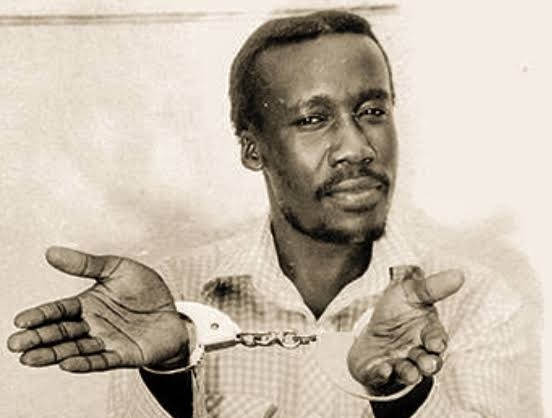
On the morning of August 1, 1982, Kenyans woke up to the shocking voice of a little-known junior air force officer announcing over the national broadcaster that the government had been overthrown.
For about six tense hours, a group of low-ranking Kenya Air Force servicemen led by senior private Hezekiah Ochuka attempted to take control of the country in what remains Kenya’s first and only attempted military coup.
Though short-lived, the rebellion left hundreds dead, scores injured, and forever altered the political landscape of post-independence Kenya.
The attempted takeover exposed deep cracks within the military, rattled President Daniel Moi’s young administration, and gave rise to one of the most repressive chapters in Kenya’s political history.
Here is a detailed account of how the coup began, who masterminded it and how it was crushed.
A coup d’état, or simply a coup, is the sudden, illegal, and often violent overthrow of a government, usually staged by a small group from within the state, such as the military, police, or political elite.
Most coups involve control of communication channels (like state radio or TV), capture of military bases, and neutralisation of loyalist forces.
The success or failure often depends on speed, coordination, loyalty from security agencies, and popular support, or lack thereof.
What triggered the Coup?
The seeds of the mutiny were sown months earlier.
Within the Kenya Air Force, particularly at Eastleigh and Embakasi bases, young soldiers complained of poor working conditions, ethnic favouritism in promotions, and lack of political freedoms under President Daniel Moi, who had taken power following the death of founding president Jomo Kenyatta in 1978.
In March 1982, a group of these soldiers began meeting secretly.
Among them was Senior Private Hezekiah Rabala Ochuka, a technician with no command experience, but big ambitions.
Together with Sergeant Pancras Oteyo Okumu, and others like Corporal Bramwel Injeni Njereman and Lieutenant Leslie Kombo Mwamburi, they plotted to overthrow the government.
Their plan was simple, yet flawed: capture military bases, seize the national broadcaster, force loyalist pilots to bomb State House and General Service Unit (GSU) headquarters, and declare a new government.
How it unfolded
At around 3:00 AM on August 1, rebel soldiers overran Eastleigh Air Base, disarmed guards, and mobilised armed personnel.
Within an hour, they also took control of Embakasi Air Base and several installations in Nairobi.
One of the key targets was the Voice of Kenya (VoK)—now KBC—the national broadcaster.
By 6:00 AM, the nation awoke to the voice of Ochuka on national radio declaring that the military had taken over.
He announced himself as the new commander-in-chief and ordered the release of all political prisoners. A curfew was imposed, and civilians told to remain indoors.
Meanwhile, in Laikipia, rebel pilots were coerced into flying fighter jets to bomb strategic government installations in Nairobi. But the plan faltered.
Loyalist pilots sabotaged missions, refused to cooperate, or outmanoeuvred rebel aircraft in the sky.
In the capital, confusion and looting spread, but resistance was already mounting.
The fightback
President Moi, though momentarily out of sight, was safe.
Command fell to loyal senior officers, especially General Mahmoud Mohamed, then a top army commander.
Within hours, the Kenya Army, supported by the General Service Unit (GSU) and regular police, mobilised and struck back.
Army helicopters fired upon Eastleigh base, loyalist tanks rolled into Nairobi, and strategic installations were recaptured one by one.
By midday, the coup had effectively collapsed.
The aftermath
When the dust settled, Nairobi was eerily quiet but deeply wounded. The official death toll remains contested.
Government figures reported around 200 deaths, but independent estimates place the number as high as 600 to 1,200, including both civilians and military personnel.
Rebel leader Ochuka fled across the border to Tanzania, but was later extradited along with Okumu and others.
They were court-martialed and, in 1987, became the last people to be executed by hanging in Kenya’s history.
Over 900 air force personnel were dismissed, many detained, tortured, or imprisoned without trial.
The Kenya Air Force was disbanded and later reconstituted under new leadership, while the government used the coup as justification to tighten its grip on power.
A few months later, Kenya was officially declared a single-party state, cementing Moi’s authoritarian rule that would last until 2002.
Legacy of the 1982 Coup
To this day, the 1982 coup attempt stands as a dark turning point in Kenya’s history.
While it failed militarily, it gave Moi the political momentum to crush dissent and centralise power.
It also exposed the fragility of state institutions, the role of ethnicity in the military, and the ease with which chaos could erupt in an otherwise stable country.
The role of state media (KBC), the loyalty of the Kenya Army and GSU, and the coordination of air defence all proved pivotal in saving the regime.
The plotters may have ruled Kenya for a few hours on the radio, but their rebellion only served to strengthen the very authority they sought to dismantle.