A fresh political wave that transcends ethnic and regional lines is rapidly gaining momentum, threatening the long-held dominance of President William Ruto and ODM leader Raila Odinga.
Spearheaded by bold, outspoken and assertive youthful leaders, this new brand of politics is shaking up the status quo with fearless conviction and people-centred messaging.
“Yes, the youthful leaders are doing what the young Turks of the 1990s did. That is how the likes of Raila Odinga emerged,” political observer Martin Andati said.
Breaking away from traditional politics rooted in tribal affiliations and regional blocs, these leaders are speaking directly to the hearts and minds of voters—speaking truth to power and articulating shared struggles and aspirations that unite rather than divide.
At the forefront of this political shift are firebrand figures such as Nairobi Senator Edwin Sifuna, Embakasi East MP Babu Owino, Saboti MP Caleb Amisi and Trans Nzoia Governor George Natembeya—leaders known for their unapologetic style, mass appeal and mastery of public messaging. Their boldness mirrors that of Gen Z, whose relentless protests and the ‘Ruto Must Go’ movement have gained significant traction.
While opinion is divided on whether the wave will tilt 2027 politics, their rhetoric is striking a chord with the masses, especially with Gen Z—youthful voters expected to play a decisive role in the next general election.
“They are asserting themselves and creating a niche so that ultimately, they become natural heirs and national leaders in 2027 going forward,” Andati said.
Their skilful articulation of national issues and fearless defiance of entrenched systems has earned them admiration both online and offline.
“Of course, it (their assertiveness) threatens the old order,” Andati said, reinforcing the impact of the new wave on the influence of the traditional bigwigs.
Mark Bichachi, a political analyst, said the youthful leaders are rewriting the country’s politics and could sway the 2027 election.
“This election is about the people, not top politicians and their rhetoric. The people disagree with politicians. Politicians agree with the people,” Bichachi said.
They are eager to shift the focus of elections from traditional ethnic lines to issue-based politics.
“The 2027 election is not just about new young leaders who are against this politician or that. It’s about a crucial election. Two elections in one. One election concerns tribal mathematics and the other pertains to reform favour."
He added, “For once, the people have a say across tribes, or the politicians have their way with tribes.”
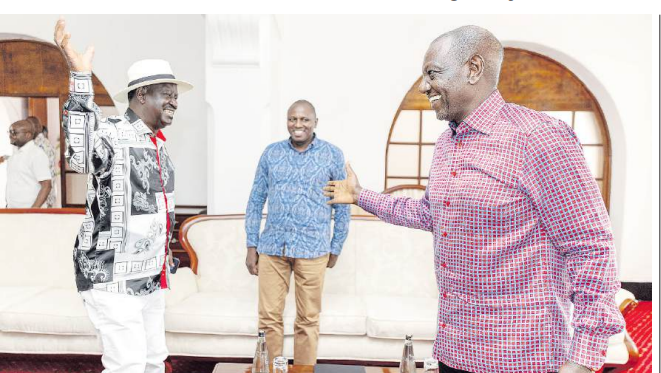
In a rare move, Raila—long viewed as the enigma of Kenyan politics—is now facing an internal revolt within ODM over his recent cooperation with Ruto.
Sifuna, the party’s secretary general, has openly and consistently rejected any alliance between ODM and Kenya Kwanza.
“Even if ODM supports Ruto, he will still lose. William Ruto will lose that election with Raila's support,” Sifuna said in a recent television interview.
He added that ODM should only associate with like-minded political entities that champion sound governance and prioritise the welfare of Kenyans.
Sifuna tore into the Ruto administration, branding it a failed regime responsible for economic collapse, police killings, abductions and state brutality.
Owino and Amisi—both vocal ODM lawmakers—have echoed Sifuna’s sentiments, strongly opposing the political alignment with Ruto.
Owino has vowed to run for the Nairobi governor seat, with or without the support of the party.
“I know ODM cannot give me a ticket. I know that because [incumbent – Johnson] Sakaja was endorsed at the Bomas of Kenya, but I love Baba. I know that I will not be given a ticket, but it doesn’t matter, because I know that it is the citizens who vote,” Owino said.
Recently, Amisi told Raila to pull ODM’s team from Ruto’s government.
“The best way to hold intergenerational dialogue is to remove the remaining, adamant, excited ODM brigade from the government and join us to remove Kasongo,” he said.
In Western Kenya, Natembeya has taken the region by storm with his populist ‘Tawe Movement,’ which challenges the influence of traditional political heavyweights.
He has publicly criticised National Assembly Speaker Moses Wetang’ula and Prime Cabinet Secretary Musalia Mudavadi—both Ruto allies—for failing to lift the region out of poverty.
“Our Luhya leaders have never sacrificed for the people. They ride on opportunism and use their parties to trade the community’s voting power,” Natembeya said last year.
He rejected the notion of community kingpins, accusing some leaders of promoting personality cults rather than service:
“Our people have suffered because of the mistakes of leaders who portray themselves as kingpins and engage in politics of worship. These leaders have done nothing for the community despite years in government and elective positions,” he said.
As their influence continues to grow, this new generation of leaders could reshape Kenya’s political landscape—and steadily weaken the decades-long grip Ruto and Raila have held over their respective strongholds.