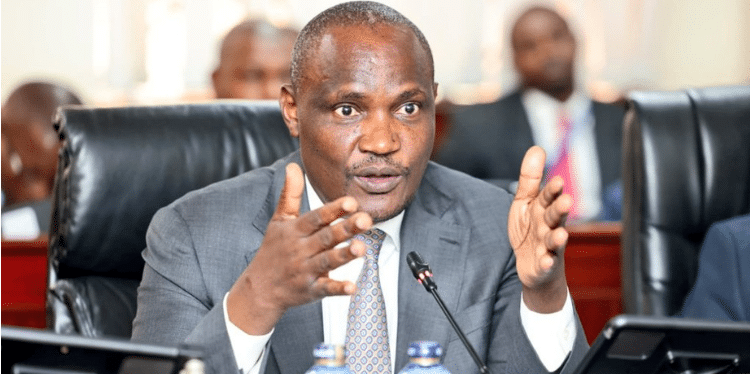
 National Treasury Cabinet Secretary John Mbadi./FILE
In a crackdown on misuse, all government transport assets, including motor vehicles, motorcycles and machinery, will be audited to curb mismanagement.
In a circular dated June 30, Treasury CS John Mbadi directed all accounting officers and county secretaries to submit detailed reports on the ownership and condition of government vehicles and machinery within 60 days.
The move comes amid increasing concerns over lost or misplaced logbooks, unserviceable vehicles abandoned in garages and disputes over rightful ownership.
In the circular to all PSs, CEOs of state corporations, and county secretaries, Mbadi said the problems cited have led to inefficiencies, unnecessary costs and potential misuse of public resources.
"Frequent transfers of transport assets between agencies often result in lost documents, hindering proper management and timely disposal," the circular reads.
It is emerging the vehicle registration documents get lost or are often misplaced during transfer between public agencies, thus hindering their proper management and timely disposal.
“Treasury recognises the existence of these gaps and the consequent risk of loss or misuse of government transport assets that are lacking logbooks,” Mbadi said.
The Treasury CS said unserviceable transport assets are being abandoned in garages or in parking yards, resulting in an added burden to taxpayers in demurrage charges.
Public entities are required to reconcile their records, locate missing logbooks, and report assets without ownership documents and those physically missing.
“All PSs and other accounting officers of public sector entities are directed to acquire logbooks for all government transport assets,” the directive reads.
On acquisition, original logbooks would be in the custody of the accounting officers of the relevant public entity, and certified, sealed copies submitted to the National Treasury or county treasury for record purposes.
“Where an entity is a body corporate, the logbook shall be registered under the name of the entity and shall be in the custody of the accounting officer,” the directive reads.
Principal secretaries and accounting officers have been directed to undertake a reconciliation and report if they have logbooks of all transport assets in their jurisdiction.
For those without logbooks, the public entity must advise the National Treasury, which transport assets lack ownership documents, including motor vehicles.
The Treasury directive also covers leased, project-based and disputed assets, with specific templates provided for each category.
Entities holding unserviceable vehicles must begin the process of acquiring logbooks to facilitate disposal in line with procurement laws, the circular reads.
County governments, state corporations and national agencies are expected to comply promptly, with reports to be submitted to the Treasury for centralised record-keeping.
Public scrutiny of misuse of state resources is increasing.
Auditor General Nancy Gathungu, in a recent report, flagged wanton wastage of government vehicles assigned to state departments.
She cited violations of the law and directives by the Treasury on the usage of cars assigned to state officers.
Her 2022 audit flagged cases of lost vehicles, vehicles lacking logbooks, and others registered in the name of contractors at a number of ministries.
Budget reviews by the Controller of Budget have recently reprimanded the government for excessive spending on travel.
Last October, Treasury drew up a policy setting limits on allowable engine capacity of vehicles funded by taxpayers.
It provides that vehicles assigned to top officials are limited to 2,600cc for sedans and 3,000cc for utility vehicles.
To reduce high costs, it proposed a government fleet management department, domiciled at the Treasury, to oversee the use of government cars.
Efforts at control are not new. When he was Finance minister, former President Uhuru Kenyatta called for a similar crackdown and audit.
He introduced the Volkswagen Passat as the benchmark car for government officials, saying it was suitable, given the need for budget austerity.
On assuming the presidency, his administration said government drivers would be surcharged for operating official cars outside working hours.
The Jubilee administration directed the Government Vehicle Check Unit to impound such vehicles, but cases still arose and continue to do so.
Most government functionaries use V8-powered engines, mostly 4,000cc and above, at the cost of taxpayers. Prado V8s, Mercedes-Benz 580s, Lexus 570s, and Nissan Patrols are common with officials, including those below ministerial level.
Instant analysis
The audit aims to enhance accountability and ensure proper custody of government assets, with the Treasury warning against non-compliance. The audit exercise is part of broader efforts to streamline public sector asset management and reduce the financial burden on taxpayers.