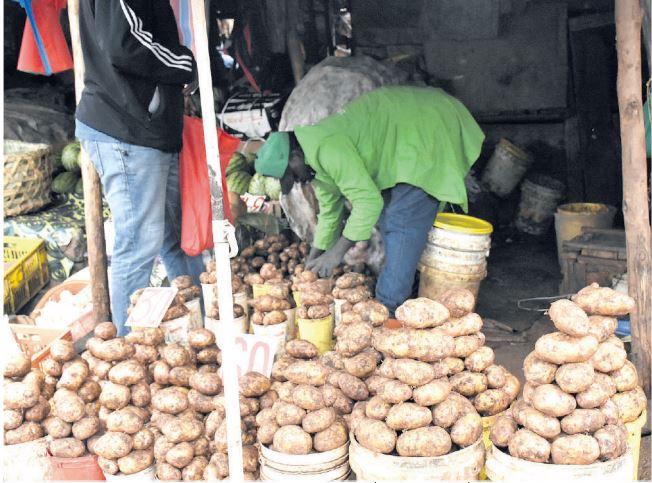
 A potato vendor sells potatoes to a customer at Kangemi Market /FILE
Kenya’s year-on-year inflation fell to 3.8 per cent in June from 5.1per cent in May, marking the lowest level recorded since mid-2020.
This is according to data released by the Kenya National Bureau of Statistics.
This is due to stabilised food and fuel prices, which provide short-term relief to households and policymakers, combating financial vulnerability due to fiscal retrenchment and high debt repayment obligations.
The deceleration in inflation was primarily driven by a slowdown in the rise of food prices, which constitute approximately 32.9 per cent of Kenya’s Consumer Price Index (CPI) basket.
Notably, the cost of maize flour, fresh vegetables, as well as other commodities, had stabilised after local production got the upper hand, owing to favourable weather conditions in key producing regions.
Also, the transport index increased at a lower annual rate due to the stabilisation of the prices of oil on a global basis and variations in subsidising fuel at the local level.
Energy costs, however, are a structural issue since Kenya is an importer of fuels and is subject to fluctuations in foreign exchange.
Lower inflation translates to slower erosion of real incomes, thereby slightly enhancing the purchasing power of households.
This slowdown implies that the income of millions of Kenyans with set wages will be preserved more in terms of the purchase of goods and services, which enhances their well-being in the short term.
However, it is crucial to note that while inflation has eased, prices remain high relative to pre-pandemic levels.
The inflation rate represents a rate of increase in price and not a decrease in absolute prices. Therefore, the benefit of purchasing power is minimal, particularly for the low-income group of consumers who use a higher percentage of their spending on food items and transport.
The ease in inflation to the midpoint of five per cent, the intended range of inflation, i.e. five per cent ± 2.5 per cent by the Central Bank of Kenya, gives the policymakers a breather to concentrate on the recovery of the economy through economic growth, at the same time, control the fiscal risks.
Still, the Central Bank will be abreast of the external risks such as global tensions on the price of oil, the policy changes in the global monetary markets, and domestic tax, which may reinstate inflationary pressures.
There is also an impact of lower inflation on the budgetary expectations of the government. The Kenyan fiscal system depends partly on a consumption tax that increases proportionately to the price and the amount of transactions.
If the inflation rate decreases drastically without a proportional increase in output and volume of consumption, VAT collections may fall short of expectations, which will further increase the pressure on the already tight schedule of fiscal consolidation efforts after the IMF announced the Extended Credit Facility.
This process reaffirms the necessity of a broad scope of economic growth policies as opposed to the situation of tax buoyancy, which is based on prices.
Critical among them is increasing agricultural productivity, diversifying manufacturing and ensuring ease of doing business to bring on board investments that give us taxable means of earning sustainably.
Relaxation of inflation will add to consumer confidence, especially with the moderation of food inflation. This can aid modest recovery in the retail, hospitality and transport industries that are highly reliant on household discretionary income.
Nevertheless, chronic unemployment as well as underemployment (disproportionately among younger people) remains a constraint to total demand and economic mettle.
In addition, as fiscal reforms such as fuel levy restructuring as well as VAT restructuring are still in motion, the threat of inflation spikes in the short term is still there.
Such reforms will be needed to bring the debt back to a sustainable level, but it might reverse the increase in purchasing power that households in the country are receiving through the slowing inflation currently.
Generally, Kenya's decline in inflation to 3.8 per cent in June is a welcome development, reflecting easing cost pressures and potential stability in household budgets.
This marginal increase in purchasing power will ease the worries of the cost of living in the short term, yet there are also structural constraints.
To extend this improvement, fiscal and monetary officials are now forced to place importance on keeping disinflation alive and policies encouraging total economic growth and employment growth.
Otherwise, there are risks of a fixed stag-flationary situation in which it is possible to observe low inflation rates and poor growth as well as low employment levels.
The second half of the year 2025 is being influenced by a cautiously optimistic outlook, which depends on sustained weather conditions, controlled global oil prices, and sound fiscal policies.
For Kenya, taming inflation sustainably is only one step in the broader quest for inclusive economic transformation and resilience in an increasingly complex global environment.
The writer is an Economist and a Business consultant