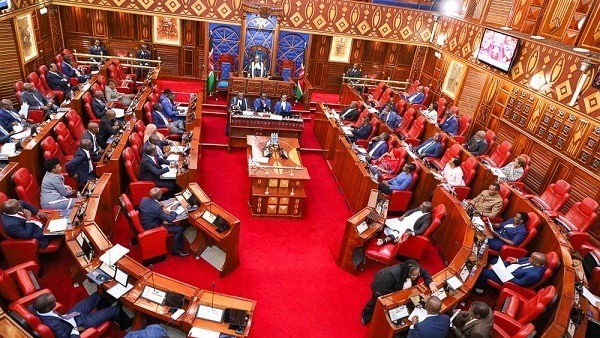
Senators are pushing for sweeping constitutional changes that would elevate the Senate to the status of an ‘upper house’ with expanded legislative and oversight powers.
In the proposed Constitution of Kenya (Amendment) Bill, 2025, lawmakers are seeking authority to approve the national budget, vet constitutional office holders and veto decisions made by the National Assembly.
Published on Wednesday, the Bill also proposes granting the Senate power to originate any piece of legislation, participate in the removal of state officers from office and establish a County Assembly Fund to give members of county assemblies financial autonomy.
“The principal object of the Bill is to strengthen and secure devolution. The draft Bill seeks to provide a framework to achieve this purpose by reviewing the mandate of the Senate and the National Assembly,” the Bill states.
It also outlines a leadership structure for the Senate, including the Speaker, the leader of the majority party and the leader of the minority party.
If adopted, the amendments would significantly strengthen the Senate’s role—mirroring the powers held by the US Senate—and mark a major shift in Kenya’s legislative framework.
Currently, the Senate is largely seen as an ‘idle’ House due to limited powers and the mandate bestowed on it in the constitution.
The Bill is co-sponsored by Senate majority leader Aaron Cheruiyot and his minority leader counterpart, Stewart Madzayo.
It was drafted by a team of top legal minds in the House led by Justice and Legal Affairs committee chairman Hillary Sigei (Bomet) and senior counsels Okongo Omogeni (Nyamira) and Tom Ojienda (Kisumu).
The Bill comes months after the lawmakers secured the endorsement of opposition chief Raila Odinga, whom they recently hosted in Parliament.
“We would like to see our Senate work like that of the US – give it proper powers and responsibilities,” Raila said in May, amid applause from the lawmakers who flanked him.
The Senate’s proposed Bill is likely to ignite fresh tensions between the two Houses of Parliament.
Already, the National Assembly has passed a competing constitutional amendment Bill, anchoring several funds—including the controversial National Government Constituency Development Fund (NG-CDF) and the Senate Oversight Fund—and sent it to the Senate for consideration.
Senators have since threatened to reject the National Assembly’s version, citing constitutional concerns over the legality of the NG-CDF.
Whether the two Houses can reach a consensus remains unclear, as the Bills must be passed by both chambers.
The Senate Bill proposes that all legislative authority at the national level be exercised jointly by the National Assembly and the Senate, with legislation allowed to originate in either House.
“A Bill may be introduced by a member or committee in the National Assembly or the Senate,” the Bill states.
In another radical proposal, a Bill allocating revenue to the two levels of government may originate in the Senate, but the National Assembly may propose and pass amendments to it.
Conversely, an appropriation Bill may originate in the National Assembly, but the Senate may propose and pass amendments to it.
“Where a receiving House amends an allocation or an appropriation Bill, the originating House may veto the amendments by a resolution supported by at least two-thirds of members,” it says.
The Bill mandates that the Treasury Cabinet Secretary submit to Parliament estimates of the revenue and expenditure of the national government for the next financial year to be tabled in Parliament.
“Before Parliament considers the estimates of revenue and expenditure, committees of the respective Houses shall discuss and review the estimates and make recommendations to the Houses,” the Bill states.
Currently, the constitution bars the Senate from handling money Bills—legislation dealing with taxation, public borrowing and expenditure—reserving that role exclusively for the National Assembly.
Senators argue this has significantly diminished their legislative role.
The new Bill seeks to change that, asserting that Parliament as a whole—both the Senate and National Assembly—should oversee national revenue and its expenditure by government agencies, state organs and public entities.
The Bill states that Parliament–the Senate and the National Assembly–exercises oversight over national revenue allocated to the national government, state organs and public entities and their expenditure.
Further, the Bill empowers the two Houses, as opposed to the National Assembly alone, to enact legislation providing for the procedure of removal of state officers at the national level.
The Senators are also seeking powers to appropriate funds to independent officers, including that of Controller of Budget and the Auditor General.
Further, the lawmakers want to take part in the vetting of the chairperson, vice chairperson and members of the Public Service Commission and all the other constitutional and independent offices, as well as in their removal.
“The Bill also proposes to amend Articles 157, 215, 228, 229, 233 and 250 of the constitution to assign the responsibility of approving or vetting of various state officers to both Houses of Parliament,” it states.
“The Bill proposes to amend Article 251 to assign the process of removing from office a member of a commission or of a holder of an independent office to both Houses of Parliament.”
In a bid to entice the MCAs, the Bill establishes a County Assembly Fund in each of the devolved units.
“The Fund shall be used for administrative expenses of a county assembly and such other purposes as may be necessary for the discharge of the functions of a county assembly,” the Bill says.
Currently, assemblies lack financial autonomy and are entirely dependent on county treasuries.
INSTANT ANALYSIS
The operationalisation of the constitution, particularly devolved governance and bicameralism, has seen many successes but has also brought to the fore a number of challenges of constitutional design and architecture that require reform so as to strengthen and secure the devolved system of government and for greater unity and harmony of the constitutional dispensation. The principal object of the Bill is to strengthen and secure devolution. The draft Bill seeks to provide a framework to achieve this purpose.