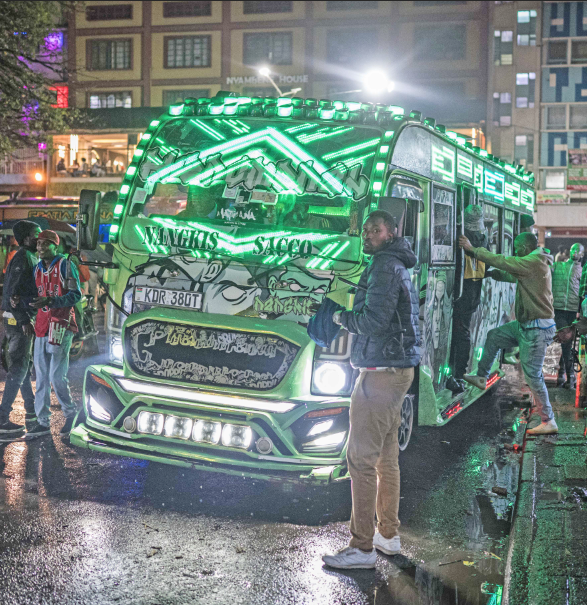
Braving the cold evening, I stood patiently at Archives with
one motive in mind—boarding a nganya (pimped up matatu). My daily commute to
and from work had become too monotonous for my liking.
What better way to spice up my evening commute than
relishing the rich matatu culture in Nairobi.
Since it is rush hour, multitudes of commuters have gathered
around different sections of the stage. Paired with the blaring lights from
different nganyas and kamageras (touts) boisterous calls for people to board
specific matatus, the atmosphere is buzzing.
It is a reenactment of The Hunger Games for the matatus as
they try to get the attention of commuters standing on the side of road.
Rhythmic toots ringing in the air, a spectacle of flashing
neon lights, drivers rocking the matatus up and down skillfully—nothing is
spared. In the midst of this electric scene, however, one particular nganya
with white and blue neon lights piques my interest, the Detroit 313.
The white cloud of smoke emitted from the matatu’s smoke
machine immediately resulted in a beeline of commuters heading to the matatu.
Before boarding this matatu, the graffiti on the exterior of
this bus is sure to spark your intrigue. From the jump, it is apparent that the
muse for the graffiti on the matatu is Detroit Lions, an American football
team. On the side of the matatu, the name Detroit is in bold calligraphy,
making it hard to miss. At the front of the matatu, the number ‘313’ is also in
bold calligraphy, paying homage to the city’s area code for the Detroit Lions
football team.
The colour palette of the graffiti on the exterior is a
mixture of Honolulu blue, white, black and silver, just like the colours used
by the Detroit Lions football team. These shades harmoniously create a cool
appeal that attracts even more commuters. Moreover, in the background of the
graffiti, there is a faint display of American football players in Detroit
Lions jerseys hitting homeruns in a stadium.
However, even more notable is the coloured graffiti at the
back of the matatu of one of the most popular players in Detroit Lions, Calvin
Johnson. Fully adorned in his number 81 jersey, Calvin Johnson is beaming with
excitement as he holds the duke in the graffiti. The white helmet strategically
placed on top of the nganya is what brings the whole graffiti look together.
Unlike other conductors who dress out of convenience more
than anything, the tout of this nganya stands out. Even though he has worn the
red tout uniform, a few tweaks elevate his overall look. The silver chain on
his neck and his right stud earring exudes a hip and trendy fashion sense.
Furthermore, his neatly tied dreads is a far cry from the shabby look expected
on a dread head.
Instead of the usual antics of other conductors of forcibly
dragging people to matatus, this tout just warmly approaches customers at the
stage with an enticing smile that makes him look trustworthy.
As soon as you board the nganya, you are greeted by an array
of screens all over the interior of the matatu. There are nine big screens in
the deck, three on both sides of the upper interior, one in the middle of the
matatu’s ceiling, one in the back and another one in the front. In this deck,
the screen in the middle of the matatu’s ceiling is the biggest. All these
screens work hand-in-hand to create an optical satisfactory experience for
passengers as they watch the music videos of the songs being played. The
passengers sitting next to the driver at the front are however the ones who
truly savour the visual experience at a closer range through the several
screens installed on the dashboard of the matatu.
When the nganya is at full capacity, the driver amps up the volume of the music. The initial bass sound from the countless high-quality speakers hits you like a wave popping your ears within seconds. Deep vibrations from the speakers are strong enough to create an illusion of an intimate live music concert for the passengers. Additionally, the strategic placement of the speakers in the matatu, achieve a surround sound feel that further improves the music experience for passengers.
Initially, I assumed the cost I would incur as fare would
burn a hole in my pockets. However, the fare was surprisingly fair with the
ride from town to Ongata Rongai being Sh100. For such a thrilling passenger
experience, the money spent on fare is without a shadow of doubt worthwhile.
Looking at the other passengers in the nganya, I do not seem
to be the only one savouring my experience. The demographic in the matatu is
comprised of fairly young people understandably and the animated conversations
and gummy smiles are a stamp of approval from them. A journey that would
normally bore me into deep slumber felt short-lived by the time I got to my
destination.
It is no secret that the matatu culture has steadily earned
its place in the hearts of many Kenyans over the years. A culture that was
initially dubbed as rebellion, has now transformed to something that brings
Kenyans from all over the country together.
Ahead of the contentious Beba Awards set for November 30
this year, several matatu owners have been going above and beyond to emerge at
the top in this competition. Through a competition that awards the most
revamped and eye catching matatus with graffiti in Nairobi, there has been a
sudden surge in the launch of newer matatus in the streets. Just launched in
June 2025, Detroit 313 is one of the matatus giving other PSVs a run for their
money.
Speaking to the Star, Derrick Kimani says, “As a matatu
enthusiast, I am proud of the great strides that the matatu culture is taking
to further progress. Matatu projects like Mood recently launched on July 19,
are a testament to the extent matatu owners are willing to push boundaries,
with the intention of further improving the experience for passengers.”
Noel Ndwiga, a Gen Z Nairobi resident, adds, “As a young person, nganyas are a breath of fresh air after dealing with stress at work. Given the choice, I would happily subject myself to the long lines of commuters waiting to board nganyas rather than boarding a matatu with no graffiti and trendy music. Boarding the latter would just be an anticlimactic end to a stressful day.”