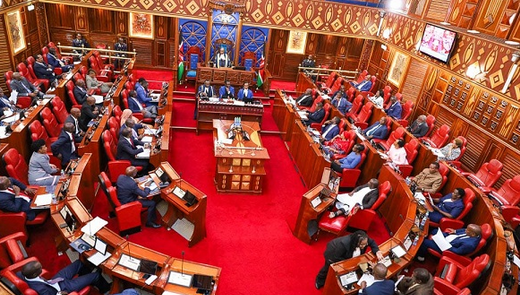
MPs have launched a fresh effort to amend the constitution to enforce the two-thirds gender rule in the National Assembly and Senate.
The proposed changes, spearheaded by Deputy Speaker Gladys Boss alongside Dagoretti North MP Beatrice Elachi and Laikipia Woman Representative Jane Kagiri, seek to modify Articles 90, 97, and 98 of the Constitution.
The Constitution of Kenya (Amendment) Bill, 2025, aims to introduce gender top-up seats after general election to ensure compliance with the constitutional requirement that no more than two-thirds of parliamentary members be of the same gender.
“The principal object of the Bill is to ensure the membership of the National Assembly and Senate conforms to the two-thirds gender principle provided for in Article 81 (b) of the Constitution,” the Bill’s memo reads.
If passed, special seats will be created to bridge the gap and “to ensure that the gender principle is realised in Parliament.”
“The number of special seats shall be determined after the declaration of results of a general election,” the proposed law reads, adding that the top-up would be “necessary to ensure no more than two-thirds of the 290 elected MPs are of the same gender”.
It further proposes that the seats be allocated proportionately to the number of seats won by a political party in the general election.
The proposed amendment includes a sunset clause, limiting the top-up mechanism to 20 years, with a possible 10-year extension.
The drafters argue that this timeframe will allow sufficient progress toward gender parity in elected offices.
“It is expected that by that time, enormous gains will have been made concerning gender parity in elected members of Parliament,” the Bill’s memo reads.
However, extending the provision beyond the initial period would require approval from at least 233 National Assembly members and 31 senators.
The initiative mirrors one recommendation from a task force that was formed to tackle the gender question under the National Dialogue Committee (Nadco) process.
The task force had recommended the top-up to be implemented in the current Parliament, but a House team (Justice and Legal Affairs Committee) said ‘the overly ambitious proposal’ would be hard to implement immediately.
When an election doesn’t achieve the required third, parties would be required to fill the additional special seats, that is, if the Bill sails through.
In the current proposal, the missing gender is to be topped up using zebra party lists after every election.
Currently, women hold only 81 seats in the National Assembly and 20 in the Senate, following Gloria Orwoba’s removal recently.
Men, on the other hand, hold 264 seats in the National Assembly, being 76 per cent, against women who constitute 23.2 per cent, instead of the ideal 33 per cent.
The current Senate has 46 men against 20 women, hence at least three are required for the balance to be achieved.
Where no woman is elected in the National Assembly, 104 would be nominated; seven in the case no woman is elected in the Senate.
Even as the proponents push the amendments, and despite their intentions, the Bill faces significant hurdles.
Parliament has failed at least five times to realise the required vote of 233 MPs to enact legislation enabling the two-thirds gender principle.
This culminated in former Chief Justice David Maraga advising then President Uhuru Kenyatta to dissolve the 12th Parliament for breach of the gender rule.
The debacle is long-drawn, dealing a blow to persons with disability, marginalised groups and minorities.
Legal challenges may also arise, particularly concerning the amendment process.
The Bill is proposing that the amendments would be effected through a parliamentary initiative.
“The Bill shall require passage by both Houses of Parliament under Article 256 of the Constitution,” the memo adds.
Constitutional expert and Rarieda MP Otiende Amollo argued that the proposal cannot be implemented as proposed.
“The changes require a referendum as it relates to the sovereignty of the people,” the lawmaker said.
He argues that the changes “indirectly affect the functions of Parliament by enlarging the membership through top-up seats”.
Financial implications of the additional seats, which the drafters have acknowledged, further complicate the proposal, in the face of the country’s already stretched wage bill.
Presently, the costs of salaries for 349 MPs—excluding allowances—is Sh832 million. Adding more members could push the expenditure close to Sh1 billion going by the current numbers.
Besides the basic pay, MPs also get allowances and several other benefits, which remain a cause of concern for those keen on a lean public service.
INSTANT ANALYSIS
As the debate unfolds, the Bill’s fate hinges on political consensus, legal interpretation and public sentiment on gender equality versus the fiscal space. Whether this latest attempt will succeed where others have failed remains uncertain, but it reignites a long-standing conversation about representation and the constitutionality of the country’s legislature.