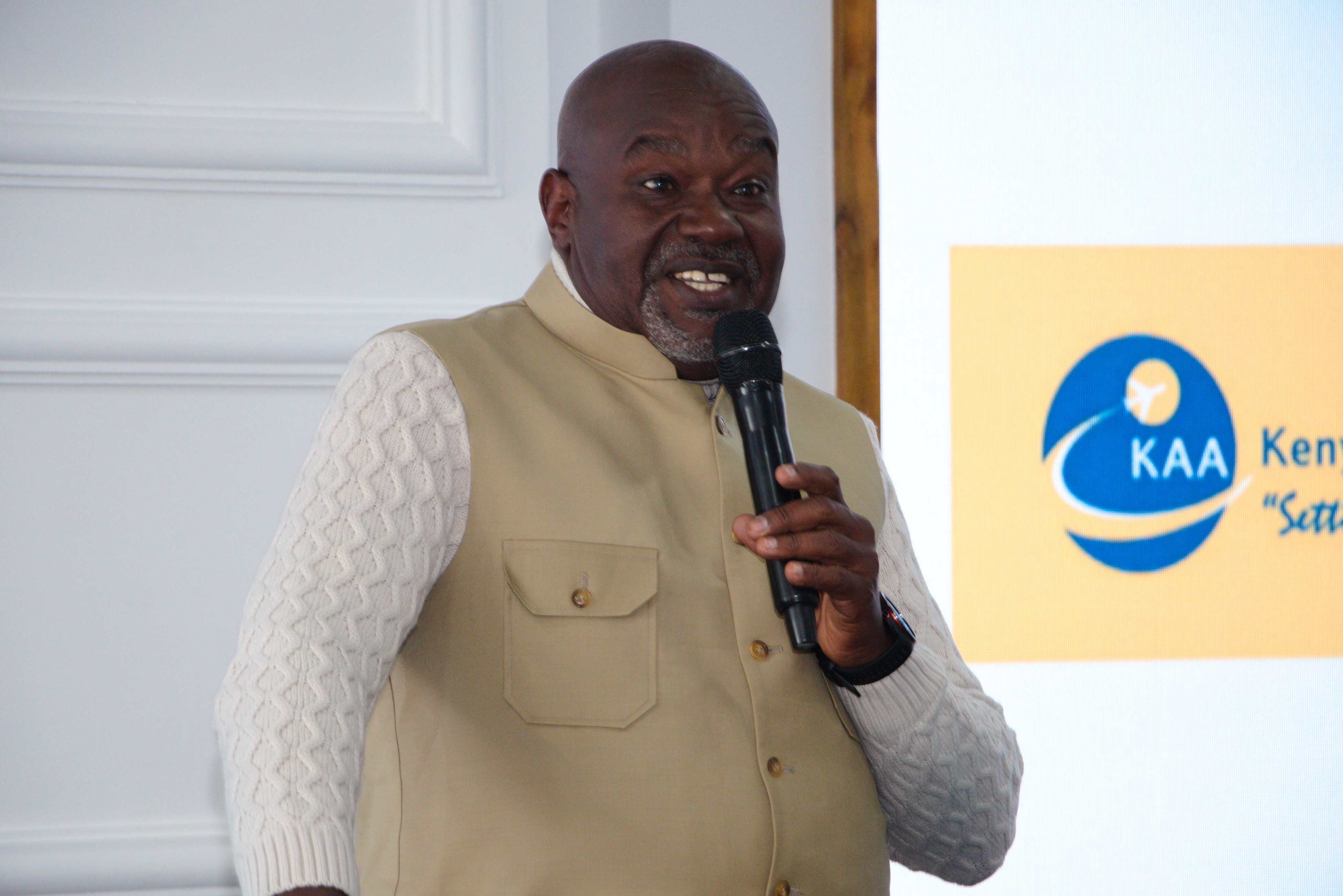
KAA Board Chair Caleb Kositany during the engagement with players in the aviation sector./HANDOUT
The Kenya Airports Authority (KAA) is pushing ahead with plans for a major upgrade of Wilson Airport, one of East Africa’s busiest domestic air transport hubs, even as concerns rise over unchecked high-rise buildings and land encroachment.
The airport, which is mainly used for domestic flights, has lately come under scrutiny over the quality of its runway and mushrooming private developments on its land.
During a high-level stakeholder engagement held at the airport, senior officials from KAA, the Kenya Civil Aviation Authority (KCAA), and the Kenya Association of Air Operators (KAAO) discussed the proposed rehabilitation of both runways and associated infrastructure, amid concerns over safety, capacity, and regulatory compliance.
The discussions come as high-rise buildings and other developments continue to encroach on the airport's safety buffer zones—contrary to aviation laws and international safety standards.
According to KAA an aerial inspection of Nairobi’s skyline has been conducted to assess the extent of encroachment and its impact on airspace safety.
“This inspection demonstrates our shared commitment to rehabilitating and modernising Wilson Airport to meet present and future demands. We are focused on delivering infrastructure that matches Kenya’s ambitions as a regional aviation leader,” said KAA Board Chair Caleb Kositany.
Wilson Airport handles over 120,000 aircraft movements annually and is a key node in Kenya’s domestic and regional aviation network.
However, its location within a rapidly urbanising part of Nairobi has in the recent past been a concern among aviation experts over increasing risks to flight operations.
Without disclosing the fate of the properties that have encroached on the land, KAA said the rehabilitation project will proceed in close coordination with aviation regulators, local authorities, and private operators to ensure compliance with safety standards and sustainable urban development practices.
The scope of the upgrade includes runway rehabilitation, expansion of airside operations, and improved safety infrastructure.
A 2024 report showed that state-owned airports are facing a Sh260 billion shortfall in development funding to bring their operations up to date.
Half of the amount ($1 billion; Sh130 billion) is projected to be what the country's main airport, Jomo Kenyatta International Airport (JKIA) requires to become a competitive hub in the region.
In the Aviation Policy for Kenya, a document that received Cabinet approval in 2024, the government said it would explore different financing and funding options to accelerate airport expansion.
"It is considered that current infrastructure is not adequate to handle passenger and cargo operations at most airports. In this manner, it is estimated that KAA's aerodrome network requires an investment of approximately $2 (Sh258 billion) for the mentioned period, including both expansion/compliance as well as major maintenance and replacement investments," says the aviation policy.
"Jomo Kenyatta International Airport is the main driver of the mentioned investment plan, accounting for approximately $1 billion (Sh129 billion) to increase its current capacity and be able to accommodate the forecasted demand."
The meeting brought together KAA Board Chair Caleb Kositany, KCAA Board Chair Brown Ondego, KAAO Vice Chair Jimmy Kibati, and senior officials from the Nairobi City County Government.
Also present were KAA Acting Managing Director Mohamud Gedi, KCAA Director General Emile Arao, and KAAO CEO Liz Aluvanze.