
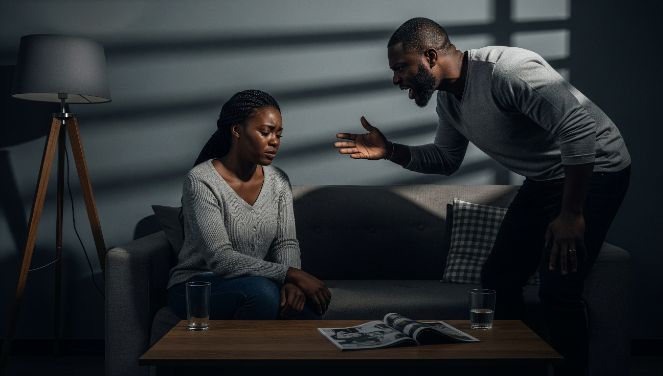
Many a times, the knee-jerk reaction to a victim opening up about the abuse experienced is looking for physical proof.
A black eye, cuts, discoloured bruising, scars- anything to make you ascertain the true extent of the abuse endured.
After clarifying that the abuse is emotional, most victims are shut down, with their abuse being dismissed as trivial.
The society often paints such victims as blatant attention seekers who should just get over their pain and move on.
If you asked Patricia Mumbi a year ago if she had found her true love, the answer would be affirmative.
Coming from a turbulent family, Mumbi’s boyfriend had healed wounds that he had not caused.
For three years, her boyfriend had gone above and beyond to prove to Mumbi that he was never going to abandon her. By the third year of dating, Mumbi no longer operated on a fight-or-flight mode in the relationship.
However, the world turned upside down for Mumbi after a heated argument one evening. The genesis of this argument was the topic of having children.
Mumbi’s boyfriend insisted that he had waited long enough for Mumbi to be ready. When Mumbi expressed that she did not see herself having children anytime soon, all hell broke loose.
Maliciously, Mumbi’s boyfriend said that he regretted investing his time in someone who was too broken.
Completely taken aback, Mumbi swept this incident under the rug, attributing it to the heightened emotions.
However, the constant emotional abuse that she endured for a whole year following this incident made her realize how convoluted her assumption was.
“The crazy thing about emotional abuse is that even after leaving, the degradation from the relationship shackles you for a long time. The one person I thought the world of morphed into a person who dissipated my will to live. Therapy dug me from this pit,” Mumbi says.
Speaking to The Star, Ben Lukase insists that the society is misguided in its belief that victims of emotional abuse can only be women.
His experience is a true testament to this. When Lukase met his ex-girlfriend at the gym he frequented, it felt like fate.
He still remembers how she looked like a deer in headlights as she tried to figure out the gym equipment.
Finding her adorable, Lukase offered to help with her exercise. What started as occasional gym sessions ended up blossoming into a beautiful relationship.
Lukase still rues the day he asked her to be his girlfriend. It was like a switch flipped. Within the first weeks, Lukase realized that he was in for a tough ride.
Her soft-spoken and bubbly personality was instantly replaced by acute rage.
Despite Lukase’s efforts, nothing he ever did seemed right in her eyes. When Lukase shared his predicament with his ‘boys’, Lukase was told that the girlfriend was just being ‘dramatic’, like all women are.
According to them, the girlfriend’s ‘drama’ was the price he had to pay for having a relationship.
“By the time I realised that I was being emotionally abused, I was in too deep. The constant jabs and degradation had slowly stripped down my masculinity beyond recognition," Lukase says.
"When I broke up with her, I couldn’t bear telling my ‘boys’ that it was because of being a victim of emotional abuse. They would have simply laughed mockingly in my face,” he details.
For several years, Grace Nyokabi had excused the emotional abuse in her relationship.
Even though the abuse began from the first month of dating, Nyokabi was not alarmed because it felt less damning.
From when she was a toddler, Nyokabi got a front seat to the overt physical abuse that her mother endured at the hands of her father.
Her perception from a young age was tainted to believe that men are naturally aggressive.
Therefore, when the emotional abuse started, Nyokabi did not initially see the need to leave. In her mind, Nyokabi consoled herself that at least it was not ‘real abuse’.
The emotional abuse that began with a few insensitive remarks snowballed to profound degradation. From the moment Nyokabi woke up, her boyfriend would begin the parade of abuse.
Her slim body that had once been praised by him suddenly became off-putting. Her dressing, hair, cooking- nothing Nyokabi ever did seemed enough for the boyfriend.
Days on end, the boyfriend drilled in Nyokabi’s mind that she was more of a charity case that no one would ever love.
“In my naivety of initially opening up to him about my traumatic childhood, I loaded his gun. Even when I decided to break up with him, I had not yet fully accepted my emotional abuse. It sounds insane right now, but at the time, I felt like I was a weak woman. After all, my mother had endured so much more, and she still stayed,” Nyokabi recounts.
According to Gilbert Wanjala, a therapist, you may not think you are being abused just because you're not being hurt physically.
Nevertheless, emotional and verbal abuse can have short-term and long-lasting effects that are just as serious as the effects of physical abuse.
Emotional and verbal abuse may include insults and attempts to scare, isolate, or control you. It is also often a sign that physical abuse may follow. Emotional and verbal abuse may also continue if physical abuse starts.
Wanjala also explains that emotional and verbal abuse may manifest in a plethora of ways. Some abusers start out behaving normally and then begin abuse after a relationship is established.
Others may purposefully give a lot of love and attention, including compliments and requests to see you often, at the beginning of a relationship.
Often, the abuser tries to make the other person feel strongly bonded to them, as though it is the two of them “against the world.
“Do not let society fool you into thinking that your emotional abuse is trifling. At the end of the day, abuse is abuse," Candidly, Wanjala emphasises.
"The moment you feel like you are being emotionally abused, leave immediately and surround yourself with a strong support system. Do not allow yourself to be part of the statistics of victims who were gaslighted into staying.”






