Details have emerged of a deepening financial crisis at the Nairobi City Water and Sewerage Company, with the latest audit report revealing that the utility firm is operating deep in the red.
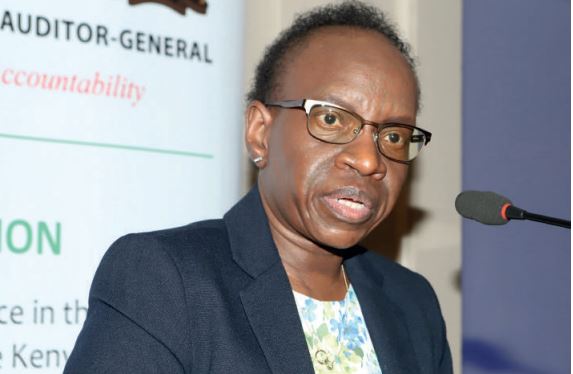
The report by Auditor General Nancy Gathungu shows that the company is grappling with debts amounting to over Sh5 billion.
In addition, the firm is losing at least Sh8.57 billion annually through non-revenue water—water that is produced but not billed to customers.
Despite these heavy losses, the company spends more than Sh3.26 billion on a bloated wage bill.
Covering the financial year ending June 30, 2024, the audit report revealed that the utility posted a negative working capital of over Sh3.4 billion, with liabilities far outweighing assets.
Declaring the company technically insolvent, Gathungu said Nairobi Water is on the verge of collapse, citing collusion and negligence among senior management as key contributors to the financial mess.
These revelations were made during a sitting of the Senate County Public Investments and Special Funds Committee, held on Monday to deliberate on the audit findings.
Nairobi Governor Johnson Sakaja, appearing before the committee chaired by Vihiga Senator Godfrey Osotsi, struggled to explain the glaring mismanagement at the utility firm.
According to the report, the company produced 185.8 million cubic meters of water but only billed for 90.3 million cubic meters.
The remaining 95.4 million cubic meters, classified as non-revenue water, resulted in a staggering loss of Sh8.57 billion—accounting for more than 78 percent of the company’s total operating revenue of Sh10.94 billion during the review period.
The audit also exposed widespread operational laxity. For six months, staff relied on estimated billing for 15,320 customers rather than obtaining actual meter readings.
Moreover, 23,384 customer accounts—billed a total of Sh344.4 million—remained unpaid, yet continued to receive water services. Even more troubling, 10,192 active accounts were not billed at all throughout the year.
Governor Sakaja explained that the company resorted to self-meter reading, allowing customers to send their readings via SMS due to limited access to residential premises.
Managing director Nahashon Muguna defended the move, saying meter readers often encountered locked gates, hostile dogs, or even physical attacks.
However, Nairobi Senator Edwin Sifuna dismissed the explanation.
“With all the force we’ve seen City Hall enforcement officers use to break into properties, what are these places you’re unable to access for six consecutive months?”
Nominated Senator Hamida Kibwana questioned whether any measures had been taken to disconnect non-compliant customers. Governor Sakaja downplayed the issue, stating that the 15,320 affected accounts represent just six per cent of the company’s total 250,000 accounts.
Elgeyo Marakwet Senator William Kisang queried why the utility has not invested in smart meters, which would allow for remote billing and disconnection of defaulting customers.
Muguna cited the high cost of installation as a prohibitive factor, a position supported by Governor Sakaja, who said the adoption of technology must be based on a thorough cost-benefit analysis.
“You cannot run away from technology. It may be costly at first, but it will be beneficial in the long run,” Senator Osotsi responded.
The audit also highlighted the company’s unsustainable wage bill. Of the Sh10.94 billion in annual revenue, Sh7.1 billion—65 per cent—was spent on salaries for 2,930 employees.
By contrast, Lamu county employs 1,675 staff, Vihiga county has 3,305 and Kilifi county has 4,297.
According to Regulation 25(1)(b) of the Public Finance Management Act, 2015, personnel emoluments should not exceed 35 percent of total revenue.
Gathungu stated that had the company complied with this regulation, it would have spent only Sh3.83 billion, saving Sh3.26 billion.
Despite mounting debt, the audit found that management has not made any serious effort to recover Sh10.93 billion owed by debtors.
Of this, Sh7.3 billion has been outstanding for more than 480 days, far beyond the 120-day standard, with no recovery measures in place.
Gathungu further noted that the company’s negative working capital is worsening—rising from Sh2.78 billion in the financial year ending June 30, 2023, to Sh3.49 billion during the period under review.
Nairobi Water now has liabilities of Sh6 billion, compared to assets worth only Sh4.3 billion.
“The company is technically insolvent and may not be able to meet its current obligations as and when they fall due,” the report concluded.
INSTANT ANALYSIS
Nairobi City Water and Sewerage Company was incorporated in December 2003 under the Companies Act cap 486. It is a wholly-owned subsidiary of Nairobi City County with the main responsibility of providing and managing water and sewerage services in Nairobi, while the asset holding body, Athi Water Works Development Agency is charged with the responsibility of developing key water and sewerage infrastructure.