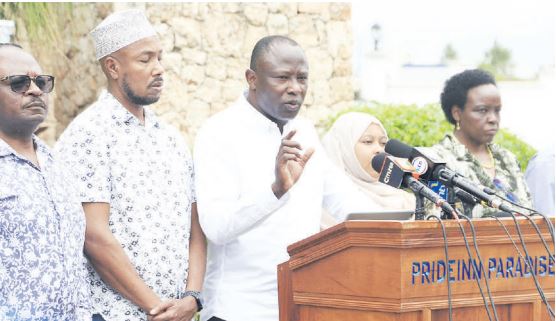
 IEBC chairperson Erastus Ethekon and the agency’s new commissioners give an update on the commission’s priority areas at PrideInn Paradise - Shanzu in Mombasa county /JOHN CHESOLI
Members of Parliament could be headed for turbulent times as Kenyans increasingly move to invoke the constitutional right to recall underperforming or unpopular lawmakers from office.
The Independent Electoral and Boundaries Commission has confirmed receiving petitions seeking the recall of MPs, with indications that more appeals could be underway. “We currently have roughly four petitions.
We will look at them once we get back to the office,” IEBC chairman Erastus Ethekon said on Saturday in Mombasa.
The IEBC chief affirmed that the right to recall is enshrined in the Constitution, and said the commission is committed to upholding the law.
"It is the right of every Kenyan to exercise that right of recall under the Constitution, and as IEBC, we will be there to do that which we can or which the law allows us," Ethekon said.
He assured the public that all processes will be conducted in accordance with legal and constitutional provisions.
"We will receive those petitions, we will examine them, and then we will, of course, respond to them accordingly," Ethekon said.
The recall process of Members of Parliament is anchored in Article 104 of the Constitution and the Elections Act, 2011. Article 104 establishes the right to recall an MP.
It allows Kenyans to initiate the removal of an MP, Senator, or MCA only after two years since their election, and not within the 12 months before the next general election.
Grounds for recall include breach of leadership and integrity standards, misuse of public resources, or conviction for electoral offences. A registered voter from the MP’s constituency must initiate the process by submitting a petition to the IEBC.
The petitioner must gather supporting signatures from at least 30 per cent of registered voters in the constituency, including representation from at least half of the constituency’s wards.
The IEBC then verifies the authenticity of the signatures, confirms the petition meets the legal threshold and is based on valid grounds.
If the IEBC is satisfied, it refers the matter to the High Court to determine whether the MP has indeed violated the Constitution or committed any of the alleged misdeeds. Ethekon’s revelations paint a grim picture for a section of MPs, many of whom have faced public backlash – particularly from Gen Z – over controversial decisions in Parliament.
The uproar over the Finance Bill, 2024, appears to have been the final straw, triggering a revolt against legislators perceived to be out of touch with their constituents or actively defying public will.
Among the MPs facing the wrath of their constituents are Nairobi Woman Representative Esther Passaris, Erick Wamumbi (Mathira) and Kikuyu’s Kimani Ichung’wah.
Passaris came under fire for sponsoring the controversial Public Order (Amendment) Bill, 2025, which proposed banning protests near Parliament and confining public demonstrations to designated areas.
Following intense backlash, she withdrew the Bill, citing the need for broader public dialogue. In Kikuyu, constituents have accused Ichung’wah of being disconnected from the people.
In mid-November, voter Samuel Ngari from Mathira led efforts to collect the 31,000 signatures – equivalent to 30 per cent of the constituency’s 104,000 registered voters – required to trigger the recall of Wamumbi.
He accused the MP of improperly supporting motions against former Deputy President Rigathi Gachagua, misusing CDF funds, engaging in improper practices during public consultations on the ex-DP’s impeachment and dismissing staff without due process.
Others who have angered the public include James Githua (Kabete), Rahim Dawood (North Imenti), Caleb Mule (Machakos Town), Beatrice Elachi (Dagoretti North), Mwengi Mutuse (Kibwezi), Tharaka Nithi Senator Mwenda Gataya and Wajir Woman Representative Fatuma Jehow.
INSTANT ANALYSIS
Despite the constitutional provision, the recall of elected leaders in Kenya remains rare due to the high legal bar. Petitioners must prove gross misconduct, gather thousands of signatures, and secure approvals from both the IEBC and the High Court. The process is designed to prevent frivolous recalls, but it is now being tested by a new wave of civic consciousness, especially among the youth.