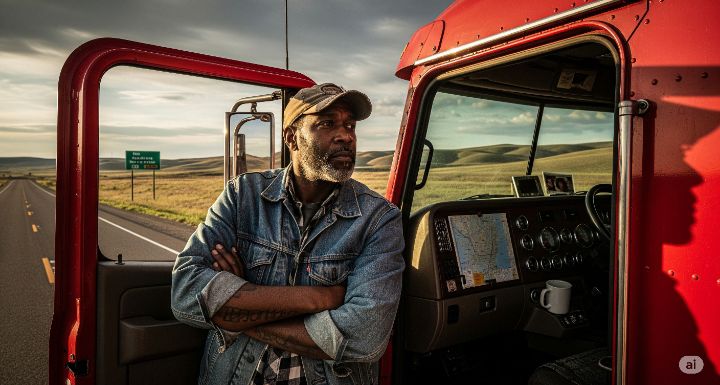
 AI illustration of a long distance truck driver
 For most Kenyans, the thought of a long-distance drive is enough to stir dread—especially for those navigating Nairobi’s chaotic traffic.
Even those with personal vehicles aren’t spared: children crying for food or bathroom breaks in the middle of nowhere, partners snapping over aggressive matatu drivers, and the sweltering heat trapped in a car with the windows rolled up to avoid petty thieves.
But for a unique group of Kenyans, this chaos isn’t just a journey—it’s a career.
Long-haul truckers spend days, sometimes weeks, on the road, ferrying goods across borders. Their work powers regional trade, yet their stories often go untold, reduced to passing frustrations on the highway.
“Those Days Were the Trenches”
John Muli, a long-haul truck driver for over a decade, knows this life intimately. After high school, he chose the road over the classroom.
With his family struggling financially, he made the bold decision to skip college and support his younger siblings instead.
Growing up in Nakuru, where trailers bound for Uganda were a common sight, Muli fixated on joining their ranks. Without connections or money, he began frequenting a roadside café popular among truckers, persistently asking for job leads.
“Those days were the trenches,” he recalls.
“Most of them mocked me. I couldn’t even afford to buy lunch to warm up to them.”
A year of relentless tarmacking paid off when a kind-hearted trucker took him under his wing. Today, Muli is a seasoned driver with thousands of kilometers under his belt—but not without scars.
At one point, his employer gave him an impossible target: Nairobi to Kampala in record time.
“It got to a point where I gave myself only one bathroom break the entire journey. I was sleeping two hours a night. I developed chronic insomnia, and it’s something I still battle with,” Muli says, pointing to the dark circles that have become a permanent feature of his face.
Breaking Barriers on the Highway
For Aisha Bitini, the road was a rebellion—and a rescue.
Aisha never quite fit into the domestic mould expected of her as a girl in a conservative coastal household.
Her parents tried every method to “correct” her aversion to house chores, but she stood her ground. Eventually, she shocked them by choosing long-haul trucking as a career.
“My mother nearly fainted when I told them. Days later, they kicked me out,” Batini recalls with a wry smile.
“But I never turned back.”
She found her way into the male-dominated industry, relying on a strong network of friends and her natural charm.
But the road hasn’t always been kind. On a trip to the Democratic Republic of Congo, Batini’s front tire burst in the dead of night.
As she struggled to change it on a lonely dirt road, two men emerged from the bushes—one already unbuckling his belt.
“I froze. Just then, a lorry pulled up behind me. The driver jumped out with a machete, chased them off. That’s how I survived,” she says, her voice trembling at the memory.
Family on the Sidelines
But the impact of long-haul trucking extends beyond the cab of a truck.
Grace Mumbi, now in her twenties, remembers growing up with a dad she rarely saw. When her mother was diagnosed with leukaemia, her father became a long-haul trucker to cover the bills.
“Evenings were the hardest,” she says.
“I used to have the best chats with my dad. Then suddenly, the house went silent.”
At just eight years old, Mumbi became her mother’s little caregiver. Her weekdays dragged into what felt like months, waiting for the next weekend when her dad might come home.
“Many nights, I cried myself to sleep. But as I grew older, I understood. The long hauls gave us financial stability—and that was the price we had to pay as a family.”
A Means to Survive, and Thrive
For Tom Omondi, long-haul trucking was a lifeline. A former matatu driver in Nairobi, Omondi, found his income dwindling after starting a family. With twin babies and growing bills, he knew he needed more than just survival—he needed a better life.
After a month of deliberation, he returned to driving school to learn trailer handling.
“My monthly earnings tripled,” Omondi says proudly. “Through long-haul trucking, I can give my family the kind of life I never imagined."