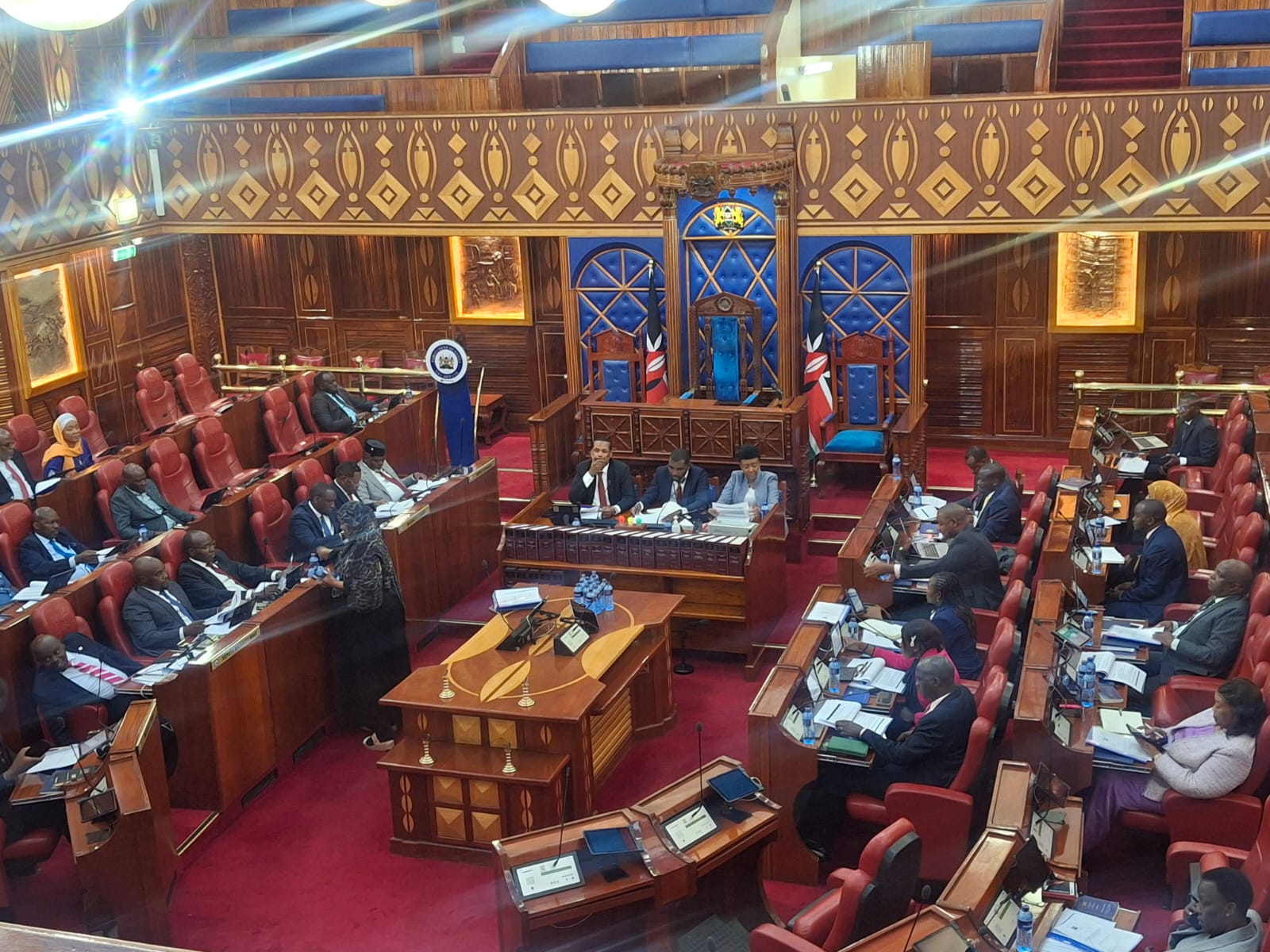
More Kenyans living abroad could soon enjoy greater access to voting in national elections if the Independent Electoral and Boundaries Commission adopts a new proposal by the Senate to increase the number of polling stations in foreign countries.
The Senate is pushing for the IEBC, in collaboration with the Ministry of Foreign and Diaspora Affairs, to establish at least 100 voter registration and polling centers in key global regions with significant Kenyan populations.
The proposal, championed by Kisii Senator Richard Onyonka, seeks to ensure that more Kenyans in the diaspora are able to exercise their constitutional right to vote with ease.
“The IEBC, in conjunction with the Ministry of Foreign and Diaspora Affairs, should establish no fewer than 100 voter registration and polling stations worldwide,” Senator Onyonka stated.
“These new stations should be prioritised in regions with high concentrations of Kenyans, including North America, Europe, the Middle East, Africa, Asia, and Oceania,” he said.
Senator Onyonka emphasized the need to decentralize voter registration and polling services from embassy-based facilities to more accessible community venues.
This move, he said, would enable broader participation by overcoming physical and logistical barriers.
“In the 2022 General Election, the IEBC managed to set up only 27 diaspora polling stations across 12 countries. These were largely concentrated in cities hosting Kenyan embassies, high commissions, or consulates,” he explained.
Among the countries where IEBC established polling centres in the last polls are Uganda, Tanzania, Rwanda, Burundi, South Africa, the United Kingdom, Canada, the USA, South Sudan, Qatar, UAE, and Germany.
Qatar led with 1,437 votes while neighbouring Tanzania came second with 1,402. Uganda and Rwanda follow with 1,211 and 1,090 votes, respectively.
South Africa had 958, South Sudan (977), Germany (314), the UK (798), UAE (745), Canada (366), and the USA (744).
“This limited scope significantly restricted access for many eligible voters who live far from these urban centres.”
The senator argued that the current framework disproportionately affects diaspora voters who face a range of challenges, including long travel distances, visa and documentation issues, high travel costs, limited time off work and other logistical hurdles.
He warned that this situation undermines Article 38(3)(b) of the constitution, which guarantees every citizen the right to vote.
To address these barriers, Onyonka called on the IEBC to roll out robust civic education and voter sensitisation campaigns targeting diaspora communities.
He urged the commission to leverage digital tools and local diaspora networks to promote awareness and engagement on voter registration and election participation.
“The IEBC must ensure the additional polling stations are operational well ahead of the next general election cycle,” Onyonka said.
“It must also put in place effective monitoring mechanisms to ensure transparency, efficiency and integrity of the voting process.”
In addition, Senator Onyonka proposed that the commission formulates clear regulations and guidelines to streamline implementation of diaspora voting.
He urged IEBC to explore adoption of secure, verifiable technologies that would support continuous voter registration and education for Kenyans abroad.
“This is not just about increasing the number of polling centers. It is about strengthening democratic inclusion, ensuring that all citizens—regardless of where they live—have the opportunity to contribute to the governance of their country,” he concluded.
If implemented, the proposal would mark a significant step forward in enhancing diaspora participation in Kenya’s electoral processes.
INSTANT ANALYSIS
Currently, a case concerning the right to vote for Kenyan citizens living outside the country is in court. It is estimated that there are about three million Kenyans who live outside the country. These citizens contribute to the socio-economic development of the country. According to the World Bank, Migrations and Remittance Factbook, 2012, it is estimated that they contribute about USD 1.8 million annually, which accounts for 5.4 per cent of GDP.