
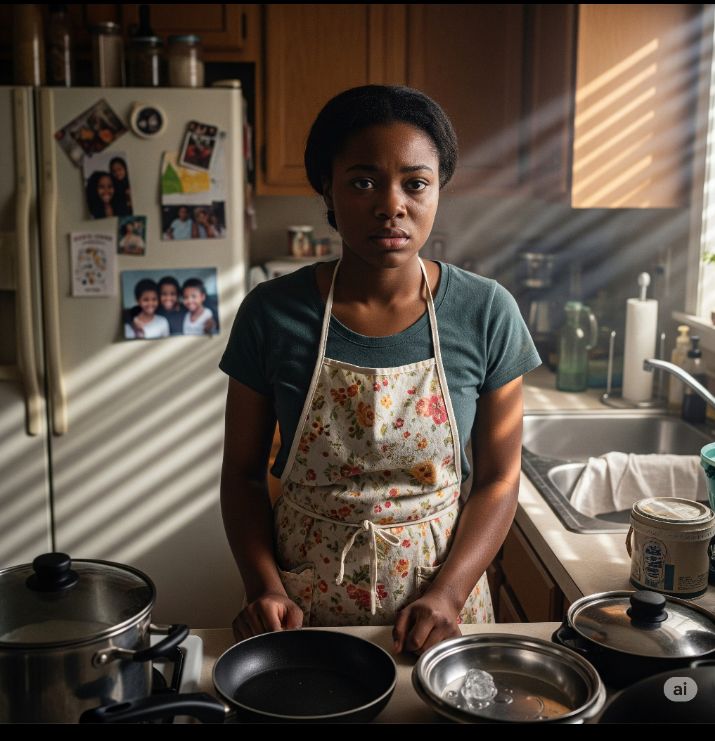
 AI illustration of a first-born daughter juggling responsibilities
 At first, you assume that the mountain of responsibility given to you is simply because you are the eldest daughter in the family. The many responsibilities entrusted to you are a sign of your parents’ high regard for you.
Your parents trust you to hold down the front when they are busy or away from home. Internally, you promise to surpass the expectations of your parents.
Therefore, within no time, you become mature even before you get a chance to live out your childhood without a care in mind. From morning, you busy yourself in the house with chores that seem to snowball with each passing hour.
As if not tiring enough, you are expected to streamline your siblings to behave accordingly. After all, your parents do not need more stress trying to deal with all the children in the house.
You reason that your parents’ energy should be reserved for the bigger concerns in the family, like finances.
Subtly, your vigour to please your parents begins to dwindle. At night, when you lie in your bed, bone tired, you wonder what is the point of all your efforts. Any acknowledgement from your parents for the things you consistently do in the house is a rarity.
Being a third parent in the house ends up brewing animosity between you and your siblings. When you dare to complain about the many responsibilities you have, all you get is a disappointed look from your parents that eats away at you.
In the end, you end up full of resentment for the burden you never asked for.
Speaking to The Star, Grace Nyokabi describes her journey as a firstborn daughter. Coming from a religious family that did not believe in family planning, Nyokabi ended up having seven siblings, with her as the eldest.
Living in the countryside as a low-income household, her father would be out the whole day trying to get casual work from other people’s farms. The money that his father got as a casual labourer was, however, not enough to feed eight children. Therefore, Nyokabi’s mother was forced to go from door to door asking neighbours for any work available.
More often than not, Nyokabi’s mother would spend the better part of her day washing people’s clothes and come back in the evening to prepare supper.
That left Nyokabi with the task of trying to juggle between taking care of her siblings and completing the many house chores that her mother had left for her.
From the moment she got out of bed in the morning, her clock started. She made breakfast, did the dishes, washed the house, swept the compound, went to the nearby brook to replenish the water supply at home, made lunch for her siblings and did some farm work in their little shamba.
Before she was even seven years old, Nyokabi had quickly learned how to bathe all her siblings who were too young to do that on their own.
Nyokabi describes, “When I got the chance to board in high school, I sighed in relief. At least away from home, I did not have as many responsibilities. I could now devote all my time and effort in my studies, just like any normal high school student ought to.
While my classmates waited with bated breath for holidays to begin, I was filled with dread. Dread for the mountain of work that was waiting for me back at home. On many holidays, I would lie to my parents about the closing date so I could stay with my best friend for a week. My best friend’s parents were gracious enough to host me.
I was at least assured of adequate time to complete my holiday assignments because I knew back at home, I wouldn’t get the chance to even catch my breath.” Nyokabi says.
The life of Maureen Nduku shifted drastically when her mother passed away. Being the eldest daughter in her family, she had already accepted the responsibilities that she had at home while her mother was still alive.
Nduku was expected to be proactive in the house by willingly volunteering to help her mother in the house chores. Nothing could have, however, prepared her for the doubled burden that she would have to carry after her mother’s passing.
Nduku recounts, “Overwhelmed by grief, my father switched careers and took a job as a long-distance driver for trucks and trailers. I think staying at home, a place that constantly reminded him of the void in his life, was too much for him to stomach.
Though I understand where my father was coming from, I still can’t forgive him for the consequential effects of his absence. During the week when my father was away for most hours, I was expected to step up.
My father had instructed my aunt to take care of us during the week. Unbeknownst to him, all my aunt did the whole day was lazily watch television with her legs hoisted on the table. Quickly, I had to become a second parent in the household.
Every school evening, I would stay an extra hour at school to finish my homework. Hurriedly after this, I would get home to my two siblings waiting for me patiently. After washing our school uniform and ensuring my siblings did their homework, I would then start preparing dinner for us.
"Even when I was busy late in the night washing the huge pile of dirty dishes that accumulated at the sink the whole day, my aunt wouldn’t even dare lift a finger to help me,” Nduku says.
The burden of being a firstborn daughter is overlooked a lot of times. Without addressing this issue, some first-born daughters end up loathing motherhood. One such person is Tabitha Kaluhi, a firstborn daughter in a family with four children.
Kaluhi expresses candidly, “To date, my siblings and I have a strenuous relationship. According to them, I was harsh when we were growing up. I, however, bitterly ask myself if they truly understand that I was also a child at that time.
"My parents were both alcoholics, and as the first-born daughter, it dawned on me at a young age that I had to be the parent in our home. Overwhelmed with stress, trying to take care of the house and my siblings, any rebellion from my siblings was met with sternness."
"At that moment, the last thing I needed was the added responsibility of adolescent rebellion. After I moved out of the house, I vowed to myself that I would never mother a child. Some of my friends criticise me for my unwavering resolve, but they do not understand that I have mothered enough children for my young age."
Sometimes, the burden that first-born daughters bear is so blatantly obvious that other siblings immediately notice. Talking to The Star, Brian Kimathi explains how, as the last born in his family, he saw firsthand the higher expectations placed on her eldest sister by their parents.
Kimathi voices, “I have three siblings and we are each a year apart. Our age difference is therefore minuscule. This made me question why my elder sister was expected to grow up quickly and pick up responsibilities in the house.
For example, when we would go and play with other children in our estate in the evening, my elder sister was sternly forbidden to do so. Verbatim, my mother bluntly said that she was not raising a ‘tomboy’ for a daughter. From an early age, it was drilled in my elder sister’s mind that her life goal was to be a homemaker, in preparation for her future marriage.
"The double standards screamed of intense misogyny. I was therefore not surprised when my elder sister decided to go no contact with our parents as soon as she moved out," Kimathi says.
According to Tom Mukuha, a family therapist, the ball is in the court of parents in ensuring that the voice of firstborn daughters in Kenya is heard.
Mukuha emphasises, “Parents need to internalise that their first-born daughters are children. Every child deserves to live out their childhood experience freely without being forced by circumstances to grow up earlier than normal.
The wall that most parents hide behind, of preparing daughters for future responsibilities in marriage, is gradually cracking as the world continues to evolve.
Parents should recognise and alleviate the burden placed on first-born daughters. This involves actively reducing expectations for responsibility, promoting self-care for the daughters and creating a conducive environment for open communication where the needs and challenges are fully heard.
If we want to change this predicament as a society, parents need to be receptive to the fact that the call is coming from inside the house.” Mukuha says.






