The atmosphere at most matatu stages is a symphony of chaos.
Crowds weave through narrow spaces with determined faces, deafening toots from minibuses fill the air, and touts holler prices and destinations over blaring speakers.
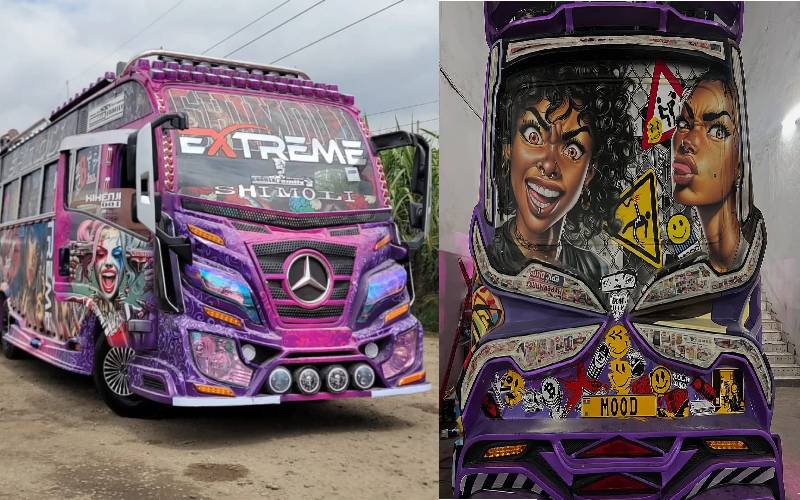
Amid this urban rhythm, brightly painted matatus, decked out in graffiti and thumping with trendy music, stand out like moving canvases, capturing the essence of Kenya’s vibrant street culture.
It’s a preference shared by many commuters, especially the younger generation, who view these graffiti-clad matatus, often called nganyas, as more than just a means of transport.
“Matatus with graffiti just have a way of calling to me. I know it sounds childish, but if I am going to endure sharing space with people on my journey to Rongai, I would rather board a nganya which always looks appealing. It’s kind of a silver lining for me," Nelvin Kimani, a university student, explains.
"Additionally, most matatus with graffiti are the ones that have trendy songs blasting loudly from their speakers. What more would I want from my public transport experience?”
However, not all Kenyans love matatus with graffiti. Though few, they would rather board matatus that are more plain with minimal calligraphy.
“I don’t know when society accepted graffiti on matatus. I know that most people criticise the older generation for being pessimistic about every trendy thing happening," Jane Mwende, a 60-year-old Nairobi resident, says.
"However, I have yet to understand the buzz behind matatu graffiti. More often than not, matatu graffiti comprises of drawings and words that threaten to cross the boundary of civility.”
Matatu graffiti is a vibrant form of street art popularly tied by the rest of the world to Kenya's public transport vehicles, known as matatus.
These minibuses are heavily customised with elaborate, colourful designs, often featuring popular culture icons, slogans, and artistic expressions, making them a unique and popular aspect of Kenyan urban culture.
It is undeniable that matatu graffiti in Kenya is a cultural sensation that continues to triumph over opposition from different fronts.
On May 14, the High Court in Nairobi temporarily suspended a recent directive by the State Law Office and the National Police Service Commission (NPSC) that sought to ban all forms of graffiti, decorative art, and creative enhancements on Public Service Vehicles (PSVs).
John Omondi has been a matatu driver for 10 years. Speaking to The Star, he describes the evolution of matau graffiti in Kenya that he has had a front seat to.
“In the beginning, a few matatus dared to dip their toes into graffiti. As expected, they were met with a lot of criticism. However, as most people say, bad publicity is still publicity," he says.
Eventually, the matatus with graffiti started having more passengers who were driven by curiosity, more than anything else.
Steadily, the business for matatus with graffiti was booming while the other plain matatus struggled to get passengers to board their matatus.
"Seven years ago, I decided to switch to driving matatus with graffiti. If I’m being honest, that is the one good decision I made in my life, and I’m never looking back.” Omondi details.
For Mary Consolata, an owner of several matatus, the transition to graffiti for her matatus was seamless.
“You have to understand, my prime focus as a business person is to make as much profit as I can at the end of the day. When I noticed that the market preference was shifting drastically to matatus with graffiti, I quickly adjusted," she says.
"Though the cost of putting graffiti on my matatus burned a hole in my pocket in the beginning, it was a move that was worth it. Within no time, I had realised the profit that made the cost of the graffiti pale in comparison."
Some people say Kenyan matatu graffiti artists are a vibrant community of artists who transform public transport vehicles into moving works of art.
These artists, often working from garages and studios, create custom designs, portraits, and other imagery, sometimes with themes inspired by pop culture, music, movies, or social commentary.
Such struggles are what propelled upcoming artists like Mike Mandela and Faith Bosibori towards the graffiti world, specifically matatu graffiti.
“The first time I realised that I could draw was in high school. I was the class clown, which often landed me in trouble. When I was sent out of class, I usually carried my notebook where I would sketch," Mike Mandela recounts.
"On one morning, during one of my punishments, I was so lost in my own world that I did not notice the principal who had been standing behind me. Begrudgingly, he complimented my drawings and urged me to apply the same seriousness in class. I had an epiphany at that moment. If my principal, who had a personal beef with me, complimented my art, why wouldn’t I give art a try?"
According to Mandela, as soon as he finished high school, his hype for being an artist simmered down when he came face to face with the harsh reality.
"Art is a tumultuous career to pursue in Kenya," he says.
"The constant rejections and minuscule sales almost pushed me to quit. Remarks from some high-end clients who claimed that they would pay me through experience just further angered me. Imagine. Art that I had spent hours on and shed my sweat and tears for.” Mandela recounts.
“After living from hand to mouth and nearly being homeless for 6 months, I felt like I had nothing to lose. I decided to grow a tough skin and try to make a name for myself in the male-dominated world of matatu graffiti," Faith Bosibori says.
"In the beginning, my co-workers at the garage where I was working isolated me. They were rigid in their perception that graffiti could only be done by men. However, after two months of consistently showing them my skills, they started acknowledging and even offered to refine my skills."
The world of matatu graffiti continues to revolutionise. Matatus with edgier and more revamped graffiti are dominating the matatu business.
"By understanding what I’m drawing, I can graffiti with my unique artistic edge, making sure that my graffiti of Chris Brown piques the interest of Kenyans in the streets,” Mandela emphasises.
"When asked if a different artistic venture is feasible in the future, Faith Bosibori expresses,” I got into matatu graffiti as an artist out of desperation. However, I did not realise the doors that graffiti would open for me."
"I am now my own entrepreneur, having started my graffiti workshop with ten employees," he says.
"All that I am focused on right now is fine-tuning my graffiti skills and inspiring upcoming matatu graffiti artists. The grass is greener where I am, as far as I am concerned.”