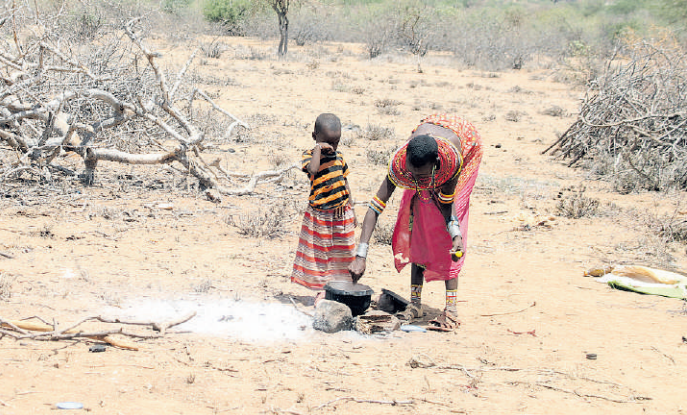
Napase Galora prepares a meal on an open field where pastoral communities were forced to migrate to in search of pasture and water due to drought in Laisamis, Marsabit, on October 26, 2021 /FILE
A new report has shown food production system is the leading driver of land-use change, deforestation and biodiversity loss.
The report, "Unlocking Sustainable Transition for Agribusiness," which was published on July 1 by the UN Environment Programme and Chatham House, shows the current food system is in crisis.
“Our food system is vulnerable in the face of the triple planetary crisis of climate change, nature and biodiversity loss, and pollution and waste. Moreover, our food system is contributing to that crisis through the degradation of the natural resource base and ecosystem services on which its resilience depends,” the report says.
It highlights three system barriers – the cheaper food paradigm, market consolidation and investment path dependencies – that must be addressed to meet sustainable development goals.
There has been a growing agreement that food systems should be transformed, the report states. However, the pace of change has been insufficient to meet globally agreed goals on climate mitigation and adaptation, biodiversity conservation, pollution and sustainable development.
“To meet these goals, we need to rapidly accelerate our efforts to transform food markets and value chains. This report shines a spotlight on agribusinesses – on the potential role they could play in fostering transformative change in the food system at scale and at pace and on the political and market structures, or 'system lock-ins', that are stifling this potential.”
Doreen Robinson, the deputy director of the ecosystem division at Unep, said with the Global Biodiversity Framework, governments have committed to reducing subsidies that harm biodiversity, reducing pollution from nutrients, pesticides and hazardous chemicals and protecting at least 30 per cent of land and sea.
“Yet, despite this abundant political momentum, the global food system remains vulnerable and contributes to the triple crisis of climate change, nature loss and pollution.”
Unlocking the positive potential of agribusiness, as shown in the report, is essential to achieving a sustainable, equitable and health-supporting food system, she added.
Private actors are central to the global food system, with the most powerful among them being large agribusinesses and investors, with great potential to transform, at scale and at speed, the way in which food is produced and consumed.
The report cites agribusiness – capital- and input-intensive businesses engaged in industrialised agricultural value chains – as at the heart of this system.
It recommends more regulation and public research to reward sustainable practices and increase the costs of doing business as usual.
Conversion of ecosystems to large-scale agricultural commodity production and livestock grazing and the homogenisation of farmland to support this, are driving the loss of biodiversity and forests, the report states.
Half of all global forest disturbance between 2001 and 2015 and up to 80 per cent of deforestation between 2000 and 2010 were driven by the expansion of agricultural land.
The intensification of agriculture – involving greater use of inputs such as pesticides and fertilisers and the consolidation of farmland into large plots to support machinery-heavy production – further threatens local biodiversity by reducing the availability and quality of water sources, food sources and habitats for wildlife.
Globally, over 800 million people are facing hunger today while about 30 per cent of food, from harvest to consumption, is being wasted.
Poor diets contribute to one in five premature deaths and the food system’s hidden environmental and health costs may be up to $20 trillion.
The new report comes even as the latest report shows that the hunger crisis is worsening in East and Central Africa.
At least six million Kenyans have minimally adequate food consumption but are unable to afford some essential non-food expenditures without engaging in stress-coping strategies.
This assessment is contained in the latest update by the Food Security and Nutrition Working Group for the East and Central Africa Region.
The report released on June 26 shows that 6,587,550 Kenyans are stressed, according to the Integrated Food Security Phase Classification, or IPC, Phase 2. It also shows that 2,531,700 Kenyans are in crisis (IPC Phase 3).
The IPC Acute Food Insecurity classification provides strategically relevant information to decision-makers.
It focuses on short-term objectives to prevent, mitigate or decrease severe food insecurity that threatens lives or livelihoods.